Clear Sky Science · en
Indecision and recency-weighted evidence integration in non-clinical and clinical settings
Why it is hard to make up your mind
We have all had moments of agonizing over a choice, whether it is picking a movie, buying a car, or sending an important email. For most people, this hesitation is just a nuisance. But in some, especially those with obsessive–compulsive problems, indecision can become paralyzing. This study explores why some people keep searching for “just one more piece of evidence” before deciding, and how their brains treat the latest information they see.
Looking at choices in everyday life
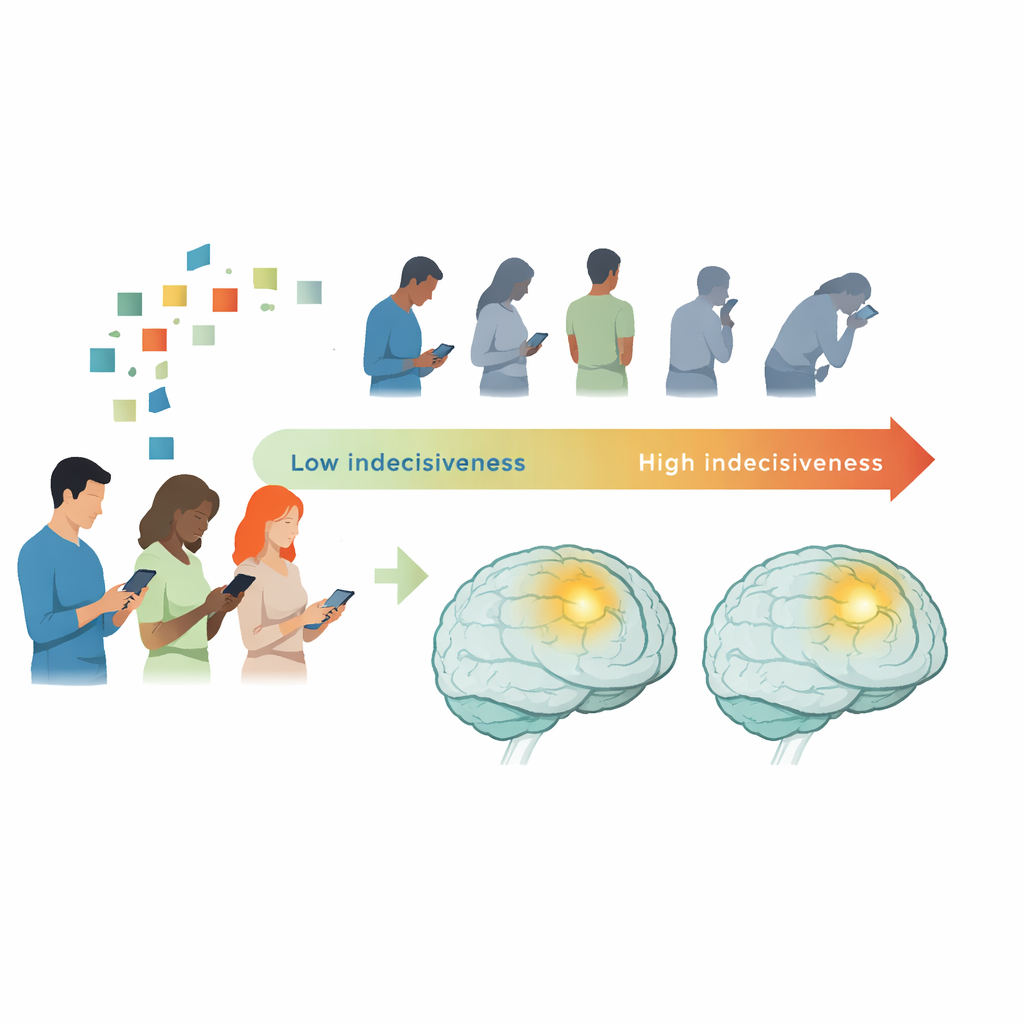
The researchers first turned decision making into a simple game that thousands of people played on their smartphones. Players repeatedly saw a grid of hidden symbols and could uncover as many as they wished before choosing which of two symbols was more common. The number of times a player sampled before committing served as a measure of indecisiveness. Alongside the game, players filled out a questionnaire that measures obsessive–compulsive traits in the general population. This large dataset allowed the team to link subtle differences in everyday decision habits to differences in personality and mental health.
Recent clues count the most
To understand what drives the moment of choice, the authors modelled decisions draw by draw. They distinguished between the total evidence gathered so far and the latest change in that evidence from one draw to the next. This “update” signal reflects how much the newest sample shifts the balance between the two options. Across thousands of participants, both the total evidence and the update mattered, but the update had a stronger influence: people were especially swayed by the most recent clues, even though all earlier samples stayed visible on the screen. This reveals a strong recency bias in information use, rather than a simple, steady tally.
When indecision and doubt take over
People with more obsessive–compulsive symptoms tended to uncover more tiles before deciding, yet they were no more accurate than others. The key difference lay not in a basic reluctance to decide, nor in a stronger urge to “speed up” after waiting, but in how they weighed new evidence. High-symptom participants relied less on the latest update signal and somewhat less on past evidence as well. They were also less confident in their choices, and the weakened impact of recent evidence partly explained this lack of confidence. In short, for these individuals, new information nudged their decisions and their feelings of certainty less than it did for others, contributing to prolonged doubt.
Zooming in on the brain’s timing
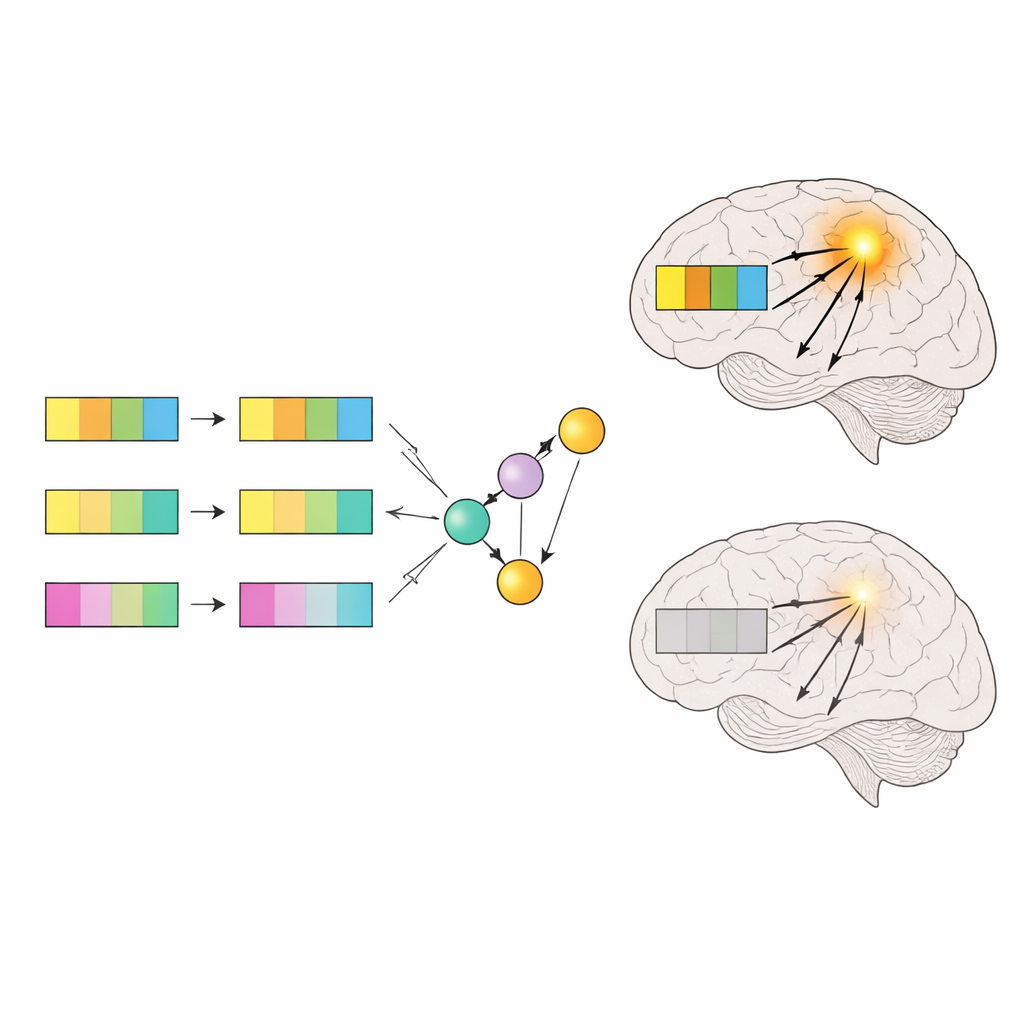
To probe what happens in the brain, the team ran a second study in the lab with patients diagnosed with obsessive–compulsive disorder or generalized anxiety, plus volunteers with high or low obsessive–compulsive traits. Participants performed a related task while the researchers recorded fast brain signals using magnetoencephalography. By decoding these signals, they could track when the brain represented different decision ingredients, such as how many samples had been seen, how much evidence had built up, and the latest update. These elements appeared in a sequence: basic context and past evidence emerged first, while the update signal appeared later, peaking close to a second after new information arrived.
A quieter signal in key brain regions
The neural signature of the update signal was weaker in people with stronger obsessive–compulsive tendencies, regardless of whether they had a clinical diagnosis. This reduction showed up in particular in mediofrontal brain regions, an area long linked to monitoring outcomes, adjusting beliefs and deciding when to act. Other decision-related signals in the brain appeared intact. Within the group of patients with obsessive–compulsive disorder, those whose intrusive thoughts were more severe showed the strongest dampening of this update signal, suggesting a specific link to the persistence of unwanted doubts and fears.
What this means for real-world indecision
Put simply, the study suggests that many of us decide by putting extra weight on the latest piece of information. People who struggle with obsessive–compulsive symptoms seem to downplay this fresh evidence, both in their behaviour and in their brain responses, so new facts fail to reassure them. As a result, they keep searching for more information without gaining extra accuracy, and they remain less confident even when their choices are correct. Recognizing this subtle shift in how recent evidence is used may point the way toward new behavioural treatments and brain-based interventions for crushing indecision and doubt.
Citation: del Río, M., Trudel, N., Prabhu, G. et al. Indecision and recency-weighted evidence integration in non-clinical and clinical settings. Nat Hum Behav 10, 727–740 (2026). https://doi.org/10.1038/s41562-025-02385-1
Keywords: indecisiveness, obsessive–compulsive disorder, decision making, evidence integration, magnetoencephalography