Clear Sky Science · en
Continental evolution influenced by relamination of deeply subducted continental crust
Hidden recycling beneath our feet
Earth’s continents look solid and permanent, but this study reveals they are constantly recycled deep underground in ways that shape the surface we live on. By blending computer simulations of colliding continents with high‑pressure melting experiments, the authors show how slices of old continental crust can dive deep, return to the base of neighboring plates, and then help fuel unusual volcanic rocks that have appeared across the planet for billions of years.
When continents crash together
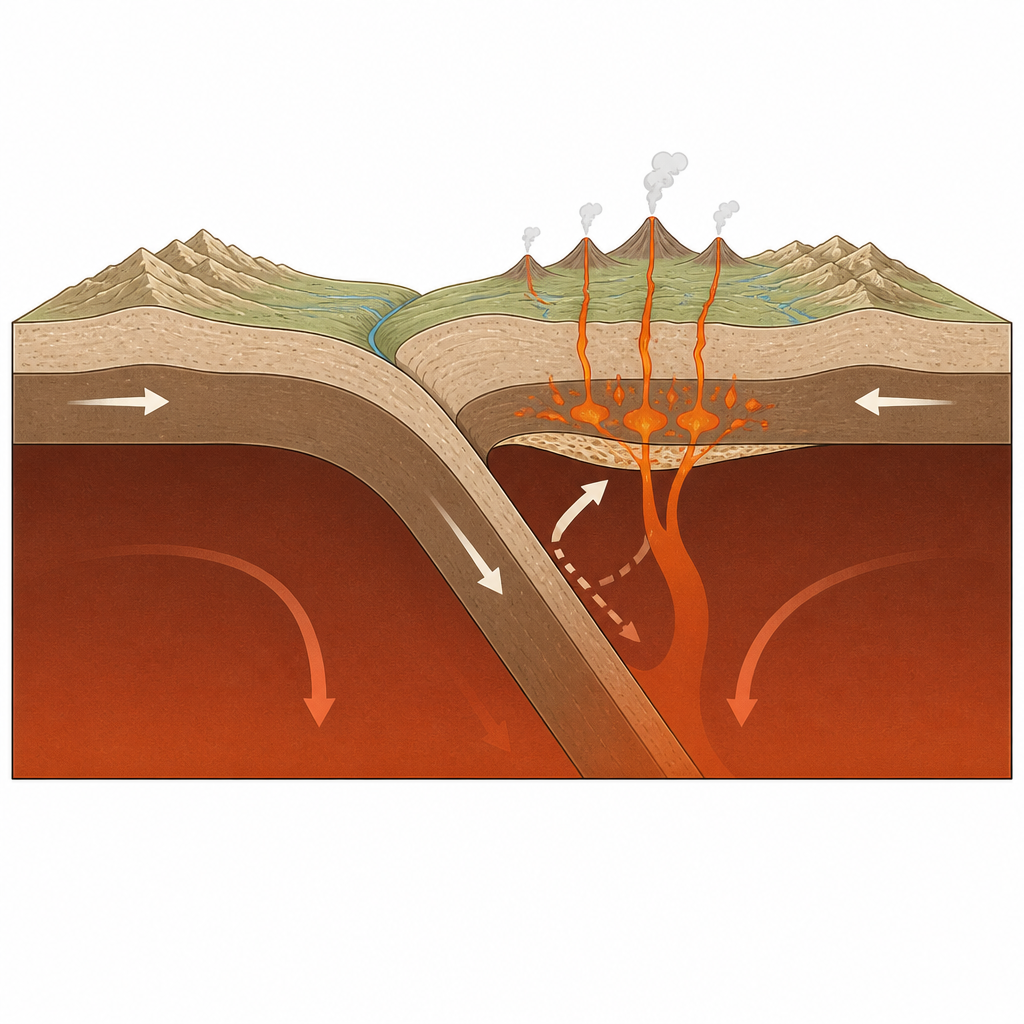
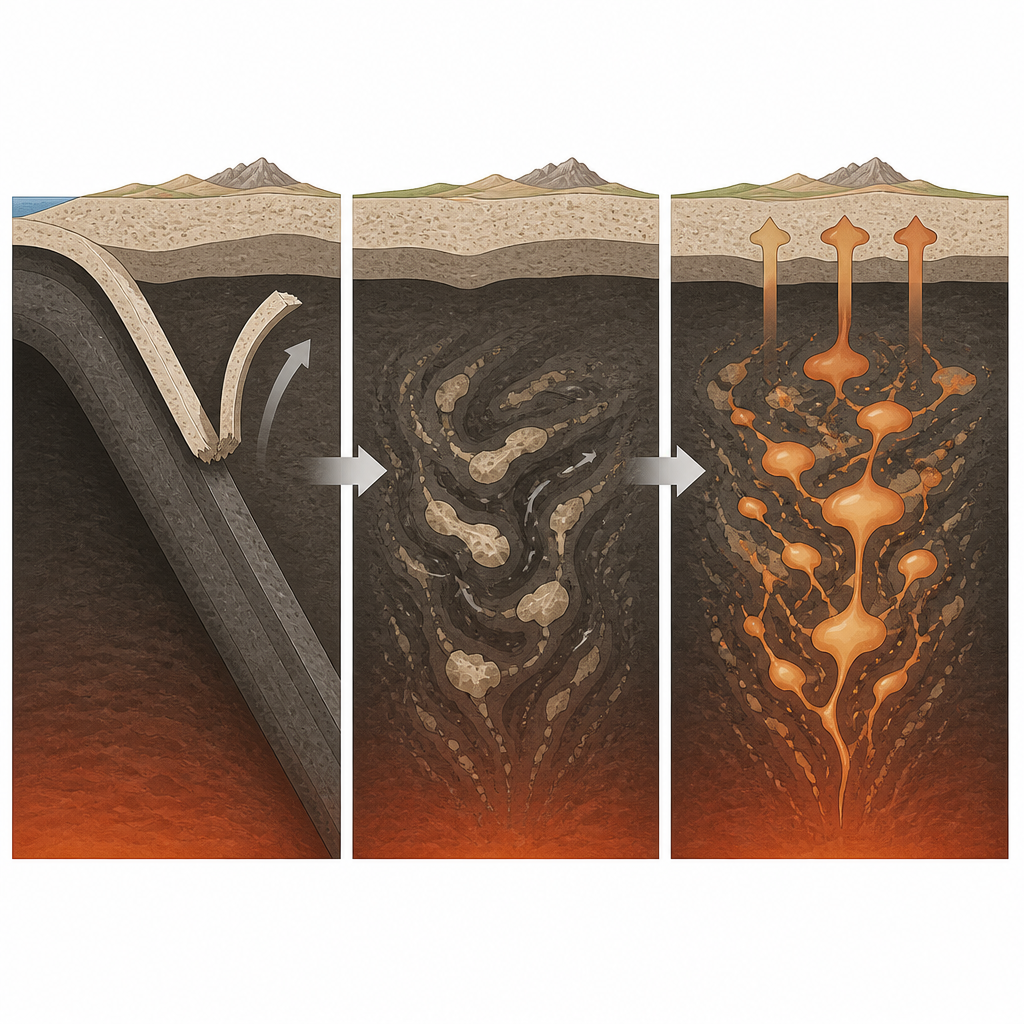
When two continents collide, their edges do not simply crumple into mountains at the surface. The research team used detailed numerical models to follow what happens hundreds of kilometres down as one plate sinks beneath the other. They found that the lighter, silica‑rich upper part of the descending continent tends to tear away from the heavier lower crust and mantle. This buoyant material rises back up and spreads along the underside of the overriding plate, a process the authors call relamination because new crustal layers are effectively glued onto the base of the continent.
A deep mixing zone in the mantle
The models show that relamination happens at depths of around 100 kilometres and continues for tens of millions of years after the initial collision. As these blobs and sheets of returning crust collect at the base of the plate, the surrounding mantle rock is strongly deformed and its grain size shrinks, which allows the two components to mix mechanically. The result is a patchy “hybrid” zone where pieces of former continental crust and mantle peridotite sit in close contact. This mixing happens just where temperatures and pressures are high enough that even a modest thermal boost can start to melt the rocks.
From deep mixtures to new magmas
To test what kind of magmas such a mixed source would generate, the team recreated these conditions in the laboratory. They pressed and heated blended powders of mantle rock and upper crust, sometimes adding sediment‑like material, to pressures and temperatures similar to those inside a collisional mountain belt. The melts they produced have chemical traits that closely match real post‑collisional igneous rocks found in many mountain chains: relatively high magnesium and potassium, low calcium, and strong enrichment in certain trace elements. These experimental results suggest that the strange chemical fingerprint of these magmas can be explained by melting of a mantle that has been “seasoned” with bits of recycled continental crust.
A long life story for continents
The authors then compared global chemical data from such magmas through time. Isotopic measurements show that these rocks often carry signals of very old crust, even when the magmas are young. This pattern fits the idea that small additions of ancient continental material, transferred downward during repeated cycles of collision and relamination, have been mixed into the mantle beneath continents over billions of years. The study argues that this deep recycling has been active since at least the Archean, meaning that early plate tectonics already moved and reworked continents in a similar way.
What this means for Earth’s history
Viewed together, the models, experiments and global rock data point to a simple but powerful picture: when continents collide, some of their upper crust is dragged deep, pasted onto the base of neighboring plates, mixed with mantle, and eventually melted to form new magmas. These magmas help grow and modify continents while preserving chemical memories of long‑vanished crust. For non‑specialists, the message is that Earth’s continents are not static blocks; they are the product of a slow underground conveyor that recycles crust and mantle, leaving a record in the volcanic rocks that geologists study at the surface.
Citation: Gómez-Frutos, D., Castro, A., Balázs, A. et al. Continental evolution influenced by relamination of deeply subducted continental crust. Nat. Geosci. 19, 589–595 (2026). https://doi.org/10.1038/s41561-026-01963-w
Keywords: continental collision, crustal recycling, mantle melting, post-collisional magmatism, plate tectonics