Clear Sky Science · en
An intermittent dynamo linked to high-titanium volcanism on the Moon
Why the Moon’s ancient magnetism matters
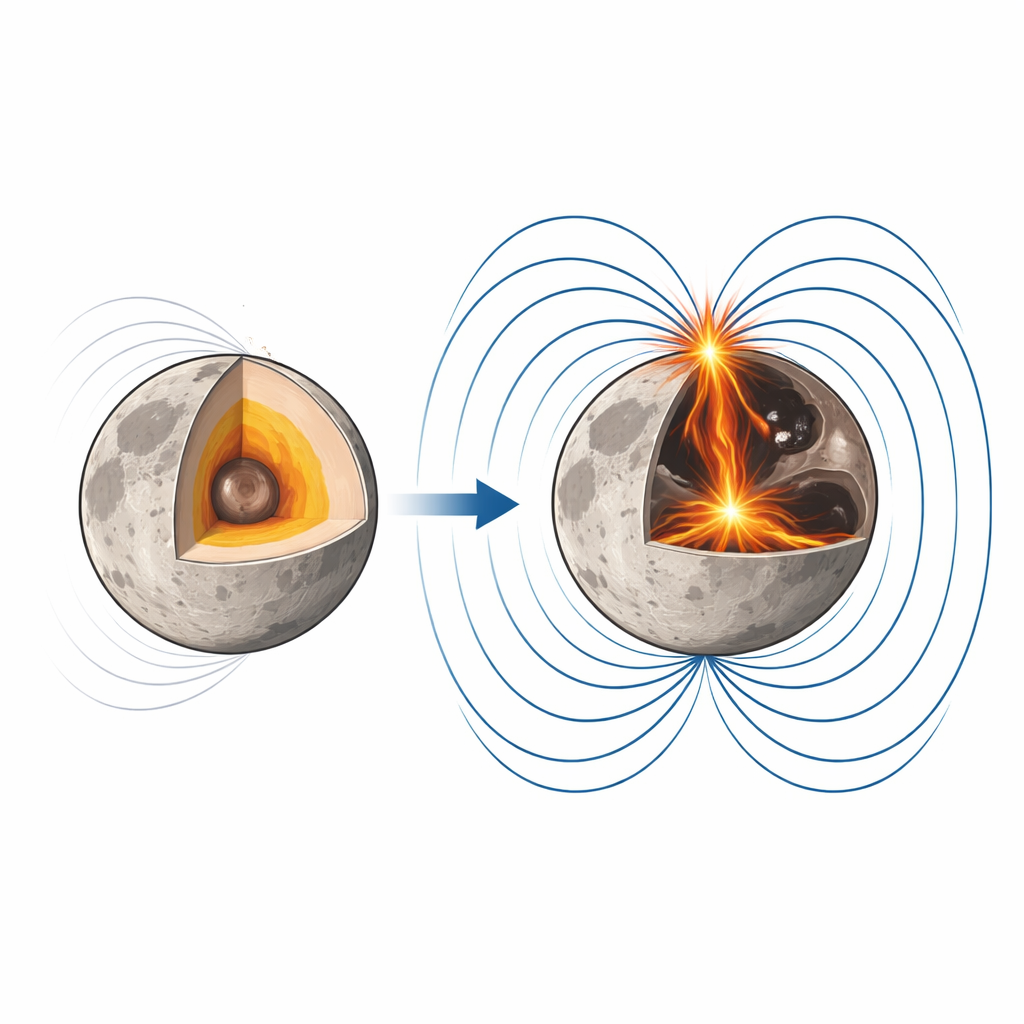
The Moon today has no global magnetic field, yet some Apollo rocks carry the imprint of a surprisingly strong ancient magnet. This puzzle matters far beyond lunar science: magnetic fields shield planetary surfaces from radiation and help us understand how rocky worlds evolve. By re-examining lunar rocks rich in the metal titanium and combining them with new interior models, this study argues that the Moon’s magnetic heart was not steady and long-lived, but instead flickered on during rare, powerful volcanic episodes deep in its past.
Clues from Moon rocks and bright surface swirls
Decades of measurements on Apollo samples and spacecraft data have painted a confusing picture of the Moon’s magnetism between about 3.9 and 3.6 billion years ago. Some rocks record strong fields, comparable to or stronger than Earth’s present-day field, while others from similar times show very weak or no magnetization. Odd, bright surface patterns called lunar swirls, which occur where local magnetic fields are strong today, also hint at a once-powerful field. At the same time, many impact craters and rocks appear only weakly magnetized. Taken together, the evidence suggests that the Moon’s global field was usually weak but occasionally flared to high strength during what the authors call an Intermittent High Intensity Epoch.
Titanium-rich lavas as magnetic tape recorders
The authors compiled magnetic strength estimates from lunar basalts and compared them with the chemistry of each rock, focusing on how much titanium oxide they contain. They find a striking pattern: every rock that records a strong ancient field is a high-titanium basalt, while rocks with low or negligible fields span many rock types. When they look at all the data statistically, the only strong link is between field strength, age and titanium content; other chemical ingredients and rock-magnetic properties do not track the field. This implies that high-titanium lavas were more likely than other rocks to be erupted during brief periods when the lunar magnetic engine was running at full power.
Deep-mantle fireworks powering a flickering dynamo
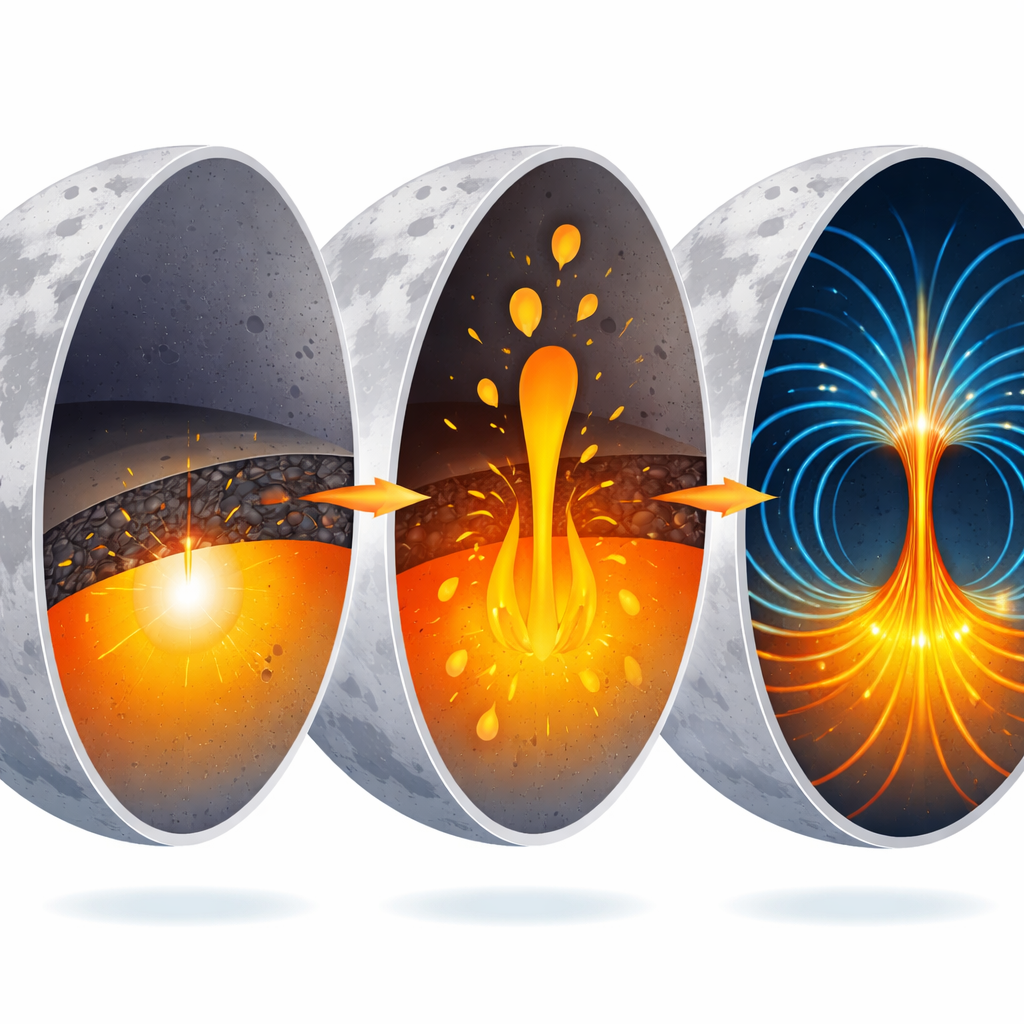
To explain this link, the study turns to the Moon’s internal structure. After the early lunar “magma ocean” cooled, dense layers rich in the mineral ilmenite (which contains titanium) sank toward the boundary between the rocky mantle and the metallic core. These ilmenite-bearing layers also contained radioactive elements that slowly heated them over hundreds of millions of years. The team models how sudden melting of this deep, titanium-rich material could briefly boost the heat flow out of the core. That extra heat stirs the liquid core more vigorously, switching on a strong magnetic dynamo—but only for a few thousand years at a time before the energy is spent.
Testing rival engines for the lunar dynamo
The researchers explore two proposed ways that ilmenite-rich material could drive such a dynamo. In one, small blobs of dense material continually drip down onto the core over a long period, melting as they arrive. In the other, a thick ilmenite-rich layer already sitting at the core boundary melts in short, intense bursts. By running many numerical experiments, they show that the slow-drip scenario cannot sustain strong fields often enough or long enough to match the rock record. The burst-melting scenario can generate the required high field strengths, but only in very short episodes occupying at most a tiny fraction of the relevant time span. That mismatch disappears if one assumes that nearly all of the rocks we have from this era happen to come from places where the deep bursts also fueled high-titanium eruptions.
How rare eruptions biased our view of the Moon
Finally, the authors combine eruption timescales, magma rise speeds and cooling rates to test whether a basalt flow could realistically record such brief magnetic surges. Deep melts are expected to rise rapidly through channels in the mantle and cool at the surface in less than a few months—short enough that they can faithfully capture a thousand-year-long magnetic spike. Because Apollo landing sites cluster near high-titanium lava plains, the returned samples are heavily biased toward exactly those rare events. The study concludes that the Moon’s strong magnetic signatures almost all come from short-lived episodes when titanium-rich cumulates at the core–mantle boundary melted, drove an intense but transient dynamo, and erupted as high-titanium basalts. For a layperson, the message is that the Moon’s magnetic heart did not beat steadily; instead, it pulsed in powerful bursts tied directly to deep, titanium-fueled volcanic fireworks.
Citation: Nichols, C.I.O., Wade, J. & Stephenson, S.N. An intermittent dynamo linked to high-titanium volcanism on the Moon. Nat. Geosci. 19, 425–431 (2026). https://doi.org/10.1038/s41561-026-01929-y
Keywords: lunar dynamo, moon volcanism, titanium basalts, planetary magnetic fields, core–mantle boundary