Clear Sky Science · en
Ocean warming weakens the sea–land breeze in coastal megacities
Why ocean breezes matter to city life
For hundreds of millions of people living in big coastal cities, the daily rhythm of cool air drifting in from the sea quietly shapes comfort, health and even energy needs. This sea breeze helps take the edge off summer heat, clears dirty air and brings welcome moisture. This study asks a simple but important question for city dwellers everywhere: as the oceans warm, are we losing this natural air conditioner that many coastal megacities depend on?
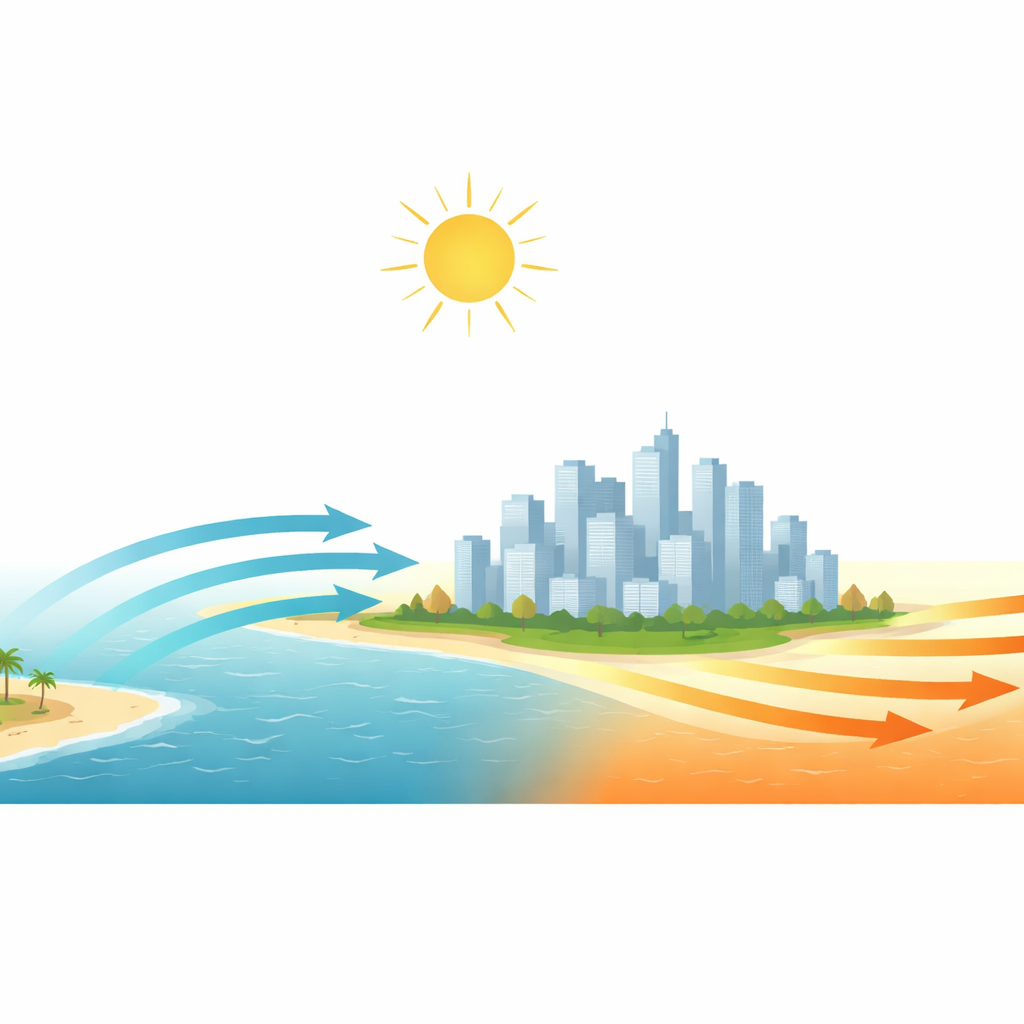
A daily wind that keeps cities cooler
Along many shorelines, a regular pattern of winds develops because land heats and cools faster than the ocean. During the day, warm air over land rises and draws in cooler air from over the water, creating a sea breeze. At night, the opposite flow, known as a land breeze, develops as land cools more quickly than the sea. Days when this cycle dominates local winds are called sea land breeze days. On those days, coastal cities tend to be better ventilated, less stifling and less polluted.
Tracking changes in city breezes worldwide
The researchers used a regional weather model that follows sea surface temperatures hour by hour to study how this daily wind has changed in 18 major coastal megacities across the globe. These cities, home to more than 140 million people, span a wide range of climates from the tropics to temperate zones. By comparing conditions from 1970 and 2010, they examined how rising ocean temperatures near each city have influenced the number of days each year with a clear sea land breeze pattern.
Fewer breeze days in many mid latitude cities
The analysis reveals that about two thirds of the studied megacities already see fewer sea land breeze days than they did several decades ago. Mid latitude cities such as London, New York, Shanghai, Tianjin, Lisbon and Buenos Aires show the sharpest drops, often losing around 30 to 45 percent of their breeze days. In these places, the nearby seas have warmed faster relative to the land, shrinking the temperature contrast that drives the daily wind. In contrast, low latitude cities closer to the equator typically still have more breeze days overall and have seen smaller declines or even slight increases, because their surrounding seas have warmed less in relative terms.
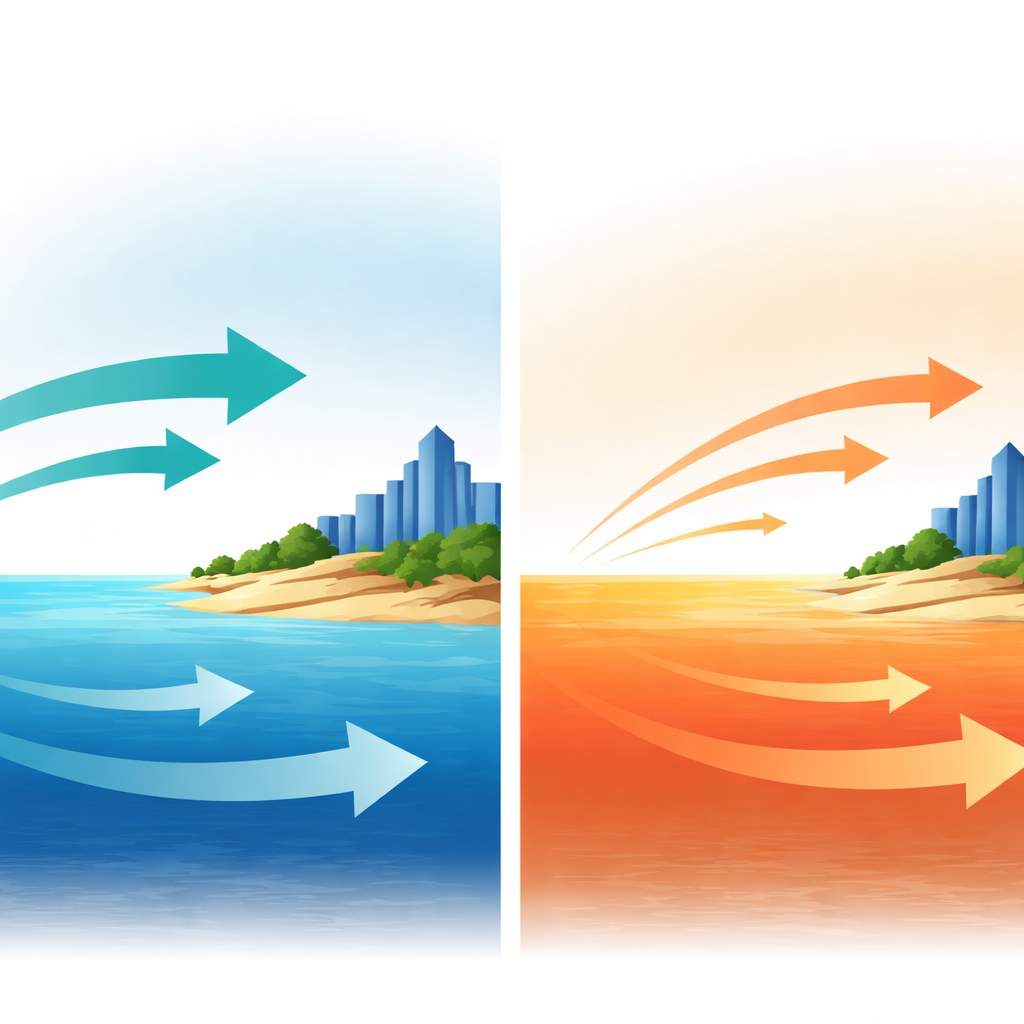
How warmer seas weaken natural ventilation
To uncover why some cities are hit harder than others, the study breaks the problem into three linked pieces: the temperature difference between land and sea, the wind pattern at the coast and how long the sea breeze and land breeze each last in a day. The key finding is that the fading temperature contrast is the main culprit in the most affected cities. When the ocean warms by roughly four to eight percent while land warms only slightly, the daytime pull of cool marine air weakens and the sea breeze runs out of steam. In less affected regions, the duration and strength of the breeze also change, but the temperature contrast still plays a leading role where warming is strongest.
Future choices shape city comfort
Looking ahead to mid century, the team tested two future pollution pathways often used in climate research. Under a lower emission path, sea surfaces warm modestly and most coastal megacities lose only a small share of their sea land breeze days, typically just a few percent. Under a high emission path, however, nearby oceans warm more quickly and the loss of breeze days in the most sensitive cities becomes four to six times larger. Some mid latitude megacities could see their breeze days cut by roughly one quarter to more than one half, sharply reducing natural cooling and ventilation.
What this means for life in coastal cities
For non specialists, the takeaway is clear: a warming ocean does not just raise sea levels and fuel stronger storms, it also quietly erodes a free source of cooling and clean air for some of the world’s largest cities. As sea land breeze days decline, heat waves can feel more punishing, pollution can linger longer and energy demand for mechanical cooling is likely to grow. The study suggests that limiting future warming can help preserve more of these helpful breeze days, while urban planners can design city layouts that keep coastal wind pathways open to maintain comfort and liveability in a warming world.
Citation: Xiao, Y., Liu, Y., Nie, Y. et al. Ocean warming weakens the sea–land breeze in coastal megacities. Nat. Clim. Chang. 16, 591–597 (2026). https://doi.org/10.1038/s41558-026-02618-9
Keywords: sea breeze, coastal cities, ocean warming, urban climate, climate change