Clear Sky Science · en
Vegetation recovery following retrogressive thaw slumps across northern tundra regions
Why the Arctic’s Hidden Landslides Matter
Far from cities, in the frozen soils of the Arctic and high mountain plateaus, the ground is starting to give way. As permafrost thaws, hillsides slump, stripping away plants and exposing long-frozen carbon to the air. This study asks a deceptively simple question with big climate implications: after these dramatic collapses, how quickly does life return, and in what form? The answer helps us gauge whether these wounded landscapes can bounce back and again help lock away carbon—or whether they will remain bare scars that leak greenhouse gases for decades.
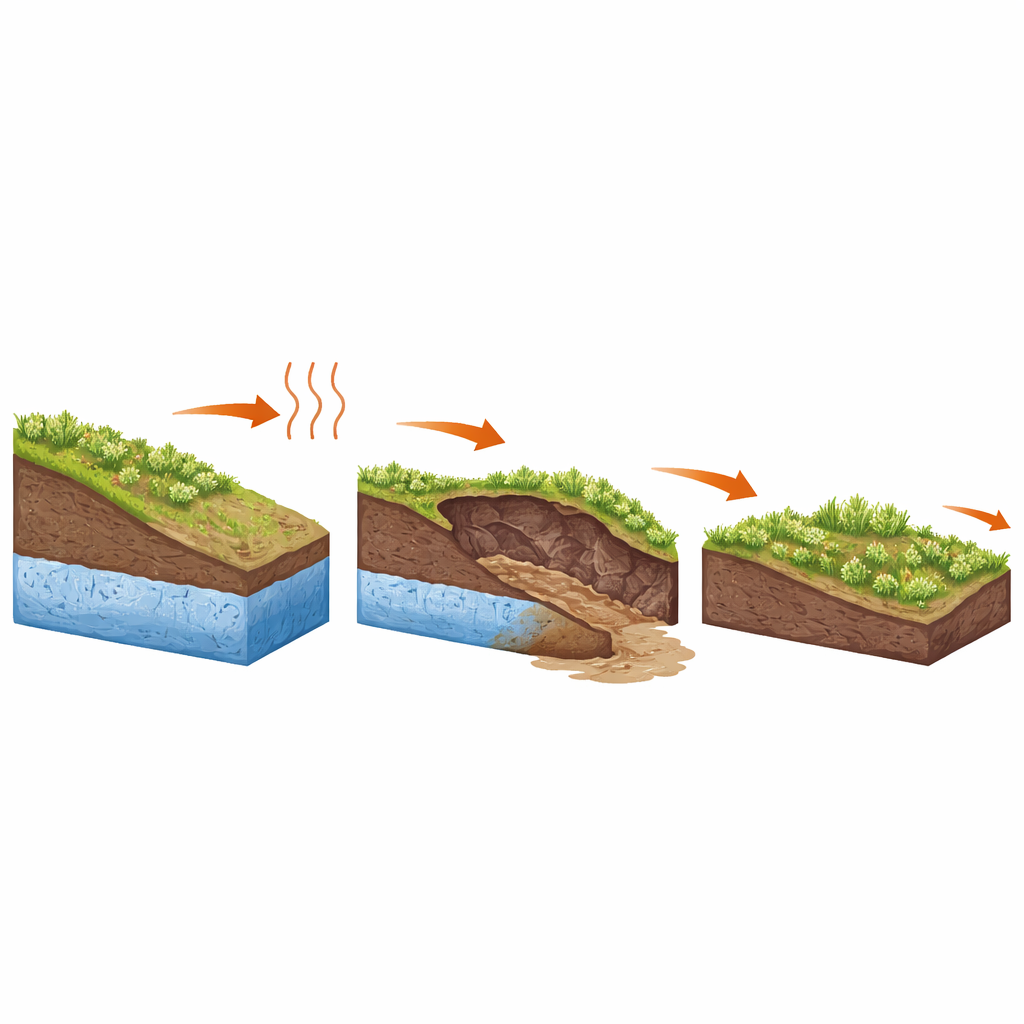
When Frozen Ground Suddenly Fails
The work focuses on retrogressive thaw slumps—slow-moving landslides that form when ice-rich permafrost melts and the overlying soil collapses. These slumps can grow to the size of multiple football fields, stripping away plants, roots and soil, and flushing old organic matter into streams and rivers. That process not only reshapes the land, it also releases ancient carbon that had been safely frozen for centuries. Over the last few decades, such slumps have become far more common across the Arctic and high mountains, turning once-stable tundra hillsides into dynamic, disturbed terrain.
Watching Tundra Heal From Space
To track how these damaged areas recover, the researchers combined decades of satellite images, aerial photographs and drone surveys across 12 regions in Alaska, Canada, Siberia and the Qinghai–Tibet Plateau. They measured how “green” the surface looked using a standard satellite index of plant cover and vigor, and compared disturbed patches with nearby undisturbed tundra. They also used very high-resolution imagery and field data to classify what types of plants—short mosses and grasses, or taller shrubs—were growing back through time. This allowed them to reconstruct vegetation “timelines” from the moment a slump formed through the years and decades that followed.
Fast Comebacks in Some Places, Bare Ground in Others
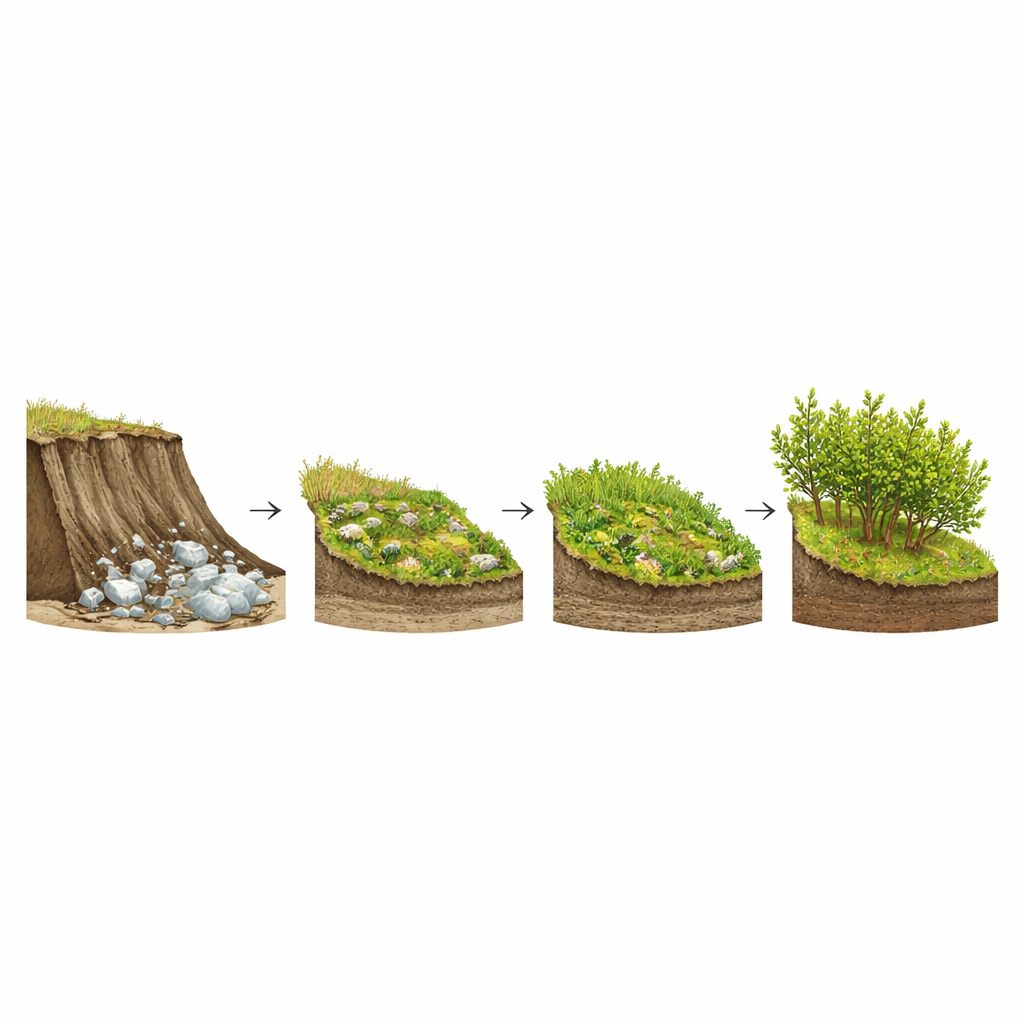
The story that emerged is one of sharp contrasts. In relatively mild low-Arctic regions with richer soils and more moisture, new low-stature plants colonized the bare ground within just a few years, and overall greenness recovered to normal levels in roughly 5 to 10 years. Over subsequent decades, these early colonizers were gradually replaced by taller shrubs that made the disturbed areas even greener than their surroundings. In stark contrast, high-Arctic islands and high mountain plateaus showed much slower recovery. There, slumps often remained largely bare or sparsely vegetated for 30 to more than 100 years, with only thin carpets of small plants returning and little sign of shrub expansion.
A Simple Rule Linking Growth and Recovery
Why such differences? Instead of trying to untangle every local detail of climate, soil and species, the team turned to a single broad measure: how productive the local plant community is overall, as estimated from satellite-based measurements of photosynthesis. They found a tight mathematical relationship between this productivity and the time it took for greenness to bounce back after a slump. In more productive tundra, recovery took less than a decade; in very low-productivity areas, it could take many decades to over a century. Remarkably, this rule held up when tested at additional sites that were not used to build the model.
What This Means for Climate and the Future Tundra
The findings suggest that many disturbed tundra landscapes are not doomed to remain long-lasting carbon sources. In relatively favorable regions, slumps can quickly turn into shrub-filled patches that capture carbon and may even become greener than they were before. However, in colder, drier, or nutrient-poor areas, the land can stay exposed for generations, prolonging carbon losses and altering ecosystems. Because the recovery time can be estimated from large-scale productivity maps, scientists and policymakers now have a practical way to anticipate where permafrost disturbances will heal quickly and where they will leave long-lived scars on both the land and the climate system.
Citation: Xia, Z., Liu, L., Nitze, I. et al. Vegetation recovery following retrogressive thaw slumps across northern tundra regions. Nat. Clim. Chang. 16, 606–612 (2026). https://doi.org/10.1038/s41558-026-02603-2
Keywords: permafrost thaw, Arctic vegetation, tundra recovery, climate change, carbon cycle