Clear Sky Science · en
Biochemical remodelling of phytoplankton cell composition under climate change
Why tiny ocean plants matter to us
Far from shore, the sunlit ocean is filled with microscopic plants called phytoplankton. These single-celled drifters turn carbon dioxide into organic matter and feed almost everything else in the sea, from zooplankton to fish and whales. But phytoplankton are not all built the same on the inside: some are rich in proteins, others in fats and sugars. This study explores how climate change is quietly rewiring that internal chemistry, with consequences for marine food webs and for the ocean’s ability to store carbon.
What makes ocean plants rich or poor food
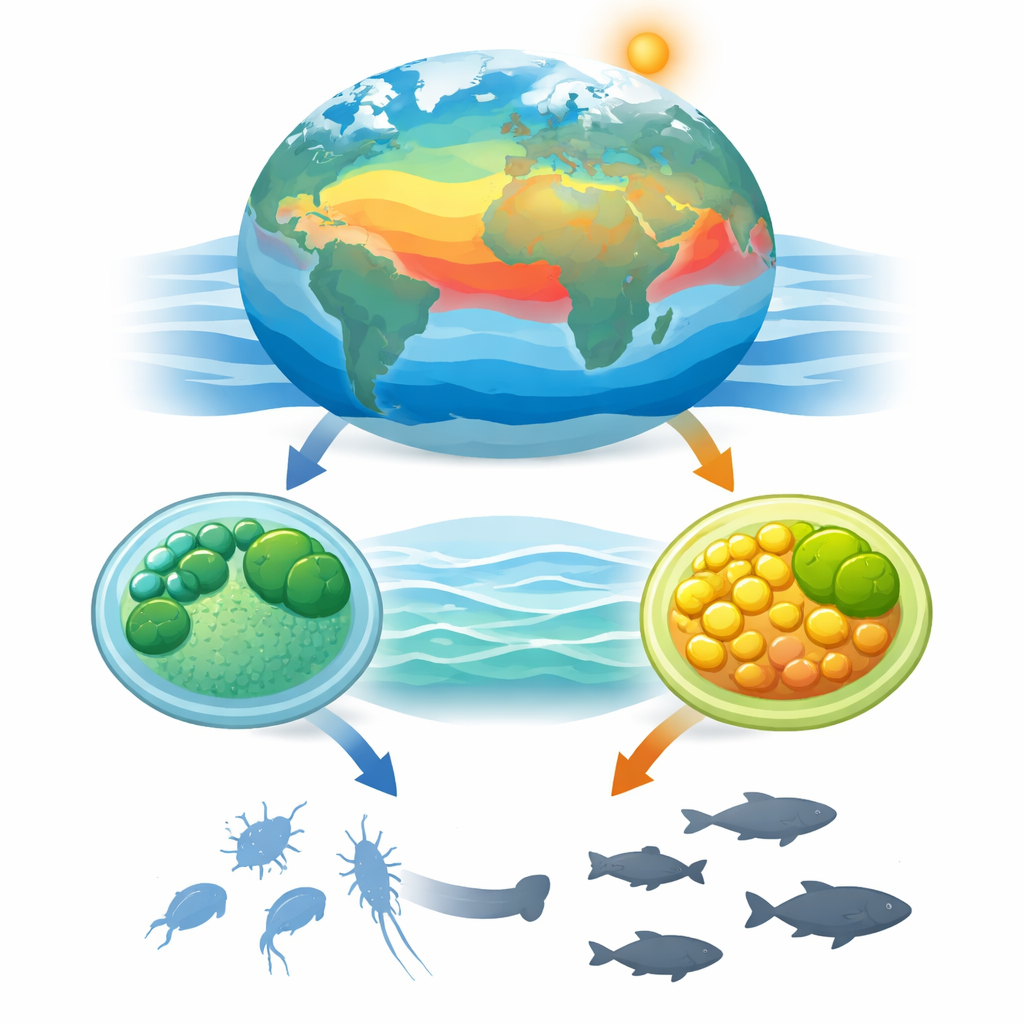
Phytoplankton cells are tiny packages of major ingredients: proteins, fats (lipids) and carbohydrates, plus smaller amounts of other molecules. Proteins are nitrogen-rich and essential for growth, while fats and carbohydrates are more carbon-heavy and energy-dense. Using a detailed biological model tied into a global ocean circulation model, the authors asked how light, temperature and nutrients shape the mix of these ingredients in different parts of the sea. They focused on two broad groups of phytoplankton—small bacteria-like cells and larger eukaryotic algae—and tracked how each group allocates its carbon into proteins versus fats and carbohydrates.
The current global pattern inside phytoplankton cells
Under pre-industrial, roughly present-day conditions, the model suggests that an average phytoplankton cell is nearly half protein and almost half fats plus carbohydrates. But this average hides big regional contrasts. At high latitudes, where waters are cold, nutrient-rich and light is limited for much of the year, cells invest heavily in protein, especially the machinery for capturing scarce light. Farther south in the warm, clear, nutrient-poor subtropical gyres, growth is slowed by lack of nutrients rather than light. There, phytoplankton divert more of their carbon into storage compounds like fats and carbohydrates. These shifts change not just food quality but also the elemental ratios of carbon, nitrogen and phosphorus in organic matter, altering how efficiently the ocean’s “biological pump” can lock carbon away at depth.
How warming reshapes the ocean’s pantry
The team then ran the model under a high-emissions climate scenario for the twenty-first century. As surface waters warm by about 3 °C, sea ice retreats and the upper ocean becomes more strongly layered, reducing the supply of nutrients from deeper waters. In polar seas, the loss of ice increases light, so phytoplankton no longer need to invest as much in light-harvesting proteins. Total protein inside cells there is projected to fall by 15–30%, while fats and carbohydrates rise, making the biomass more calorie-rich but poorer in nitrogen and phosphorus. In temperate subpolar zones, faster metabolic rates, higher light and reduced mixing likewise push cells toward more carbon-rich storage molecules at the expense of proteins.
Winners and losers in the warm, clear subtropical seas
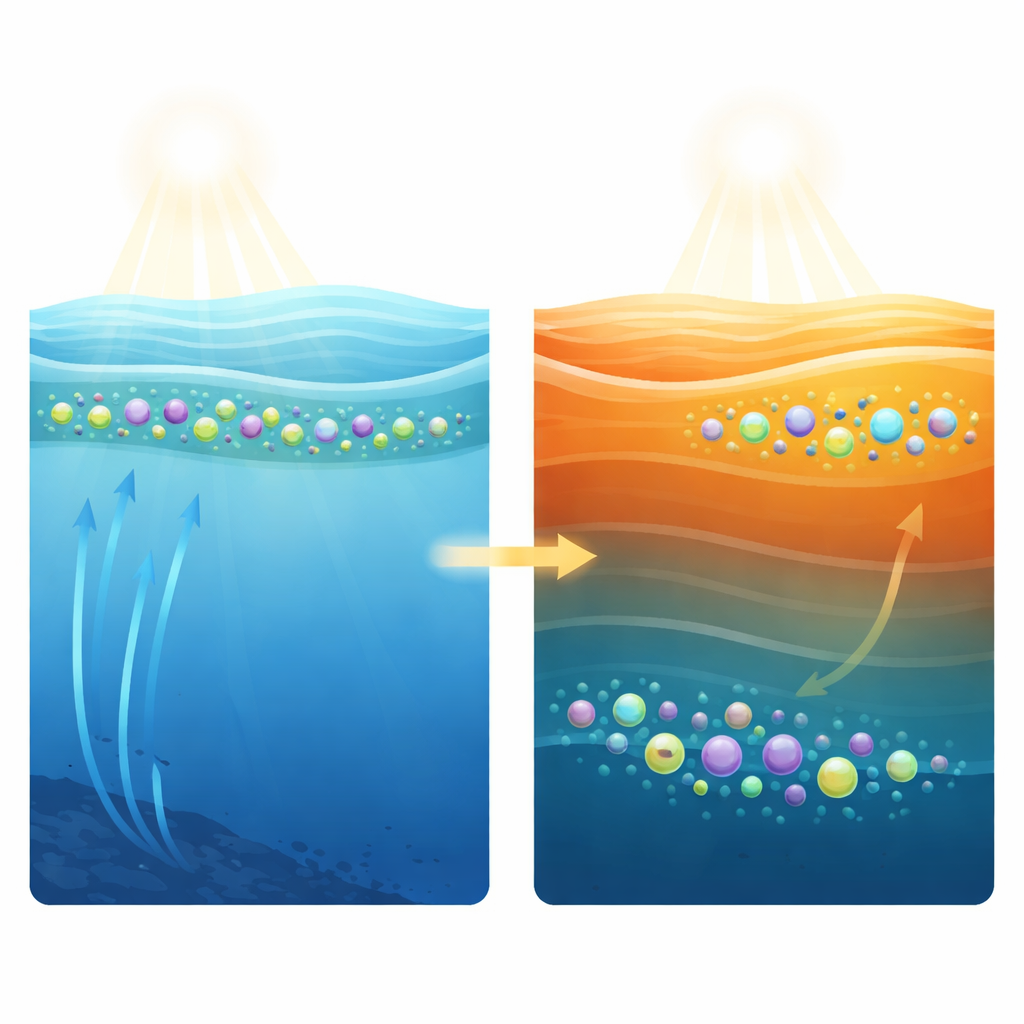
In the nutrient-starved subtropical gyres, the picture is more nuanced. Stronger layering cuts nutrient input to the surface, shrinking surface phytoplankton biomass. At the same time, a deeper, dimmer layer becomes more favorable for cells equipped with extra light-harvesting proteins. Biomass there grows and becomes more protein-rich to make better use of low light. When averaged over depth, the subtropical phytoplankton community actually increases its protein content by roughly 20%, and slightly reduces its caloric density as some fats are traded for protein. Across the globe, smaller cells with limited phosphorus storage become more common where nutrients decline, further boosting the carbon-to-phosphorus ratio of organic matter.
Ripple effects through polar and open-ocean food webs
Because many animals depend on protein from phytoplankton, these chemical shifts have ecological consequences. In high-latitude seas, reduced protein and higher carbon-to-nutrient ratios mean poorer food for zooplankton and the fish that eat them, echoing how rising CO2 has diluted the nutritional quality of land plants. At the same time, more lipids in polar phytoplankton could help some grazers stock up energy to survive dark winters—but only if the timing of blooms still matches their life cycles. In the subtropical gyres, deeper, more protein-rich phytoplankton may partly offset declines in surface productivity and could support deeper-living zooplankton and fish. Overall, the study argues that tracking how climate change remodels the internal chemistry of these microscopic plants is essential, because it signals shifts in both the strength of the ocean carbon sink and the quality of food available throughout marine ecosystems.
Citation: Sharoni, S., Inomura, K., Dutkiewicz, S. et al. Biochemical remodelling of phytoplankton cell composition under climate change. Nat. Clim. Chang. 16, 494–500 (2026). https://doi.org/10.1038/s41558-026-02598-w
Keywords: phytoplankton, climate change, marine food webs, ocean biogeochemistry, carbon cycle