Clear Sky Science · en
Chemical recycling of hydrofluorocarbons by transfer fluorination
Turning Problem Chemicals into Useful Resources
Fluorinated gases and plastics keep our food cold, our homes insulated and many medicines working—but they also linger in the environment and warm the planet. This research describes a new way to "mine" the valuable fluorine atoms locked inside these chemicals and reuse them, instead of treating them as hazardous waste. By doing so, it points toward a future where today’s climate‑warming refrigerants and persistent pollutants become tomorrow’s raw materials for drugs, batteries and specialty materials.
From One-Way Use to a Reusable Loop
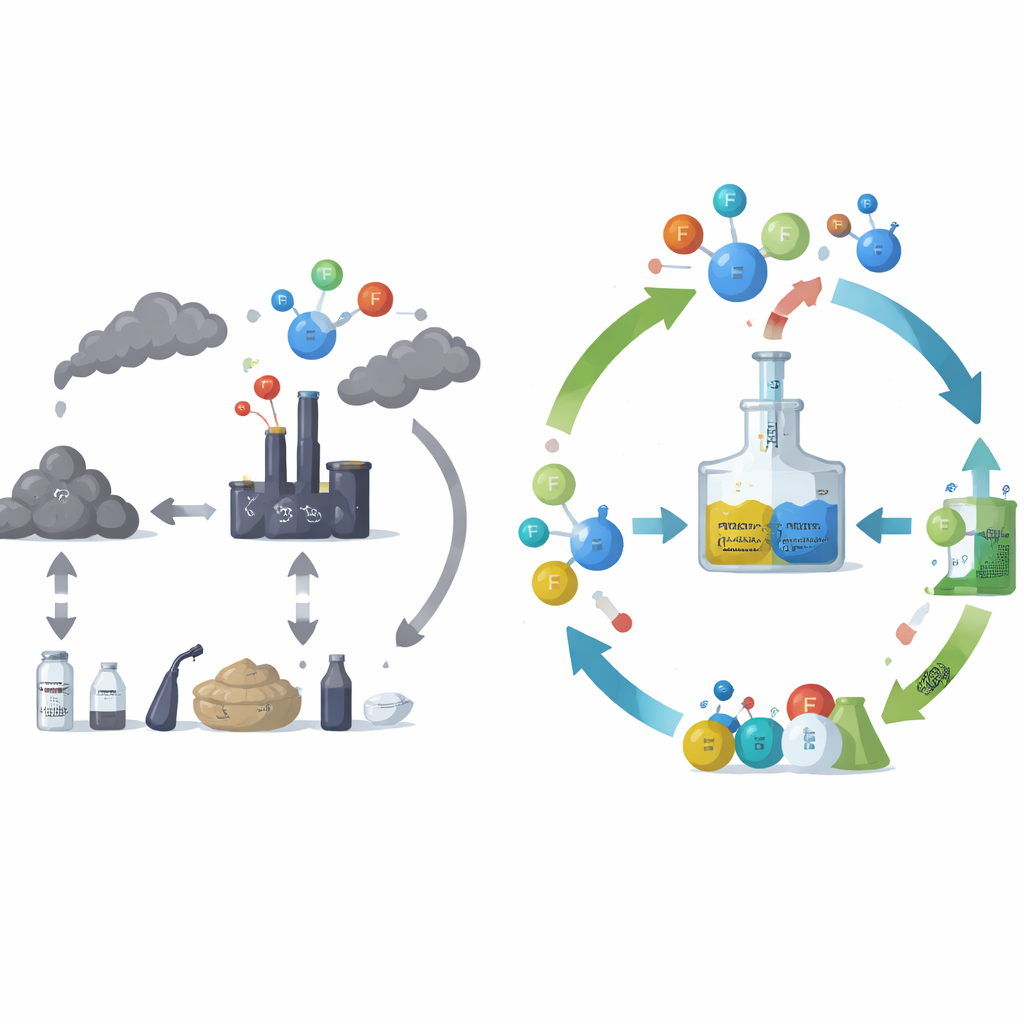
Modern fluorochemicals are made from a mineral called fluorspar through harsh industrial processes that generate toxic hydrofluoric acid. Many of the resulting products—such as hydrofluorocarbon (HFC) refrigerant gases and so‑called "forever chemicals" (PFAS)—are used once and then escape into air, water or landfills. Because they are both hard to break down and hard to replace, policymakers face a dilemma: how to protect health and climate without sacrificing the benefits these materials provide. The authors propose a different model: instead of a linear pipeline from mine to product to pollution, fluorine atoms should circulate in a loop, being recovered from old fluorochemicals and fed back into new ones.
A Simple Recipe for Harvesting Fluorine
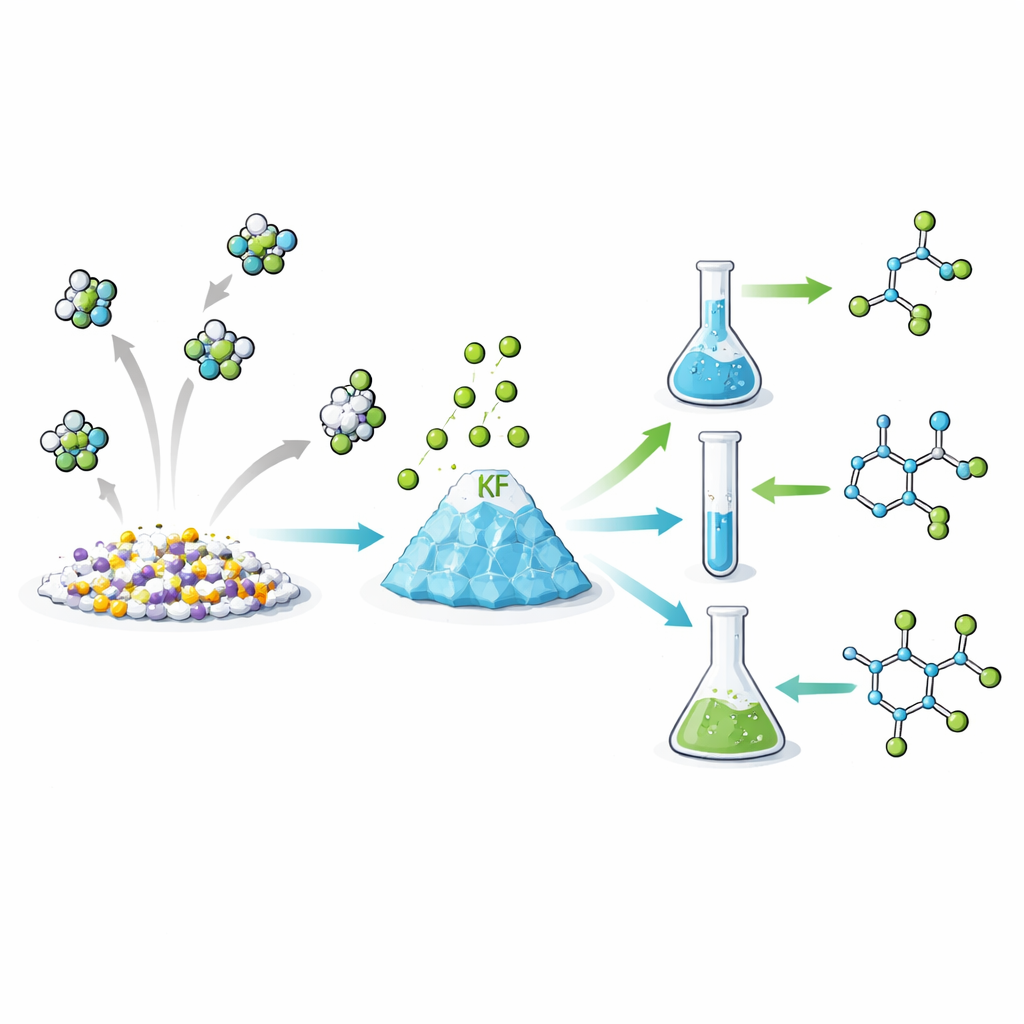
The team discovered that a common type of potassium base—a strongly alkaline substance—can strip fluorine atoms from many fluorinated molecules in ordinary organic solvents. When gases such as widely used HFC refrigerants are treated with this base, they lose fluoride ions that immediately pair with potassium to form tiny particles of dry potassium fluoride (KF). This solid salt, normally considered rather unreactive, turns out to be highly active in this finely divided form. In the same reaction vessel, adding an appropriate partner compound (such as a sulfonyl chloride or acyl chloride) lets the recycled KF deliver its fluorine to build new, useful fluorinated molecules in a one‑pot "transfer fluorination" process.
Recycling a Wide Range of Everyday Fluorochemicals
Crucially, the method works on a broad set of fluorine‑rich materials that are already produced at scale. These include major HFC refrigerants slated for phase‑down, newer hydrofluoroolefin gases, common fluorinated anesthetic gases used in operating rooms, battery electrolyte additives, low‑molecular‑weight PFAS such as perfluorooctanoic acid (PFOA), and the fluoropolymer poly(vinylidene difluoride) (PVDF) found in coatings and batteries. In many cases, the authors can recover most of the fluorine content as KF—over 90% for some refrigerants—while either converting the remaining carbon fragments into less problematic molecules or fully destroying PFAS backbones so that no persistent fluorinated residues remain detectable.
From Waste Gas to Medicines and Reagents
Once generated, the recycled KF becomes a versatile building block. The researchers used it to prepare sulfonyl fluorides, acyl fluorides, simple alkyl and aryl fluorides, and inorganic fluorides of elements such as silicon, phosphorus and iodine. Many of these products are directly relevant to pharmaceuticals: for example, they made fluorinated motifs found in antibiotics, enzyme inhibitors and specialized "deoxyfluorinating" reagents that chemists use to introduce fluorine into drug candidates. The same recycled fluorine also yields advanced fluorinating agents used to add fluorine to sensitive molecules in a controlled way, demonstrating that the reclaimed material meets demanding synthetic standards.
Scaling Up for Real-World Impact
To test practicality beyond the lab bench, the authors scaled their process in two directions. Using PVDF as a solid fluorine source, they ran reactions on gram to 50‑gram quantities with consistent performance, even when handling the base outside of an oxygen‑free glovebox. Separately, they built a flow‑chemistry setup for gaseous HFC‑134a, continuously feeding the gas and base through heated tubing to generate KF at a rate of about 1.5 grams per hour. The salt emerging from this system could be used directly in solution or isolated and washed, then applied to make a range of fluorinated products in good yields, showing that continuous fluorine recycling from waste gases is feasible.
Why This Matters for a Cleaner Future
In plain terms, this work shows that many fluorinated gases and polymers we currently view as disposal problems can instead be treated as fluorine ores. A relatively simple chemical treatment converts them into a reusable fluorine source that feeds high‑value chemistry, from drug synthesis to battery technology. While not a complete solution to the challenges of fluorochemicals, this transfer fluorination approach is a significant step toward a circular fluorine economy, where the same atoms are reused again and again rather than extracted once and left to accumulate in the environment.
Citation: Jenek, N.A., Brock, S.L., Mao, J. et al. Chemical recycling of hydrofluorocarbons by transfer fluorination. Nat. Chem. 18, 899–904 (2026). https://doi.org/10.1038/s41557-026-02096-8
Keywords: fluorochemical recycling, hydrofluorocarbon refrigerants, PFAS destruction, circular fluorine economy, potassium fluoride reagents