Clear Sky Science · en
Towards single-crystalline two-dimensional poly(arylene vinylene) covalent organic frameworks
From messy nets to tidy sheets
Imagine building a fishing net so precise that each knot lines up across an entire sheet the width of a grain of sand. This paper shows a new way to make such perfectly ordered molecular nets, called two dimensional polymer frameworks, that can guide electric charges more efficiently. These tiny, porous sheets could one day help power better electronics, sensors and solar energy devices.
Why flat molecular grids matter
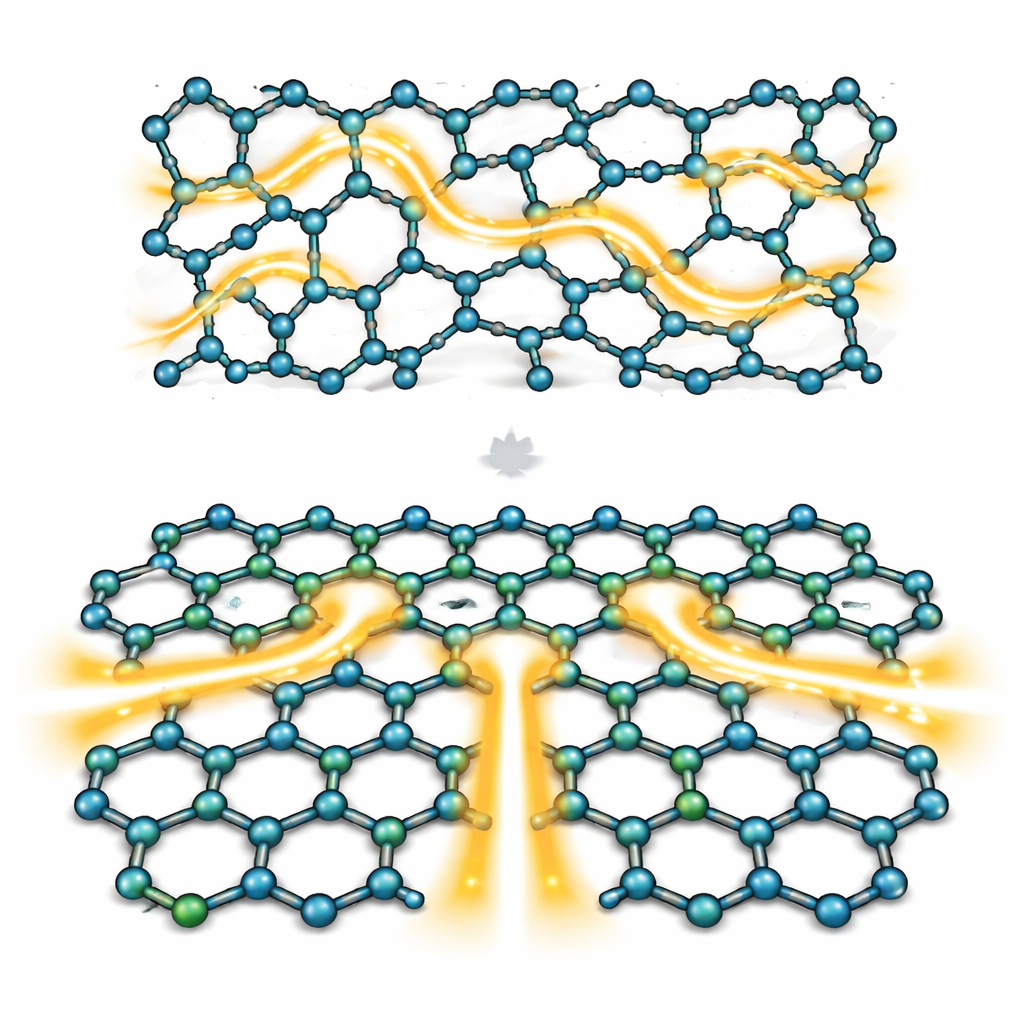
Researchers are keen on atom thin organic grids because they combine the light weight and flexibility of plastics with the orderly structure usually seen in crystals. Earlier versions of these materials used a type of chemical link that acted like a stiff but electrically uneven hinge. That limited how easily electrons could move, giving wide energy gaps and sluggish charge flow. A newer family replaces those hinges with straighter links that allow electrons to spread out more smoothly across the sheet, improving their behavior as semiconductors for optoelectronics, photocatalysis and electrochemistry.
A new way to lock the grid in place
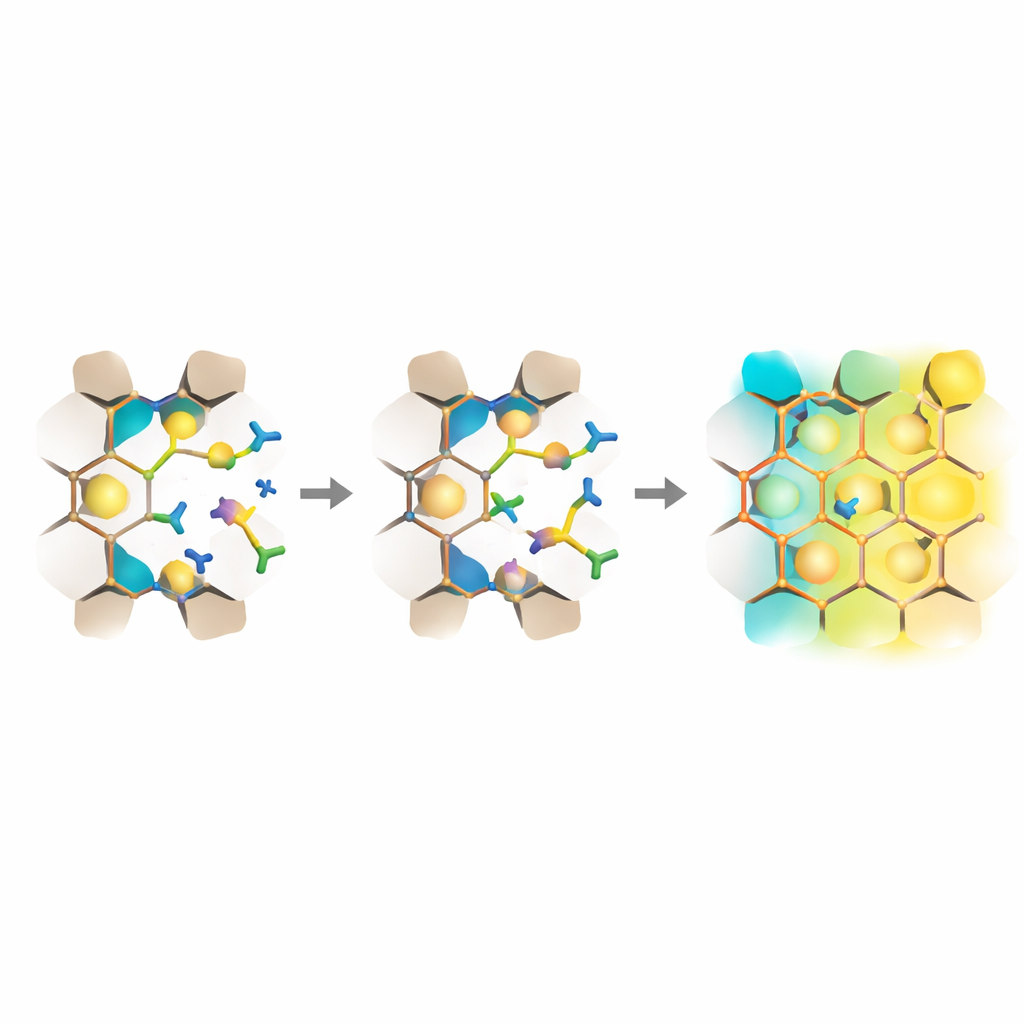
The challenge has been to make these improved grids not just in theory but as large, well ordered crystals. Standard recipes often freeze the structure too quickly, trapping defects and producing tiny, disordered domains only a few billionths of a meter across. The authors tackled this by borrowing a classic organic reaction known as a Mannich reaction and pairing it with an elimination step. First they grow a more flexible, imine linked framework that can rearrange and correct its own errors. Then, inside this pre formed net, they gradually swap each weaker link for a sturdier carbon based double bond, like replacing a scaffold with steel beams while keeping the building shape intact. Careful control of solvent, water content and base makes this swap slow and reversible enough for the sheets to settle into a highly ordered form.
Building many shapes of porous sheets
Using this strategy, the team transformed eight different starting frameworks into eleven highly crystalline or even single crystalline products. These new sheets form repeating patterns resembling honeycombs, squares or kagome lattices, each with tunable spacing between pores. Measurements of gas uptake show that the surfaces inside these pores can reach around two thousand square meters per gram, far exceeding similar materials made by older methods. Remarkably, the transformation tolerates modest mismatches in spacing between the starting net and the final one, as long as incoming building blocks can reach the right sites without stretching the lattice too much.
Seeing order at the atomic scale
To check that the nets were truly well ordered, the researchers combined several high resolution tools. Electron microscopy images revealed regular hexagonal patterns extending over crystals about two micrometers wide, while electron diffraction and X ray measurements confirmed the positions of atoms and the way the sheets stack. In one standout example, they resolved the full three dimensional arrangement of a honeycomb sheet, showing how nearly flat rings connect through the new vinyl like links. Computer calculations supported the picture, indicating that the new connections lower the energy gap and allow electrons to spread more widely across the grid than in the original imine based versions.
Faster charge traffic in tidier nets
Finally, the team tested how these structural improvements affect the movement of electrical charges. Using ultrafast terahertz pulses, they compared crystalline sheets with amorphous ones and with their imine linked precursors. The crystalline versions moved charges at least ten times more efficiently than their disordered cousins and several times better than the starting materials. Direct conductivity measurements on pressed pellets told the same story. In simple terms, turning a fuzzy molecular network into a sharp, well aligned grid creates smoother "roads" for electrons, which is essential for future devices that rely on stable, porous, carbon based sheets.
What this means going forward
This work shows that a controlled chemical swap inside a pre built net can turn flexible two dimensional polymers into robust, single crystalline sheets without losing their shape. For non specialists, the takeaway is that chemists now have a general recipe for making flatter, tidier and more connected molecular nets. Such materials combine huge internal surface area with good charge transport, making them promising platforms for next generation electronics, light harvesting and catalytic technologies.
Citation: Ghouse, S., Guo, Z., Gámez-Valenzuela, S. et al. Towards single-crystalline two-dimensional poly(arylene vinylene) covalent organic frameworks. Nat. Chem. 18, 853–862 (2026). https://doi.org/10.1038/s41557-025-02048-8
Keywords: covalent organic frameworks, two dimensional polymers, conjugated materials, charge transport, porous crystals