Clear Sky Science · en
Organic crystalline nanoparticles with a long-lived charge-separated state for efficient photocatalytic hydrogen production
Turning Sunlight into Fuel
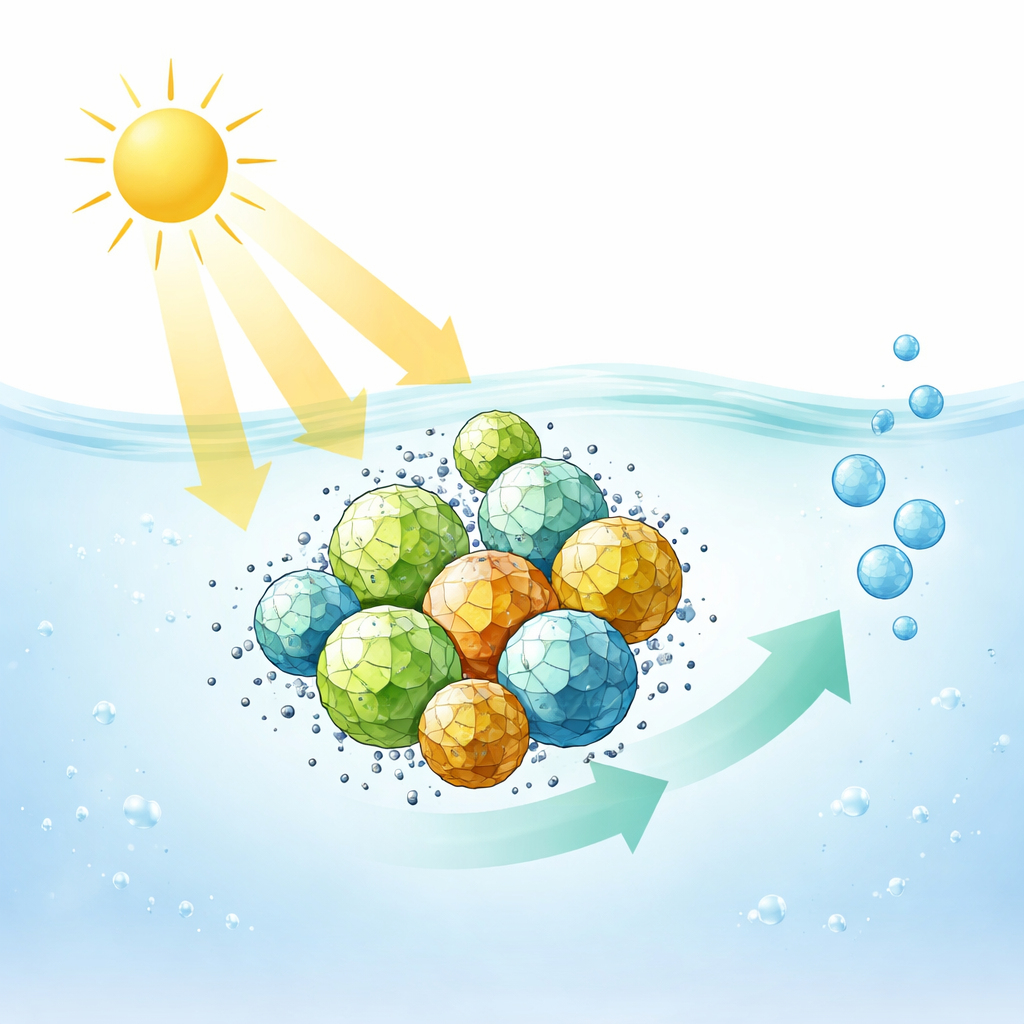
Imagine sprinkling a fine powder into water, shining sunlight on it, and watching it steadily make clean hydrogen fuel. This study explores exactly that idea. The researchers designed tiny organic crystals—built from carbon-based molecules rather than metals—that can soak up visible light and turn it into long‑lived electrical charges. Those charges then help split molecules and drive the formation of hydrogen gas, a potential clean fuel for the future.
Why Tiny Crystals Matter
The heart of the work is a tailor‑made organic molecule called IT‑PMI. It is shaped so that an electron‑rich “core” is flanked by two electron‑poor “arms,” a layout that naturally encourages electrons to shift when the molecule absorbs light. In liquid form, these molecules behave like many other dyes: they absorb visible light and briefly enter an excited state before relaxing back down. But the team’s real advance came from coaxing these molecules to assemble themselves into highly ordered nanoparticles in water. With the help of a surfactant—an amphiphilic polymer that keeps them dispersed—the molecules pack into neat, layered stacks that act as tiny crystalline grains only tens of nanometres across.
Building Order from Chaos
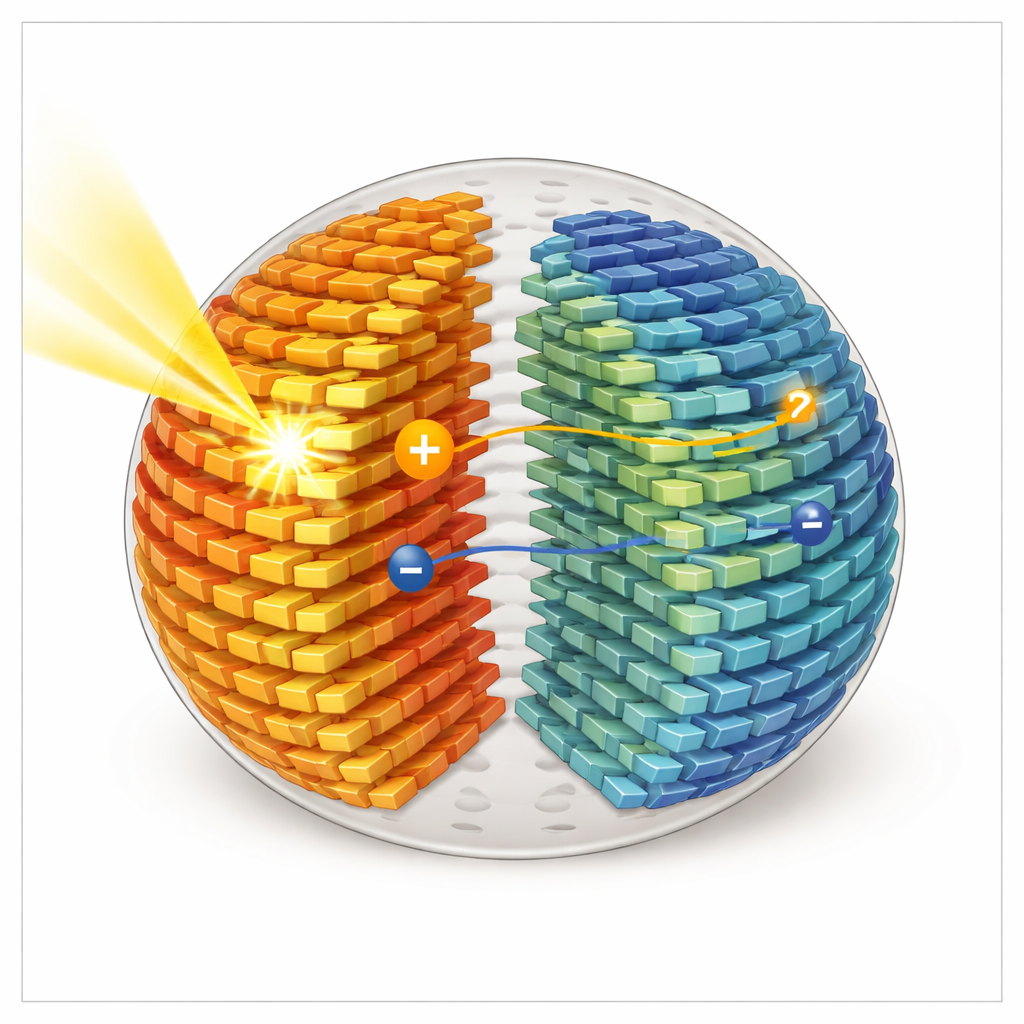
Microscopy and X‑ray measurements showed that, inside each nanoparticle, the molecules line up in a slipped, head‑to‑tail pattern known from dye chemistry to be particularly effective at moving energy and charge. Instead of random piles, the researchers found regular, J‑like aggregates with consistent spacing between layers. Calculations revealed that, in this arrangement, neighbouring molecules are especially good at trading electrons rather than just exchanging energy. This structural order turns the nanoparticle into a compact highway system for charges, where an electron can hop from one molecule to the next across the crystal.
Trapping Light as Long‑Lived Charges
Using ultrafast laser techniques, the team tracked what happens after a flash of light hits either single molecules or nanoparticles. Individual molecules first form a locally excited state, then a charge‑shifted state, and finally a relatively long‑lived triplet state. In contrast, within the nanoparticles, the story changes dramatically. After excitation, charges rapidly separate between neighbouring molecules in a symmetry‑breaking step: identical units briefly become an electron donor and an electron acceptor. Because the molecules are tightly stacked, the separated charges can then hop through the crystal, spreading out from each other. The end result is a charge‑separated state that survives for up to 1.2 seconds—astonishingly long on the scale of molecular events and much longer than in most comparable organic systems.
From Long‑Lived Charges to Hydrogen Gas
The researchers next asked whether these persistent charges could be harnessed to make hydrogen. Dispersing the nanoparticles in slightly acidic water containing ascorbic acid (a common vitamin C derivative) and decorating them with a small amount of platinum, they illuminated the mixture with visible light. The nanoparticles absorbed the light and produced separated charges; the platinum helped combine electrons with protons to form hydrogen gas, while ascorbic acid supplied replacement electrons to reset the catalyst. Under optimized conditions, the system generated hydrogen at a rate of about 126 millimoles per gram per hour and achieved an external quantum efficiency of roughly 12 percent at 550 nanometres—meaning a sizeable fraction of incoming photons led to useful chemical events. Importantly, the nanoparticles remained active for at least 77 hours, achieving hundreds of millions of reaction cycles per particle, and the approach scaled up to tens of millilitres of hydrogen in larger test volumes.
What This Means for Future Clean Energy
In simple terms, this research shows that the way organic molecules pack together can be just as important as their individual design. By arranging dyes into orderly crystalline nanoparticles, the team created a material that not only captures sunlight but also holds onto the resulting charges long enough to carry out demanding chemistry like hydrogen production. Although more work is needed before such systems become practical solar‑to‑fuel technologies, the study provides a clear design strategy: use rigid, well‑organized organic aggregates to delay charge recombination and boost efficiency. This blueprint could guide future developments in solar fuels, carbon dioxide reduction, and the breakdown of pollutants using sunlight.
Citation: Cai, B., Brnovic, A., Pavliuk, M.V. et al. Organic crystalline nanoparticles with a long-lived charge-separated state for efficient photocatalytic hydrogen production. Nat. Chem. 18, 723–730 (2026). https://doi.org/10.1038/s41557-025-02035-z
Keywords: photocatalytic hydrogen production, organic nanoparticles, solar fuels, charge separation, artificial photosynthesis