Clear Sky Science · en
Mosaic gastruloids reveal a temporal restriction for developmental cell competition
How early embryos keep their cells in line
Every human and mouse begins as a single cell that must multiply and organize into a healthy body. Along the way, some cells pick up minor flaws that could threaten proper development. This study explores how early embryo-like structures sense and remove such “sub-par” cells, revealing a brief but powerful quality-control stage that helps keep developing tissues healthy. 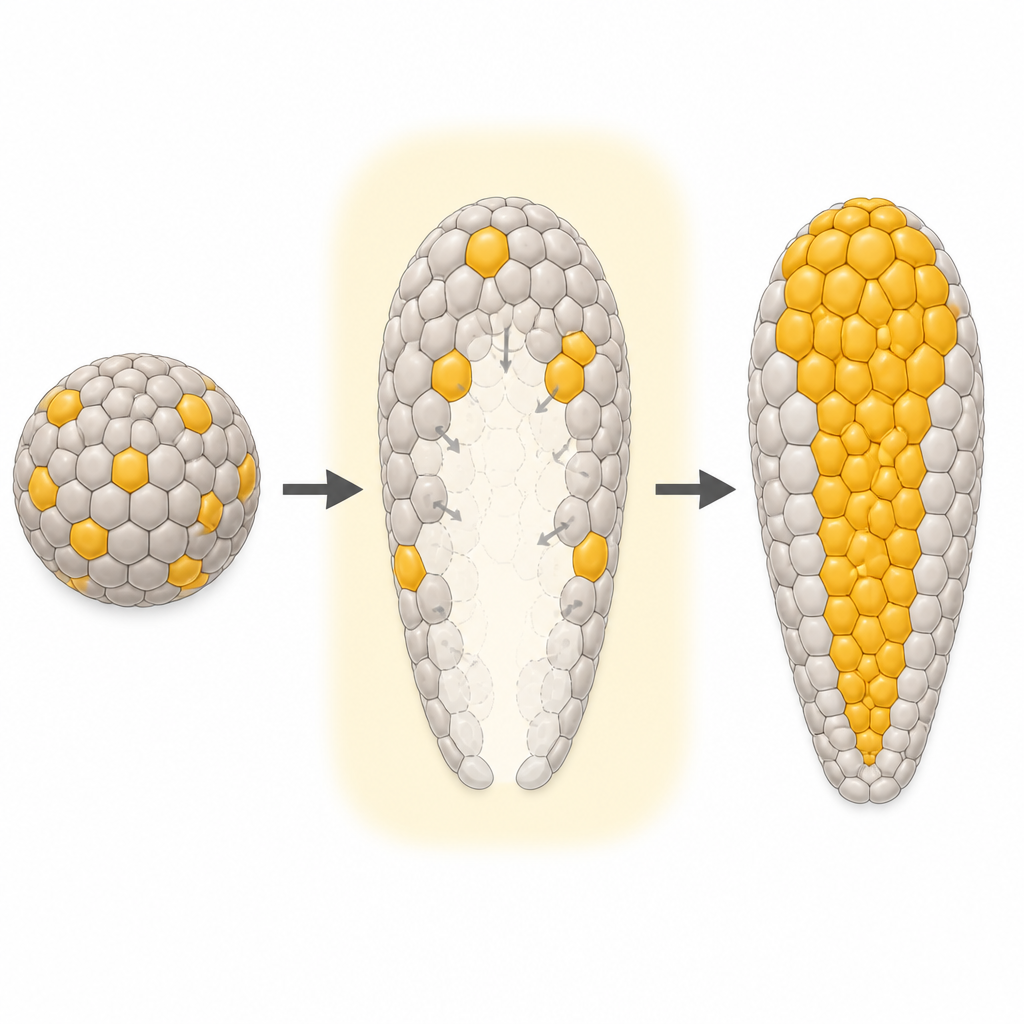
Mini embryos in a dish
Because real embryos are tiny and hard to study inside the uterus, the researchers used three-dimensional clusters of mouse stem cells called gastruloids. These structures mimic key steps of early development, especially a crucial reshaping event known as gastrulation, when the basic body plan emerges. By mixing two types of fluorescently marked cells into these mini embryos, the team could track how “normal” cells and altered cells fared as development progressed.
Super cells that outgrow their neighbors
The altered cells lacked p53, a well-known guardian protein that usually helps cells respond to damage. Without p53, these cells became “super competitors.” When only normal cells were mixed, both groups grew side by side and formed well-organized tissues. But when just a handful of p53-lacking cells were added, they gradually took over the gastruloid. As few as two such cells among roughly 150 normal ones were enough to slow or halt the expansion of their neighbors, which eventually disappeared. The overall structure stayed similar in size because the winning cells expanded to fill the gaps, showing that losses were balanced by compensatory growth.
A brief window for cellular showdown
The researchers discovered that this ruthless selection did not occur at all times. In simple flat (2D) cultures, competition only arose when cells were overcrowded, hinting at limits in nutrients or space. In contrast, in the 3D gastruloids, competition switched on only during a narrow developmental window that corresponds to the days just before and during gastrulation in the mouse. Before this stage, when cells were still in a more flexible, stem-like state, winners and losers coexisted peacefully. After gastrulation was underway, even mixing cells from different stages did not trigger competition unless both sides were in that permissive mid-stage. Signals that push cells toward more “posterior” body identities, such as Wnt and BMP, shortened or softened this competitive period, while their absence extended it.
Death from within, not simple overgrowth
Why do the weaker cells vanish? Detailed imaging and flow measurements showed that normal neighbors of p53-lacking cells did not stop dividing; instead, they activated internal suicide pathways. These loser cells accumulated high levels of p53 protein and switched on a type of self-destruct program centered on their mitochondria, the cell’s energy hubs. Blocking this mitochondrial death pathway with a protective protein called Bcl2 prevented their elimination, and even reduced the extra growth of the winner cells. Other known cell-death routes, such as those driven by surface death receptors, were not required, pointing to an internal stress response as the key trigger. 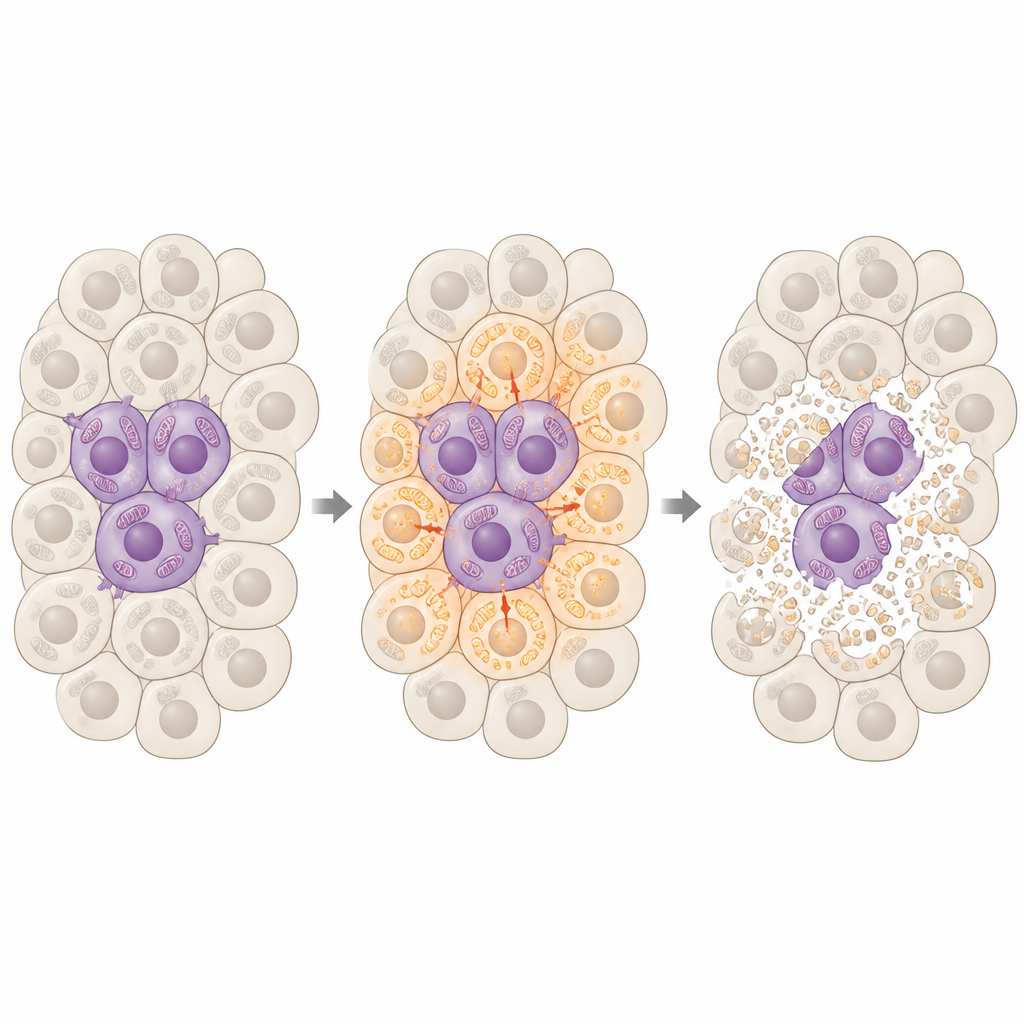
Timing, stress signals and a fitness checkpoint
The team then asked what primes cells for this showdown. Gene activity measurements showed that, as cells left their earliest stem-like state, they quietly built up a toolkit of stress and death regulators. Around the start of gastrulation, these tools were released, while later on they were dialed back again. Two master regulators of early body formation, Brachyury and Eomesodermin, were essential: cells lacking both largely escaped competition, apparently stuck in a state that never entered the critical window. Finally, by engineering a switchable “degron” tag onto p53 itself, the researchers could temporarily lower p53 protein in otherwise normal cells. Briefly lowering p53 only during the narrow developmental window was enough to turn these cells into super competitors that killed their neighbors, directly showing that relative, short-lived differences in p53 levels decide who wins and who loses.
Why this matters for healthy beginnings
This work suggests that early mammalian embryos pass through a timed quality checkpoint: during a short phase around gastrulation, cells compare their internal stress state, and those with relatively higher p53 levels are selectively removed. Gastruloids provide a powerful model to dissect this process in three dimensions, offering clues to how embryos quietly weed out less fit cells without damaging the emerging body plan. Understanding this built-in quality control may shed light on how developmental errors are prevented and how similar competition rules might later influence tissue maintenance and disease.
Citation: Frenster, J.D., Babin, S., Casani-Galdon, P. et al. Mosaic gastruloids reveal a temporal restriction for developmental cell competition. Nat Cell Biol 28, 875–889 (2026). https://doi.org/10.1038/s41556-026-01923-x
Keywords: cell competition, gastruloids, p53, gastrulation, embryonic development