Clear Sky Science · en
Kinase KEY1 controls pyrenoid condensate size throughout the cell cycle by disrupting phase separation interactions
How Algae Tune Tiny Droplets to Capture Carbon
Inside the cells of many algae sits a tiny compartment that helps pull carbon dioxide out of the air. This study reveals how algae actively tune the size and number of these compartments, called pyrenoids, through a molecular on–off switch. Understanding this control system not only deepens our view of how cells organize their chemistry, but could one day guide efforts to boost photosynthesis in crops and help draw down atmospheric CO2.
Little Liquid Factories Inside Green Cells
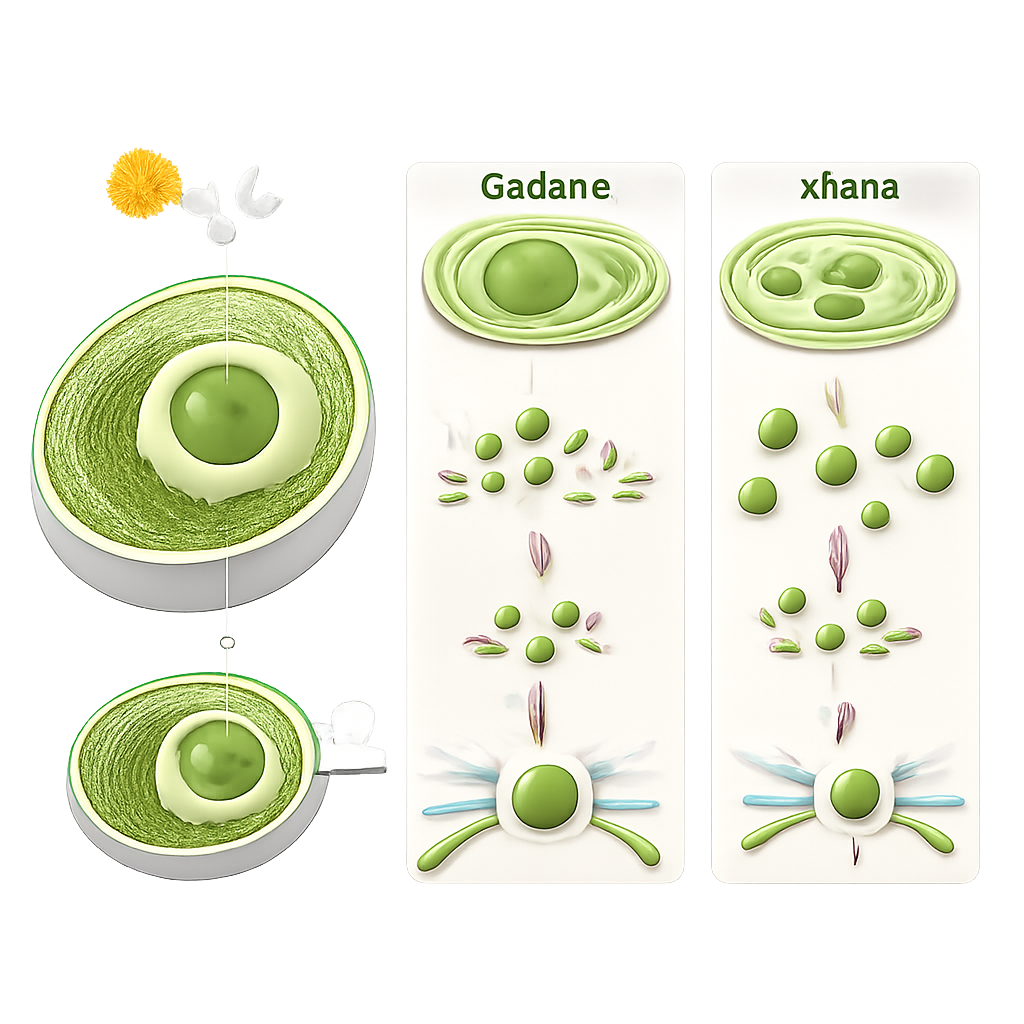
Pyrenoids are droplet-like structures inside the chloroplasts of many algae. They concentrate the enzyme Rubisco, which turns CO2 into organic carbon, and therefore contribute to roughly one-third of the planet’s CO2 fixation. Unlike rigid organelles bounded by membranes, pyrenoids behave more like liquid droplets formed by phase separation: weak, reversible attractions cause proteins to clump together into dense droplets within the watery cell interior. In the model alga Chlamydomonas, a flexible protein called EPYC1 acts as a linker, holding Rubisco molecules together so they condense into a single large pyrenoid in each chloroplast.
Why Droplet Size Matters for Life
The size and number of these droplets are not mere details. When enzymes gather into a single well-sized condensate rather than many scattered ones, they can process CO2 much more efficiently. Abnormally large or small condensates in other contexts are linked to diseases such as cancer. In Chlamydomonas, cells that cannot assemble one proper pyrenoid droplet grow poorly when CO2 is scarce, showing that correct droplet organization directly affects survival. Curiously, during cell division the usual single pyrenoid briefly disappears, then re-forms, suggesting that cells actively dissolve and rebuild this condensate on a tight schedule.
A Molecular Dial That Dissolves and Rebuilds Droplets
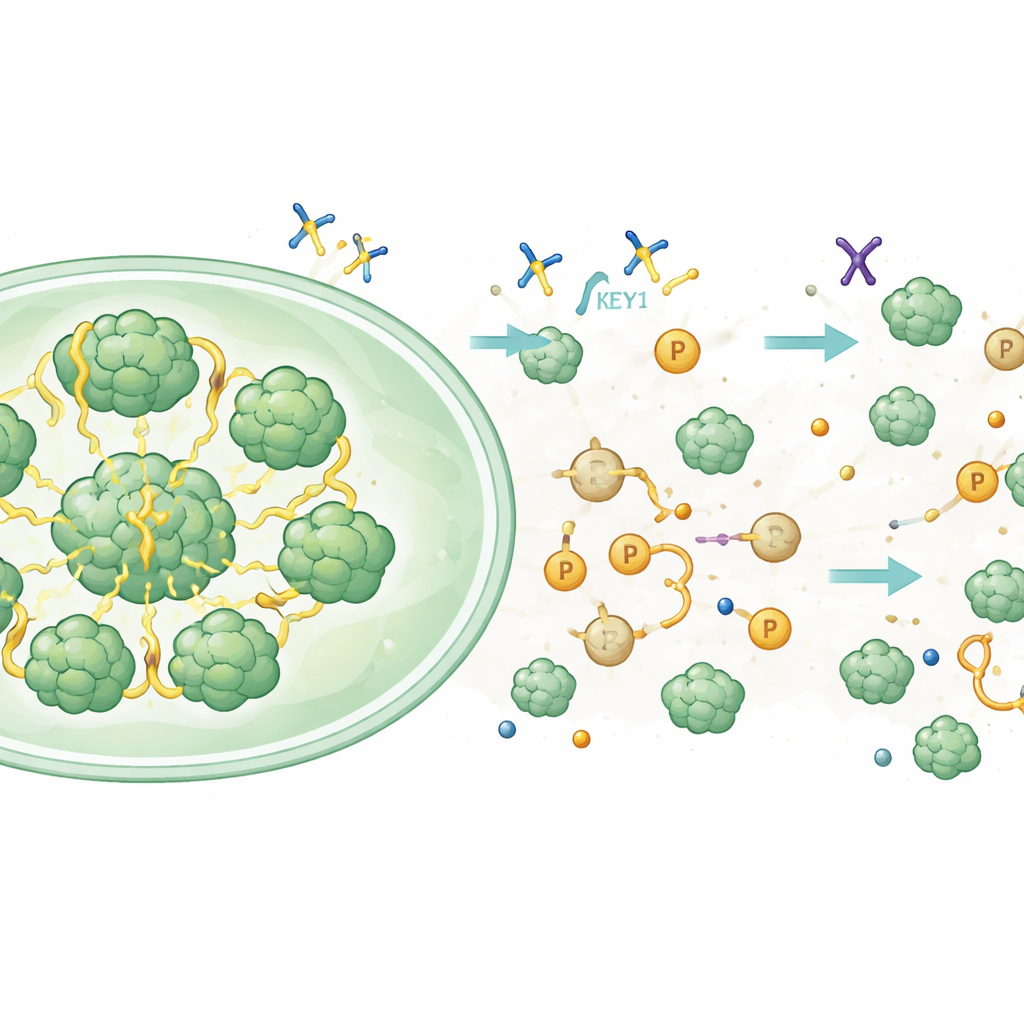
The researchers set out to find the molecular control knob behind these behaviors and homed in on a protein they named KEY1. KEY1 is a kinase, a protein that attaches small phosphate groups onto other proteins. They showed that KEY1 physically interacts with EPYC1 and is required for normal pyrenoid behavior. When they disrupted the KEY1 gene, cells no longer formed one large pyrenoid. Instead, they carried many smaller condensates that failed to dissolve during cell division. These mutant cells also grew poorly in low CO2, confirming that faulty droplet control harms the CO2-concentrating machinery. Microscopy revealed that in normal cells, the single pyrenoid dissolves into many small droplets during division and then coarsens back into one per daughter cell, whereas in the mutants these cycles of dissolution and re-formation hardly occur.
Turning Stickiness Up and Down
To understand how KEY1 works, the team examined EPYC1’s chemical state. They found that in normal cells EPYC1 is heavily phosphorylated, carrying many phosphate groups, while in KEY1 mutants EPYC1 is essentially unmodified. In test-tube experiments with purified proteins, KEY1 directly phosphorylated EPYC1, especially on sites that mediate its grip on Rubisco. When EPYC1 was phosphorylated by KEY1, it no longer formed condensates with Rubisco at any concentration tested. Sensitive measurements showed that phosphorylated EPYC1 barely binds Rubisco at all. Inside cells, the phosphorylated form of EPYC1 was enriched outside the pyrenoid, while the unmodified form packed into the condensate. This paints a simple picture: adding phosphates weakens EPYC1’s stickiness for Rubisco and drives it out of the droplet; removing them restores stickiness and allows the droplet to grow again.
Keeping Droplets Centered and Under Control
KEY1 itself is drawn into the pyrenoid through a short sequence that binds Rubisco. When this targeting sequence was mutated, KEY1 stayed in the surrounding fluid, EPYC1 remained poorly phosphorylated, and the cell again accumulated multiple pyrenoids, showing that correct localization is essential for control. The authors then built a mathematical model that treated unmodified EPYC1 as sticky and phosphorylated EPYC1 as non-sticky, with a hypothetical phosphatase enzyme reversing KEY1’s action. Simulations reproduced the main features seen in living cells: a single large condensate during growth, a shift to multiple small droplets and near-complete dissolution when KEY1 activity rises around division, and a return to one droplet afterward. The same model also suggested how this system could naturally center the pyrenoid inside the chloroplast and prevent spurious small droplets from persisting elsewhere.
What This Means for Cells and for Climate
Together, the experiments and modeling show that KEY1 acts as a master regulator of the pyrenoid condensate. By phosphorylating EPYC1 at specific sites, KEY1 tunes how strongly EPYC1 binds Rubisco, which in turn sets a preferred droplet size and number. Low KEY1 activity favors one big condensate; higher activity during cell division shrinks and dissolves it into smaller droplets that can be fairly shared between daughter cells. Without KEY1, this active size-regulation system collapses, leaving the cell with many mis-sized, misplaced droplets and a weakened capacity to capture CO2. Beyond algae, this work offers one of the clearest examples yet of how cells can use simple chemical tags to actively manage the size, number, and position of liquid-like compartments—insights that could eventually inform strategies to engineer better carbon-fixing machinery in crops or synthetic systems.
Citation: He, S., Lemma, L.M., Martinez-Calvo, A. et al. Kinase KEY1 controls pyrenoid condensate size throughout the cell cycle by disrupting phase separation interactions. Nat Cell Biol 28, 725–738 (2026). https://doi.org/10.1038/s41556-026-01908-w
Keywords: pyrenoid, biomolecular condensates, photosynthesis, protein phosphorylation, phase separation