Clear Sky Science · en
Cosmic CO and [C II] backgrounds and the fuelling of star formation over 12 Gyr
Why the hidden gas between galaxies matters
When we look at the night sky we see stars, but not the vast stores of cold gas that quietly feed them. This paper explores how much of that hidden fuel fills the universe and how quickly it is turned into new stars over the past 12 billion years. By reading faint signatures from simple molecules and atoms spread across the cosmic web, the study shows that galaxies have been drawing on a much larger and shorter lived gas supply than we had directly seen, reshaping our picture of how galaxies like our own grew up.

A new way to see all the gas at once
Instead of counting individual galaxies one by one, the author uses a technique called intensity mapping to measure the combined glow from many distant systems at once. Space missions such as Planck and Herschel mapped the sky at multiple infrared and millimetre colors, where dust warmed by young stars shines brightly. By cross comparing these maps with the known positions of millions of galaxies and quasars in different distance ranges, the study teases out how much light comes from each era of cosmic time. Within this glow sit narrow fingerprints from carbon monoxide (CO) and ionized carbon, which act as signposts for the cold molecular gas that makes stars and for the gas that cools after being heated by those stars.
Weighing the universe’s star making fuel
From these line fingerprints the paper measures, for the first time, the mean background from the full ladder of CO transitions with high confidence, and a weaker but still clear signal from ionized carbon. The strength of the lowest CO line is directly related to how much molecular hydrogen gas exists, so the author can infer the total mass of star forming fuel in the universe without needing to see each galaxy separately. The result is striking: during the era when the cosmic star formation rate was highest, roughly 10 billion years ago, there was about twice as much molecular gas as had been tallied from deep galaxy surveys. This implies that a large population of faint, previously missed galaxies and extended gas structures contributes substantially to the cosmic fuel reservoir.
A fast turning fuel tank that needs constant refills
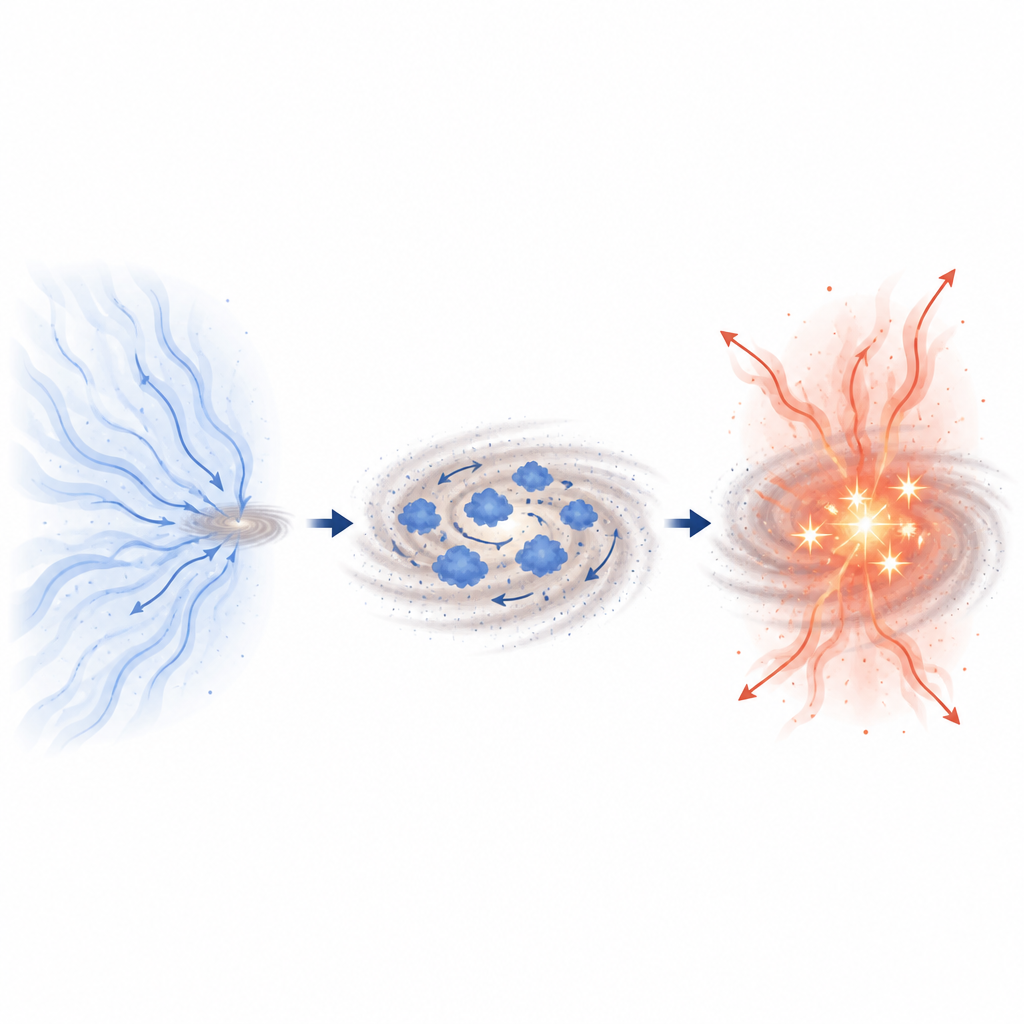
The analysis also reveals how quickly galaxies consume their gas. By comparing the total molecular gas density with the independently measured rate at which the universe forms stars, the paper estimates a global depletion time of about one billion years. This means that, once gas cools into the dense molecular phase, it is converted into stars on timescales much shorter than the age of the universe, so the tank must be continuously refilled by fresh inflows from surrounding space. At the same time this conversion is far slower than the free fall time of the gas under gravity, implying that turbulence and feedback from young stars regulate the process and keep star formation from running away.
A simple rule for making stars across cosmic history
Because different CO lines are excited under different conditions, their relative strengths act like a thermometer and densitometer for the star forming regions that dominate the background. The study links the pattern of CO excitation to a characteristic surface density of star formation in galaxies at each epoch. Combining this with the depletion time, it reconstructs how star formation intensity depends on the surface density of molecular gas. Remarkably, the relationship follows a simple super linear law long known from nearby galaxies, in which denser gas disks form stars more than proportionally faster. This same rule appears to hold, on average, across 90 percent of cosmic history when viewed not galaxy by galaxy but in aggregate.
Cooling the gas and guiding future telescopes
The ionized carbon line offers a complementary view, tracing how gas cools after being stirred and heated by stars. Its measured brightness over time provides a global gauge of how efficiently young stars transfer energy into their surroundings and how that energy is ultimately radiated away. Together, the CO and ionized carbon backgrounds sketch a coherent life cycle in which gas flows into galaxies, cools into dense clouds, forms stars, and is then heated and pushed around by those same stars. By turning theoretical forecasts into direct measurements of line strengths, this work sets practical targets for upcoming three dimensional intensity mapping experiments, which will use these lines not only to study galaxy growth but also to map the large scale structure of the universe itself.
Citation: Chiang, YK. Cosmic CO and [C II] backgrounds and the fuelling of star formation over 12 Gyr. Nat Astron 10, 742–752 (2026). https://doi.org/10.1038/s41550-026-02798-6
Keywords: molecular gas, star formation, intensity mapping, carbon monoxide, [CII] emission