Clear Sky Science · en
Dense gas linked to star-forming regions photoionized by embedded gamma-ray bursts
Cosmic explosions as clues to stellar nurseries
Long gamma ray bursts are among the brightest flashes in the Universe, briefly outshining entire galaxies. This study shows how these extreme explosions can be used as lamps to probe the dense birthplaces of massive stars, regions that are usually hidden from view. By reading subtle fingerprints in the X ray afterglow of seven such bursts, the authors reveal that these cosmic blasts sit inside compact, crowded pockets of gas and dust where new stars are forming.
A powerful flash and its fading glow
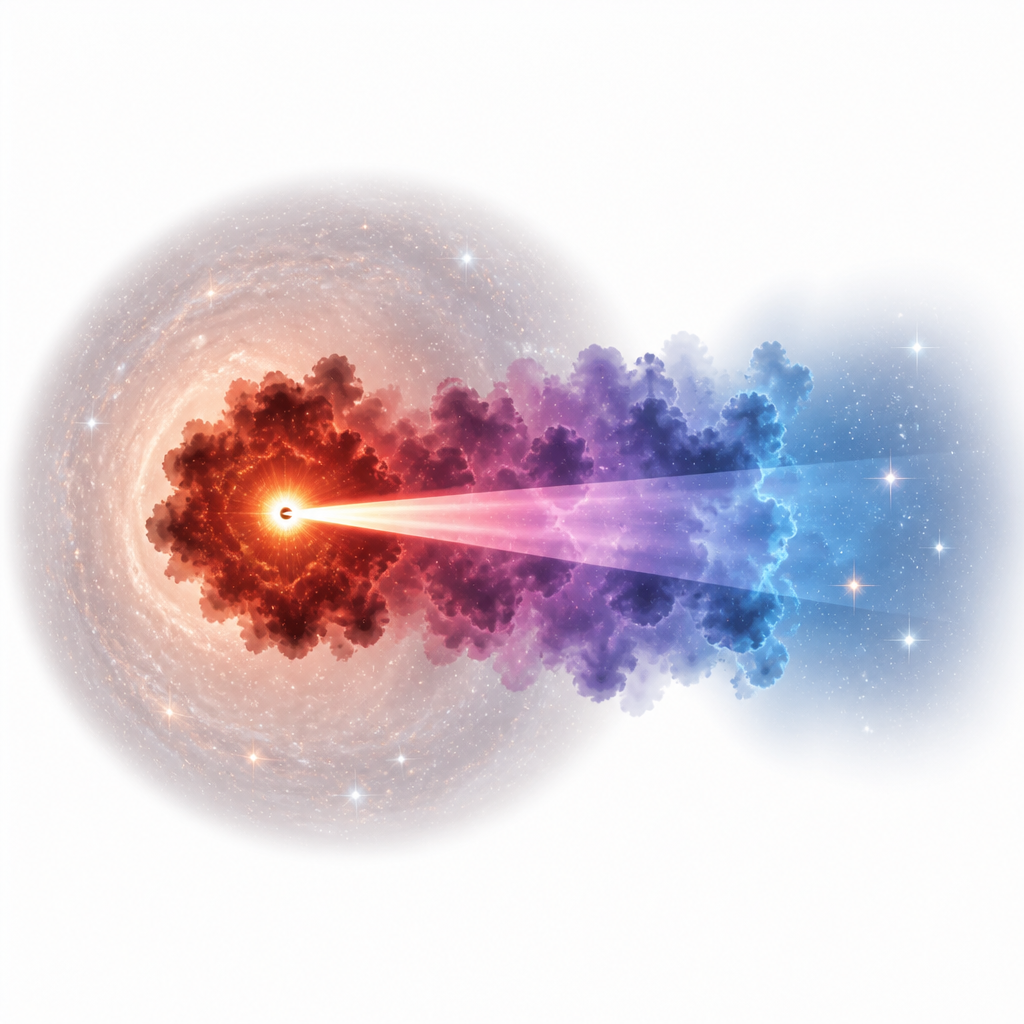
Gamma ray bursts occur when certain massive stars die, or when compact objects like neutron stars collide. In a long gamma ray burst, the first instant is an intense high energy flash, followed by an afterglow that shines for hours to days at X ray, optical, and radio wavelengths. Astronomers have long used optical light from afterglows to study the gas in the host galaxy, but close to the burst itself the gas becomes so highly stripped of electrons that it turns transparent to optical light. As a result, the crucial region within about one hundred light years of the burst has remained largely invisible in traditional observations.
Using X rays to map hidden gas
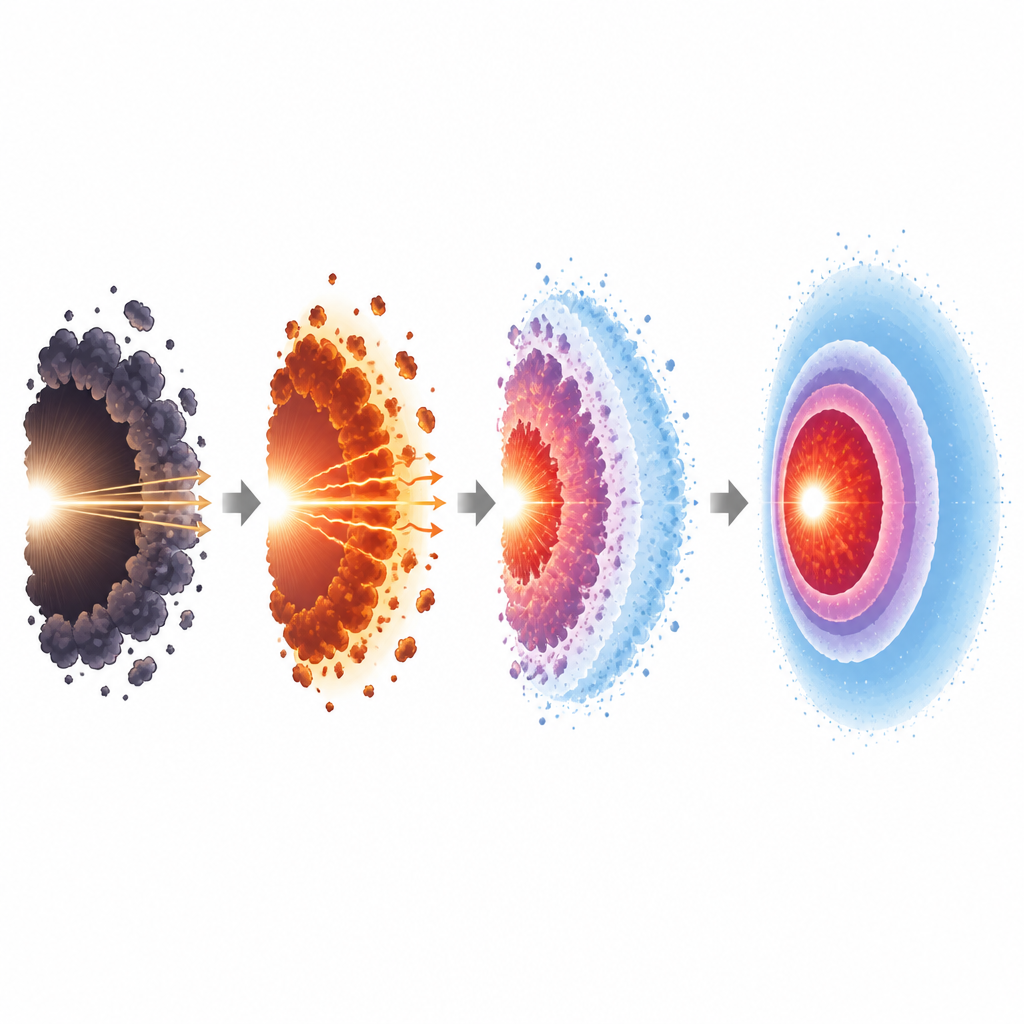
The authors turn to X rays to pierce this blind spot. Highly energetic X ray photons are still absorbed by the hot, ionized gas around a burst, leaving a complex pattern of dips in the spectrum. To interpret these patterns they employ a new computer model, called TEPID, that tracks how the burst’s changing light output ionizes gas over time and distance. Unlike older approaches that assumed the gas quickly settles into a steady state, this model follows the full time history of the flash and afterglow, more realistically capturing the layered structure of the surrounding material.
What seven bursts reveal about their homes
Applying this method to high quality XMM Newton X ray data for seven long bursts, the team compares simple neutral gas models with their time evolving ionized gas model. For most of the bursts, the neutral models leave clear, systematic mismatches with the data, while the TEPID model fits the spectra much more closely. From these improved fits they directly infer both the amount of gas and how densely it is packed. The absorbing regions typically span five to fifty parsecs and have particle densities between about one hundred and ten thousand particles per cubic centimeter, much denser than the more diffuse surroundings traced by the afterglow itself.
Pinpointing star forming regions
These sizes and densities match those of known star forming regions in our own and nearby galaxies, rather than those of whole galaxies, galaxy clusters, or the thin gas between galaxies. The X ray opacity cannot be explained by the intergalactic medium, which is too tenuous, nor solely by the ordinary gas in the host galaxy. Instead, the absorption pattern indicates dense gas close to the burst, where helium and highly ionized metals play a major role in blocking X rays. The study also finds that the long bursts in the sample show other hallmarks of massive star collapse, supporting the view that they come from short lived, heavy stars born in these crowded nurseries.
What this means for our picture of star birth
To a non specialist, the key message is that long gamma ray bursts are firmly tied to dense pockets of active star formation, not to more exotic or distant gas reservoirs. Their brilliant X ray afterglows carry a record of the gas immediately around them, allowing astronomers to measure the size and thickness of the surrounding stellar nursery even in very distant galaxies. As future X ray observatories with finer spectral vision come online, this approach could turn gamma ray bursts into powerful tools for mapping how and where massive stars formed across the history of the cosmos.
Citation: Thakur, A.L., Piro, L., Luminari, A. et al. Dense gas linked to star-forming regions photoionized by embedded gamma-ray bursts. Nat Astron 10, 714–725 (2026). https://doi.org/10.1038/s41550-026-02786-w
Keywords: gamma ray bursts, star forming regions, X ray spectroscopy, interstellar gas, massive stars