Clear Sky Science · en
The chemical habitability of Earth and rocky planets prescribed by core formation
Why the Right Ingredients for Life Are Hard to Come By
When we dream about life on distant worlds, we often picture oceans, clouds and a comfortable temperature range. But life also depends on invisible ingredients that are far harder to see from afar: chemical nutrients like phosphorus and nitrogen. This paper asks a deceptively simple question with big implications: during a rocky planet’s birth, does its deep interior chemistry quietly decide whether those nutrients ever reach the surface, and thus whether the planet can truly be habitable?
A New Kind of Goldilocks Zone
A planet’s traditional “habitable zone” is defined by distance from its star and the possibility of liquid water. The authors introduce a complementary idea: a chemical Goldilocks zone, where the interior of a rocky planet supplies just the right amounts of phosphorus and nitrogen to its surface and oceans. These two elements are central to DNA, cell membranes and proteins, yet are difficult to measure directly on exoplanets. The study argues that their long-term availability is largely controlled not by later surface processes, but by what happens very early on, when metal sinks to form a core and the remaining rock becomes the mantle that feeds crust, oceans and atmosphere. 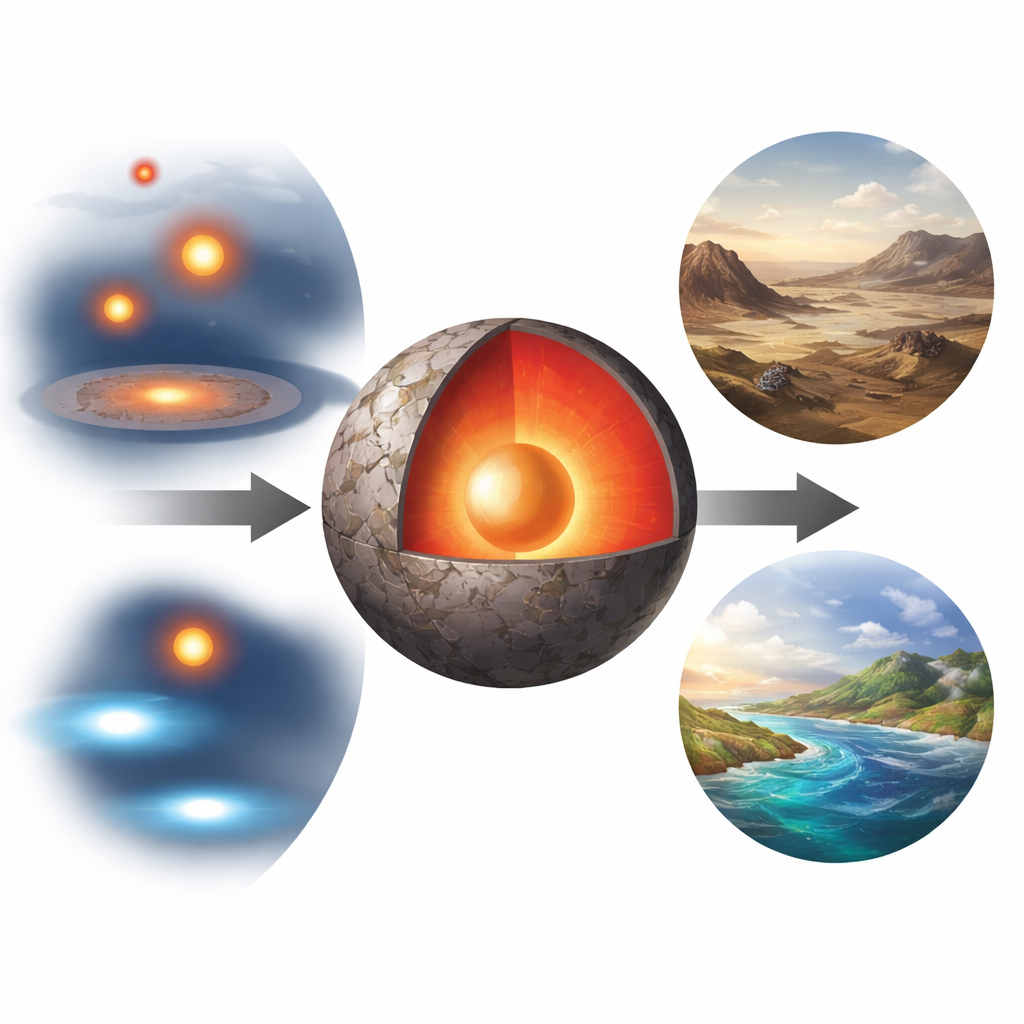
How Planetary Cores Can Hide Life’s Nutrients
During the “magma ocean” stage of planet formation, heavy metal separates from molten rock and sinks to make a core. In this process, some elements prefer to follow the metal; others stay in the silicate mantle. Experiments show that phosphorus and nitrogen behave in opposite ways as the planet’s interior becomes more or less oxidizing (that is, rich or poor in oxygen). Under strongly reducing conditions, phosphorus is drawn into the metal core and largely lost to the surface, while nitrogen tends to remain in the mantle. Under strongly oxidizing conditions, the opposite pattern emerges: nitrogen is more easily lost from the mantle into fluids, melts and, eventually, the atmosphere or even space, while phosphorus stays accessible in the rocky shell. The paper uses these experimental trends in a simple core-formation model to calculate how much of each nutrient ends up in the mantles of different kinds of rocky planets.
Earth’s Narrow Sweet Spot
Applying this model across a wide range of plausible rocky planets, the authors find that a single parameter—oxygen fugacity during core formation—acts as a master control on nutrient budgets. When conditions are much more reducing than Earth’s, planetary mantles become extremely poor in phosphorus, leaving any potential biosphere starved of this vital element. When conditions are much more oxidizing, phosphorus is abundant, but nitrogen in the mantle is reduced by about an order of magnitude and is also more easily lost during outgassing, thinning the atmospheric nitrogen that many biological processes rely on. Earth’s estimated formation conditions sit in a narrow middle band where both nutrients remain present in biologically useful amounts. This “chemical Goldilocks zone” is far tighter than the range usually discussed for surface temperature alone, implying that Earth may be unusually lucky from a chemical standpoint. 
Stars, Exoplanets and the Bigger Cosmic Picture
The team also examines how much the initial supply of phosphorus and nitrogen varies from star to star in our galactic neighborhood. Using data from large stellar catalogs, they find that while there is real scatter—older, metal-poor stars tend to have somewhat different phosphorus-to-nitrogen ratios—the effect of this cosmic variation on planetary nutrient inventories is modest compared with the powerful reshuffling caused by core formation. In other words, the way a planet separates into core and mantle matters more than the exact elemental recipe of the cloud it formed from. Combining these results with models of exoplanet interiors suggests that many rocky worlds, including gas-dwarfs with thick hydrogen envelopes and highly oxidized “Nocean” planets, may fall outside the chemical Goldilocks zone, either starved of phosphorus, short on nitrogen, or both.
What This Means for the Search for Life
If the origin and persistence of life require ready access to both phosphorus and nitrogen, then many planets that look habitable in terms of temperature and water may in practice be chemically barren. The study argues that Earth’s moderate oxidation state during core formation may have nearly optimized the joint availability of these nutrients, making our planet a rare but not necessarily unique case. For future telescopes and missions, this work highlights the importance of constraining exoplanet interior chemistry—particularly the redox conditions that shape core formation—so that any atmospheric biosignatures can be interpreted in the context of whether the planet’s mantle can actually sustain a vigorous biosphere.
Citation: Walton, C.R., Rogers, L.K., Bonsor, A. et al. The chemical habitability of Earth and rocky planets prescribed by core formation. Nat Astron 10, 502–510 (2026). https://doi.org/10.1038/s41550-026-02775-z
Keywords: exoplanet habitability, phosphorus and nitrogen, planetary cores, oxygen fugacity, Goldilocks zone