Clear Sky Science · en
The mass distribution in and around the Local Group
The Hidden Shape of Our Cosmic Neighborhood
When we look up at the night sky, it is easy to imagine that galaxies around us are sprinkled through space at random. Yet our own cosmic neighborhood, the region dominated by the Milky Way and the Andromeda galaxy, hides a surprising structure that has puzzled astronomers for decades. This paper explores how invisible matter is arranged around the Local Group and shows that our corner of the Universe is not roughly spherical, as once assumed, but stretched out into a vast, thin cosmic “floor” surrounded by enormous empty regions.
Why Galaxy Motions Seemed Mysteriously Calm
Astronomers can weigh the Local Group only indirectly, because most of its mass is dark matter that does not emit light. For over half a century, one key method has treated the Milky Way and Andromeda as two bodies that started together in the Big Bang and have since been pulled toward each other by gravity. This "timing" approach suggests that together they contain several trillion times the mass of the Sun, more than what can be seen in their stars and gas. A very different technique looks at how nearby galaxies move away from us as the Universe expands. Ordinarily, extra mass should noticeably disturb this outward flow. Instead, observations show a surprisingly smooth, "quiet" expansion around the Local Group, with only small deviations from the general Hubble expansion, apparently at odds with the high mass estimates.
Building Digital Universes That Match Our Own
To resolve this tension, the authors created detailed computer simulations of possible Universes that obey the standard cosmological model, in which cold dark matter and dark energy shape cosmic structure. Using a sophisticated statistical framework called BORG, they generated many sets of initial conditions that, when evolved forward in time, produce a Local Group closely resembling the real one. The simulated Milky Way and Andromeda end up with the right masses, positions and relative motion, and the motions of 31 carefully chosen nearby galaxies match their measured recession speeds. These constrained simulations, refined with high-resolution follow-up runs, form an ensemble of 169 "digital twins" of our cosmic neighborhood.
A Vast Dark Matter Floor and Giant Empty Bubbles
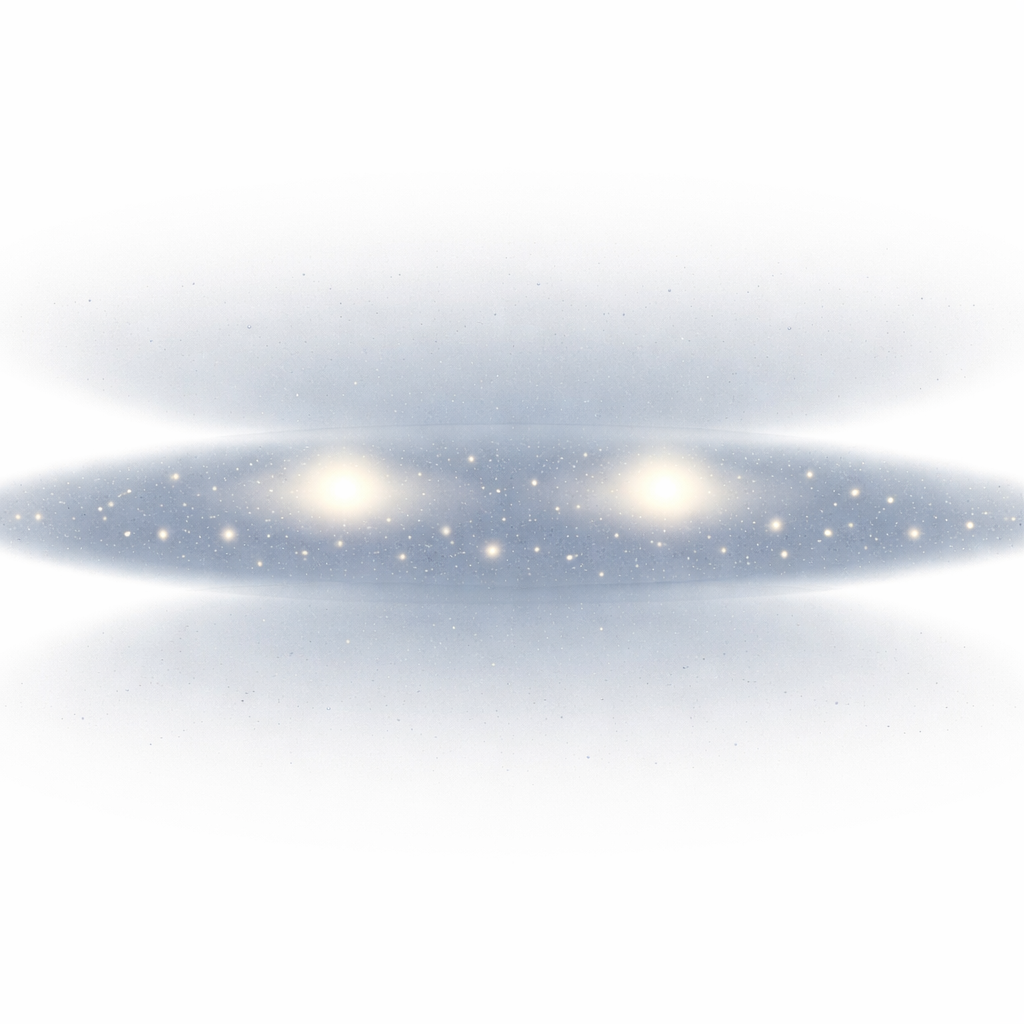
When the researchers examined the combined matter distribution in these simulations, a clear picture emerged: mass near the Local Group is not arranged like a roughly round ball, but like a flattened sheet extending at least 10 million light-years across. Within this plane, the density of matter is about twice the cosmic average, and it actually grows larger as one moves several million light-years away from the Local Group. Above and below the sheet lie deep, underdense regions—cosmic voids—where matter is only about a quarter to a third of the average density. This arrangement closely mirrors known features traced by visible galaxies, such as the so-called Local Sheet and the nearby voids, showing that the glow of galaxies does broadly track where the hidden dark matter lies on these scales.
How a Flat Mass Layout Calms the Cosmic Flow
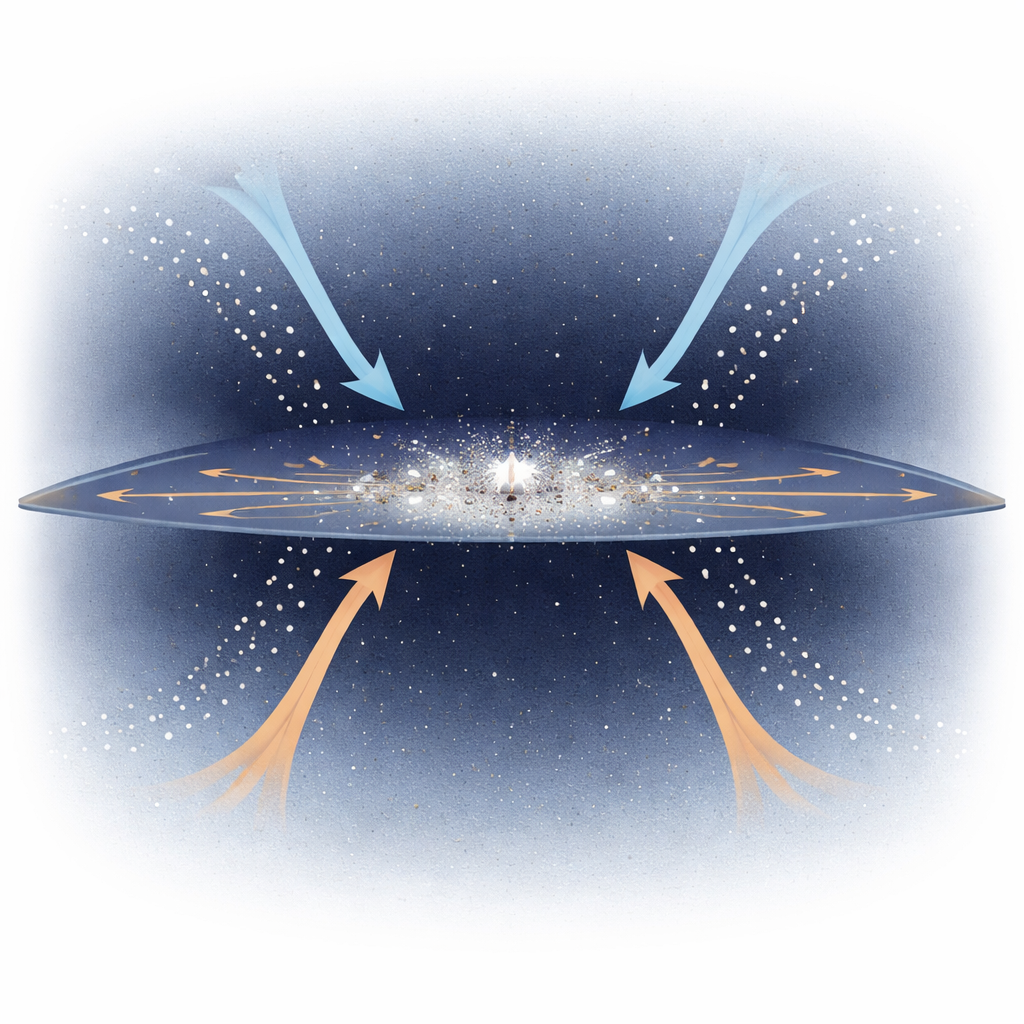
This sheet-like geometry turns out to be the key to the puzzle of the quiet local expansion. In a spherical mass distribution, the pull on a galaxy at a given distance depends almost entirely on how much mass lies inside its orbit. Adding more matter anywhere nearby would only increase the inward pull and disturb the Hubble flow more strongly. In a flat sheet, however, matter located farther out in the plane exerts sideways forces that partly cancel the inward pull on galaxies closer to the center. The simulations show that galaxies above and below the sheet fall strongly toward it, while those inside the sheet drift only gently toward the Local Group within about 2.5 megaparsecs and are actually pushed outward at larger distances. Overall, the random motions stay very small, even smaller than what observations have hinted, yet the total mass of the Milky Way and Andromeda remains high and consistent with timing estimates.
What This Means for Our Place in the Universe
This work demonstrates that there is no need to abandon the standard picture of a Universe filled with cold dark matter and dark energy to explain the calm Hubble flow around us. The apparent clash between heavy galaxy halos and gentle local expansion disappears once we recognize that the mass around the Local Group is shaped like a thin, extended sheet flanked by large voids, rather than a sphere. The authors predict that motions should be strongly directional, with particularly fast infall from the underdense regions above and below the sheet—an effect that has barely been tested because few known galaxies trace these high-latitude regions nearby. Discovering more small, isolated galaxies in those directions will provide a crucial check on this newly revealed architecture of our cosmic home.
Citation: Wempe, E., White, S.D.M., Helmi, A. et al. The mass distribution in and around the Local Group. Nat Astron 10, 548–553 (2026). https://doi.org/10.1038/s41550-025-02770-w
Keywords: Local Group, dark matter, cosmic web, Hubble flow, galaxy dynamics