Clear Sky Science · en
Elucidating the role of salinity in regulating gypsum scaling in reverse osmosis and nanofiltration
Why salty water and hidden crystals matter
As communities turn to seawater and salty waste streams for drinking water and reuse, advanced membranes help strip out salt with relatively low energy use. Yet these filters can quietly clog when invisible minerals crystallize on their surfaces, cutting water production and driving up costs. This study asks a deceptively simple question with big practical stakes: how does the overall saltiness of the water itself change the way troublesome gypsum crystals form and grow on reverse osmosis and nanofiltration membranes?
Salt, membranes, and stubborn gypsum scale
Reverse osmosis and nanofiltration push water through thin polymer films that hold back most dissolved salts. When the concentrations of calcium and sulfate rise too high, they combine to form gypsum crystals that attach to the membrane, a process known as scaling. Previous work showed that adding background salt like sodium chloride could delay gypsum formation in simple beakers, but it was not clear whether this came from changes in crystal-making chemistry, crystal growth speed, or both, nor how it would play out on the busy surface of a working desalination membrane.
Watching crystals appear in still salty water
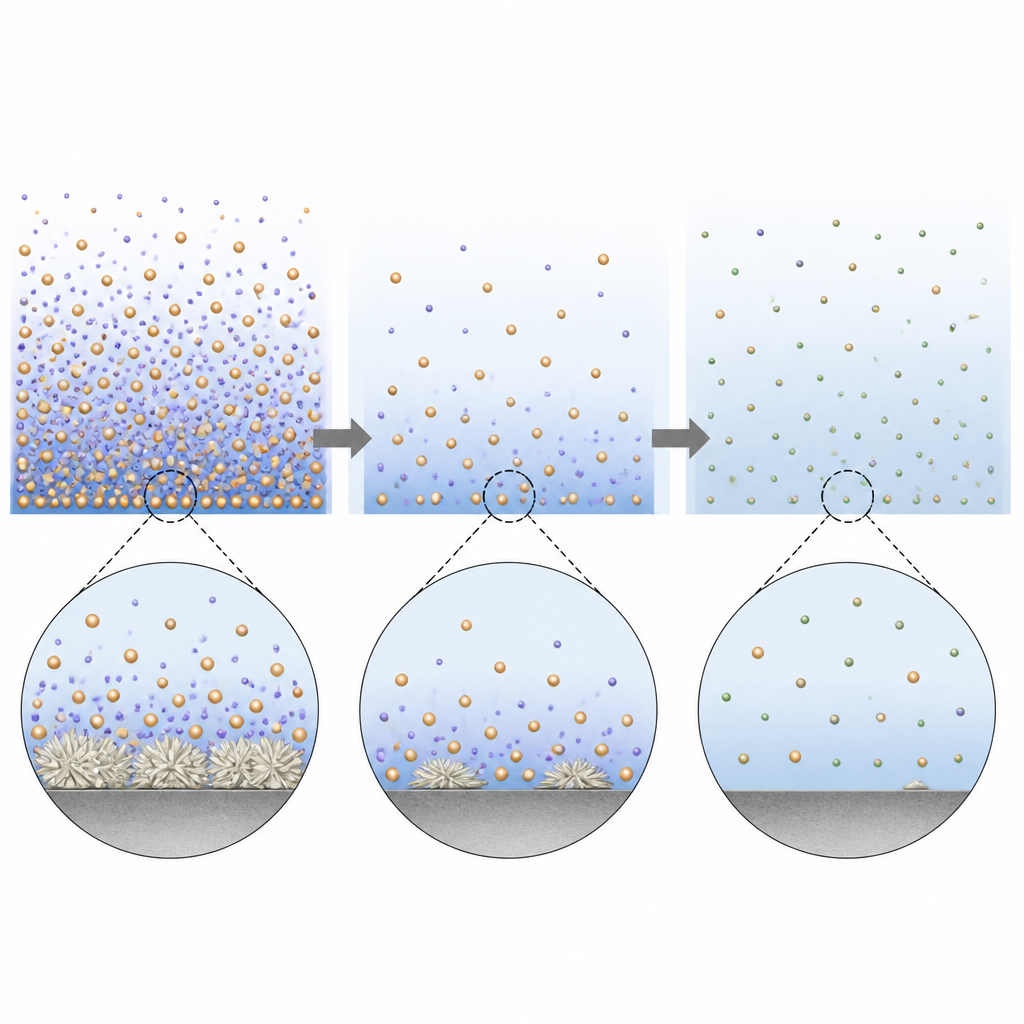
The researchers first explored gypsum formation in quiet, well mixed solutions with different levels of sodium chloride. They tracked how long it took before crystals began to form, using changes in electrical conductivity as a simple signal. As the saltiness increased, the wait for crystal appearance grew longer, showing that higher salinity slows the first steps of gypsum formation. Microscopy and X ray tests revealed that the crystals that eventually formed looked and behaved much the same across all salt levels, suggesting that the shapes and internal structures of the crystals were largely unchanged. Careful analysis using classical crystal formation theory showed that the energy hurdle and the basic collision rate for forming new crystals did not shift with salinity. Instead, extra salt reduced the “effective strength” of calcium and sulfate in solution, lowering the tendency for them to come together in the first place.
Scaling on working membranes under flowing water
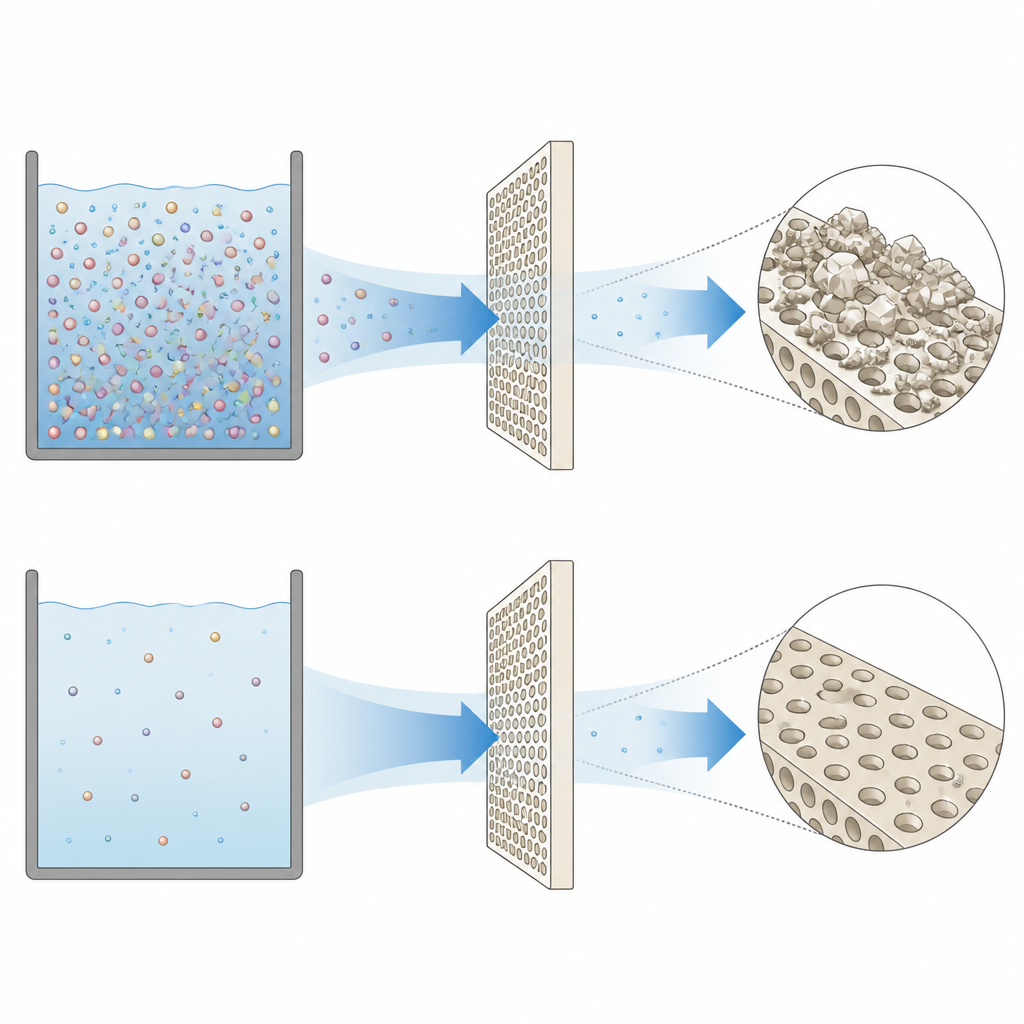
The team then moved from still beakers to flowing membrane cells that better mimic real desalination plants. They fed the systems water containing gypsum forming ingredients, with and without added sodium chloride, and watched how water flow through the membranes dropped over many hours. In every case the flow rate decreased as gypsum built up, but the decline was much slower when the background salt level was higher. Images of the used membranes confirmed less crystal coverage at higher salinity. Importantly, this pattern held across several commercial membranes that allowed water and different ions to pass at different rates, and also for modified versions of one membrane whose transport properties had been tuned while keeping surface texture similar.
How membrane traits and saltiness work together
To connect these observations, the authors calculated a “saturation level at the membrane surface” that reflects how concentrated the gypsum forming ions become right where water enters the membrane. This value depends on how strongly the membrane rejects each ion, how much background salt is present, and how much the flowing water concentrates solutes near the surface. Across all the varied tests, from different salt levels to different membrane types, this single surface saturation measure showed a strong linear link with how much the water flow declined. Membranes that allowed more background salt to pass could lower local saltiness, which might favor scaling, but if they also let more calcium and sulfate slip through, the build up of gypsum forming ions at the surface dropped and scaling eased. Surface roughness created additional twists by affecting how easily crystals attached or detached, but the surface saturation level still served as a reliable indicator of overall scaling severity.
What this means for cleaner water
For non specialists, the key message is that it is not just how salty the incoming water is that matters, but how that saltiness reshapes the microscopic chemistry right at the membrane surface. Higher background salt can actually help slow gypsum buildup by softening the driving force for new crystals, as long as membrane properties and operating conditions keep surface saturation in check. By focusing on the saturation level at the water membrane interface, engineers can better predict when and where gypsum will clog desalination systems, and design membranes and operating strategies that keep clean water flowing longer between cleanings.
Citation: Park, S., Tian, Y., Lee, H.K. et al. Elucidating the role of salinity in regulating gypsum scaling in reverse osmosis and nanofiltration. npj Clean Water 9, 43 (2026). https://doi.org/10.1038/s41545-026-00575-6
Keywords: desalination, reverse osmosis, membrane scaling, gypsum, salinity