Clear Sky Science · en
Haloalkaliphilic archaea-mediated green synthesis of superparamagnetic Fe₃O₄ nanoparticles for electrochemical detection of ibuprofen in saline environments
Why medicine in salty water matters
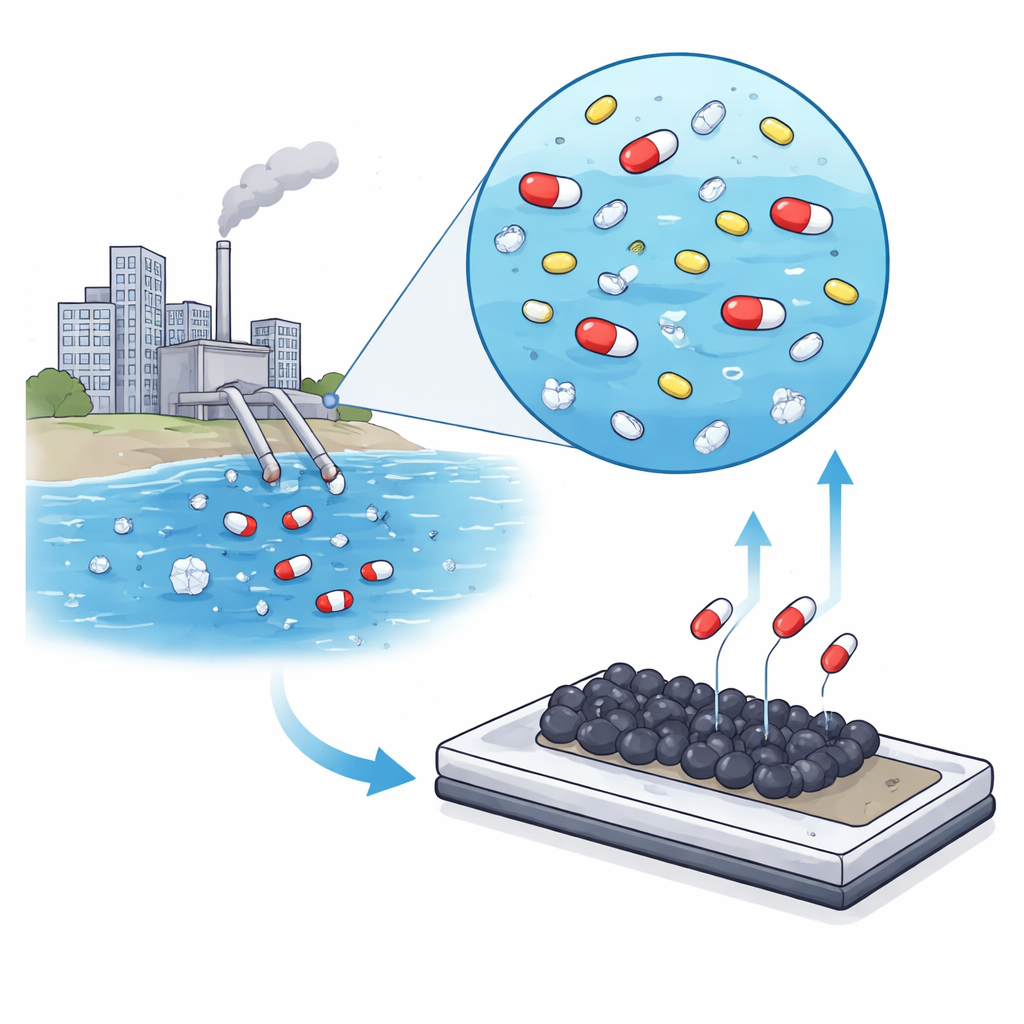
Many of the pills we take do not vanish after healing our aches. Traces of drugs such as the painkiller ibuprofen pass through our bodies and end up in rivers, lakes, and even drinking water. Conventional testing methods to track these residues are accurate but expensive, slow, and often require large laboratory instruments. This study explores an unusual ally in the quest for cleaner water: salt‑loving microbes that can build tiny magnetic particles able to help quickly sense ibuprofen in harsh, salty environments.
Invisible pills in everyday water
Ibuprofen belongs to a widely used class of painkillers that remain biologically active at very low levels. Because people take them so often, wastewater treatment plants continuously receive small amounts, creating a steady background of contamination in surface waters and sometimes groundwater. Over time, these residues can harm aquatic life and may work their way up the food chain. Traditional detection tools, like high‑performance liquid chromatography and mass spectrometry, can measure ibuprofen precisely but require costly machines, trained staff, and toxic solvents. This makes it difficult to monitor many sites frequently or in real time, especially in remote or resource‑limited regions.
Salt‑loving microbes as tiny factories
The researchers turned to haloalkaliphilic archaea, microorganisms that thrive in extremely salty, alkaline lakes where most life would struggle. From Egypt’s El‑Hamra Lake, they isolated dozens of such microbes and selected two strains, called RA5 and A6, that could turn dissolved iron into magnetite (Fe₃O₄) nanoparticles. By simply mixing each strain’s cell‑free broth with iron salts under mild conditions, the team obtained black magnetic particles that could be pulled with a magnet. Detailed imaging and spectroscopy showed that both strains produced very small, superparamagnetic crystals—so tiny they behave like individual magnetic switches—yet the particles’ surfaces differed depending on the microbe that built them.
Two flavors of magnetic nano‑sensors
Nanoparticles from strain RA5 were more crystalline and formed compact clusters with relatively clean surfaces. In contrast, A6 produced slightly smaller particles wrapped in a thicker “organic corona” made of proteins and sugars. This natural coating prevented clumping and offered many chemical groups for binding molecules. When the particles were deposited onto electrodes to create sensing surfaces, these differences mattered. RA5‑based electrodes excelled at shuttling electrons, thanks to their ordered crystal structure and stronger magnetization. A6‑based electrodes, with their richer organic shells, captured ibuprofen more readily from salty water. Electrochemical tests in salty solutions containing 0–100 milligrams of ibuprofen per liter showed that both sensors responded reliably over this wide range, with sensitivities on the order of a few microamperes per milligram per liter and detection limits close to 1 milligram per liter.
How the sensing process unfolds
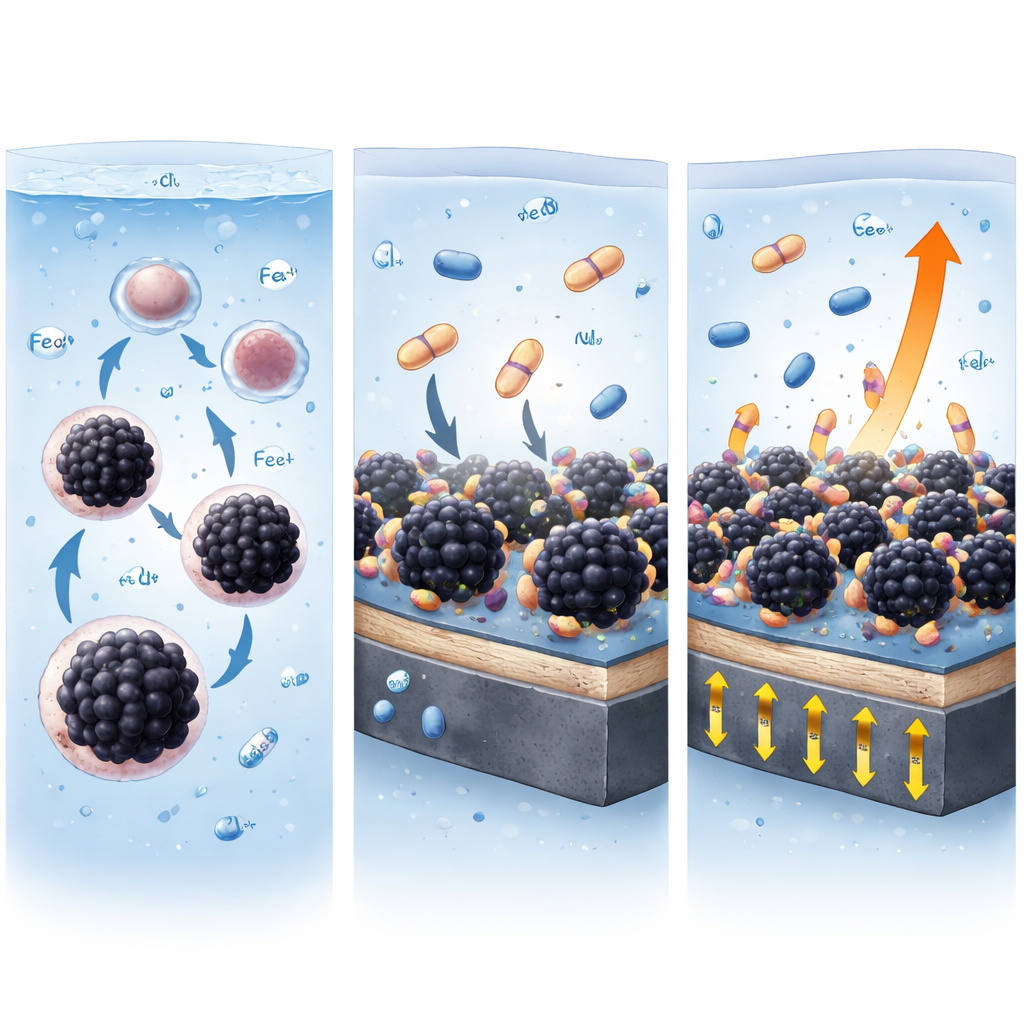
The team proposes that sensing unfolds in two tightly linked steps. First, ibuprofen molecules in the salty water are drawn onto the nanoparticle surfaces by the natural organic corona, which provides hooks such as hydroxyl, amide, and sugar groups. This step concentrates the drug at the electrode. Second, once ibuprofen is anchored, electrons are exchanged between the drug and the magnetite core, and then flow through the particle network into the electrode, producing a measurable electrical signal. Mathematical analysis of the current–concentration data showed that a so‑called second‑order kinetic model best describes the process, meaning that the rate is controlled mainly by surface reactions and electron transfer rather than slow diffusion in the water.
What this means for cleaner water
In simple terms, this work shows that hardy microbes from extreme lakes can act as eco‑friendly factories for building high‑performance magnetic nano‑sensors. By choosing the right strain, scientists can favor either faster electron flow (RA5) or stronger pollutant binding (A6), and potentially fine‑tune sensors for specific tasks. While the current devices detect ibuprofen at relatively high concentrations and still need real‑world testing, they already operate in salty conditions that challenge many other materials. This microbe‑powered approach points toward portable, greener tools for tracking drug pollution and supporting clean water efforts in line with global sustainability goals.
Citation: Hegazy, G.E., Oraby, H., Elnouby, M. et al. Haloalkaliphilic archaea-mediated green synthesis of superparamagnetic Fe₃O₄ nanoparticles for electrochemical detection of ibuprofen in saline environments. npj Clean Water 9, 30 (2026). https://doi.org/10.1038/s41545-026-00569-4
Keywords: ibuprofen pollution, electrochemical sensor, magnetite nanoparticles, extremophile archaea, water quality monitoring