Clear Sky Science · en
Perfluoroalkyl chain-length-dependent environmental fate and treatment outcomes of PFAS in water
Why These “Forever Chemicals” Matter to You
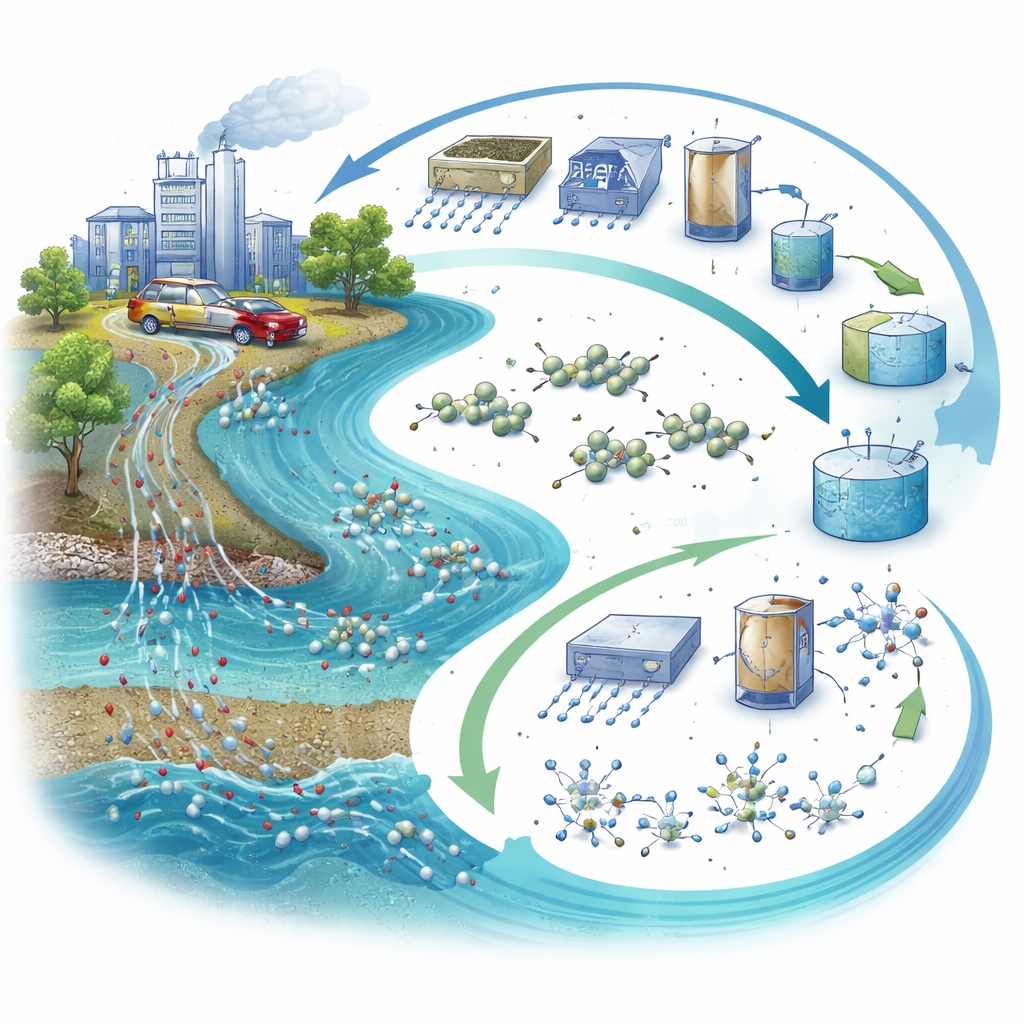
Per- and polyfluoroalkyl substances, or PFAS, are often called “forever chemicals” because they do not break down easily. They are used in non-stick pans, stain-resistant fabrics, firefighting foams, and many other products. As a result, PFAS now appear in drinking water, rivers, soils, wildlife, and even human blood. This article explains why some PFAS behave differently from others depending on the length of their fluorinated “tails,” and how that difference affects where they travel in the environment, how they build up in living things, and how well we can remove them from water.
Two Families of the Same Chemical Clan
PFAS are a large family of man-made chemicals that share a common architecture: a carbon chain fully or partly wrapped in fluorine atoms, ending in an acidic “head” group. The review focuses on a key feature of this chain—the number of carbon atoms, or chain length. Short-chain PFAS have only a few carbons; long-chain PFAS have many more. That simple structural difference changes how bulky, water-repelling, and flexible the molecules are. Longer chains create a larger, oil-like surface that shuns water, sticks more strongly to organic matter, and interacts more tightly with proteins in blood and tissues. Shorter chains, by contrast, are more water-loving and stay dissolved more easily.
How Chain Length Shapes Movement in Nature
Chain length controls where PFAS end up in lakes, rivers, and groundwater. Because they are more soluble and less sticky, short-chain PFAS tend to remain in the water itself and move quickly with flowing currents. Field studies show that these shorter chemicals travel farther from pollution sources, such as sites where firefighting foam was used, and can dominate the dissolved PFAS found in urban water systems. Long-chain PFAS, with their stronger attraction to sediments and organic-rich particles, are more likely to be held back in soils, riverbeds, and organisms. They move more slowly but can accumulate to higher levels in local environments rather than spreading as widely.
From Water into Wildlife and People
PFAS do not behave like familiar oily pollutants that hide in fat. Instead, many of them are “protein-loving”: they latch onto blood proteins and are recycled by the kidneys instead of being flushed out. The review shows that this tendency grows with chain length. Long-chain PFAS bind more strongly to proteins, stay longer in the body, and reach higher concentrations in fish and other animals. Measurements from freshwater and marine food webs reveal that long-chain PFAS, such as some well-known eight-carbon compounds, build up far more than their short-chain cousins. This means that even when long-chain PFAS are present at very low levels in water, they can still pose outsized risks through bioaccumulation and food consumption.
Why Long Chains Are Easier to Catch—and Break
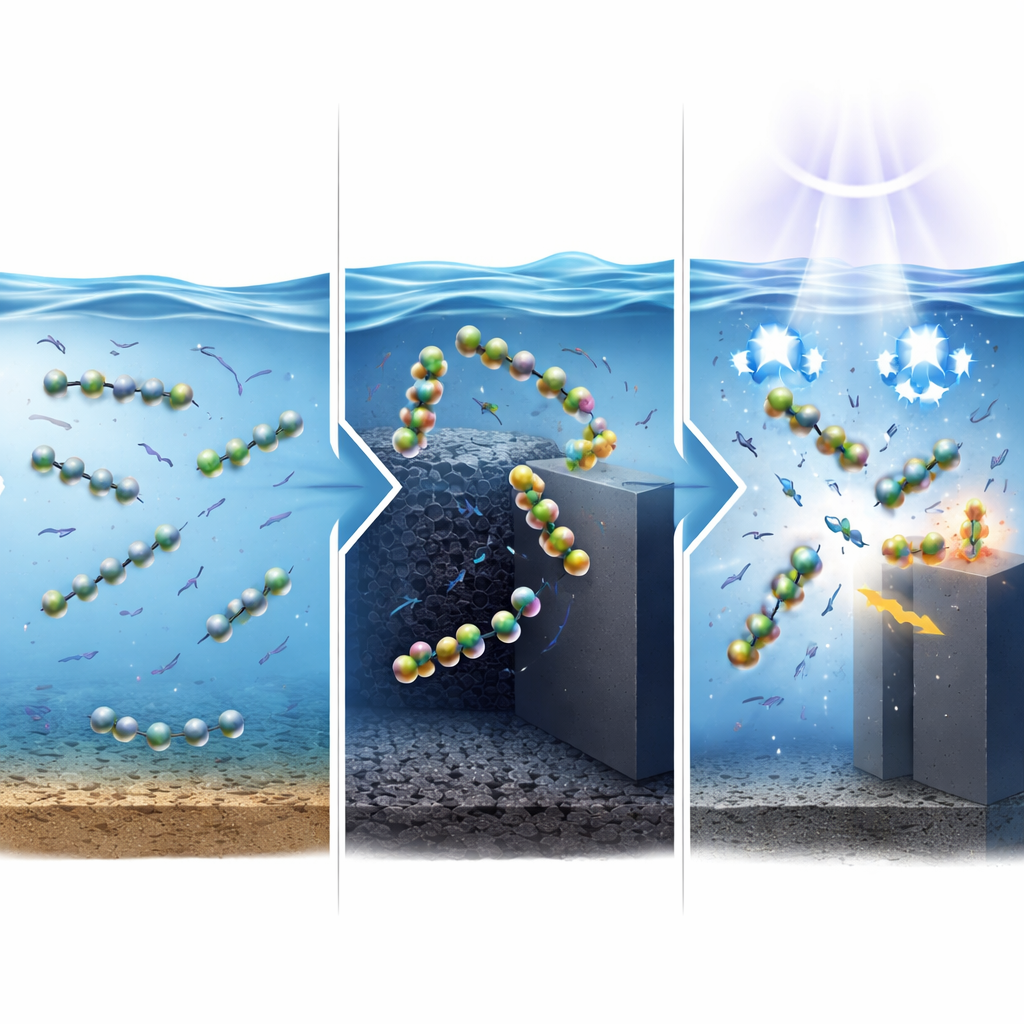
Water treatment plants use two broad strategies to deal with PFAS: pulling them out of water without changing them, or breaking them apart. In non-destructive methods—such as activated carbon filters, ion-exchange resins, and membranes—PFAS are captured on solid materials. Here, longer chains have the advantage from an engineering standpoint: their greater water-repelling character helps them stick to carbon surfaces and charged polymers, so they are removed more efficiently. Short-chain PFAS interact more weakly, slip through filters more readily, and are more sensitive to competition from other salts and organic matter, making them hard to capture at the very low concentrations found in real waters.
Zooming In on Destruction Pathways
Destructive treatments aim to do what nature struggles with: snap the strong carbon–fluorine bonds and reduce PFAS to harmless mineral forms. These approaches include intense ultraviolet light combined with chemical additives, high-temperature alkaline conditions, electrochemical systems, and plasma processes. The review highlights that longer-chain PFAS often degrade faster because they contain internal bond sites that are slightly weaker and easier to attack once electrons or reactive species are present. As they are chopped down, however, they frequently generate shorter-chain PFAS as intermediate products. These smaller fragments can be more stubborn, with fewer weak spots and less tendency to gather at reactive surfaces, so they may persist even when the parent chemicals are largely destroyed.
What This Means for Safer Water
Overall, the article concludes that the length of the fluorinated chain is a master control knob for PFAS: it shapes how these chemicals move through water and soil, how tightly they lodge in wildlife and humans, and how well different treatment methods can capture or destroy them. Current technologies tend to work best on long-chain PFAS, while the short-chain replacements that industry has turned to can slip through many defenses and resist breakdown. The authors argue that future water treatment and regulation must explicitly account for chain length, using predictive models and combined treatment trains that first concentrate PFAS and then destroy them. Only by designing solutions with these structural differences in mind can we move toward truly reducing the burden of “forever chemicals” in our drinking water.
Citation: Lee, YJ., Moon, G., Cha, H. et al. Perfluoroalkyl chain-length-dependent environmental fate and treatment outcomes of PFAS in water. npj Clean Water 9, 35 (2026). https://doi.org/10.1038/s41545-026-00568-5
Keywords: PFAS, drinking water treatment, forever chemicals, environmental contamination, short-chain versus long-chain PFAS