Clear Sky Science · en
Temporal insights into electromagnetic field-tuned scaling pathways of CaCO3 and CaSO4•2H2O during reverse osmosis desalination of real brackish water
Why this matters for clean drinking water
As communities turn to seawater and salty groundwater to ease water shortages, a quiet enemy lurks inside desalination plants: mineral scale. These rock-like deposits clog reverse osmosis (RO) membranes, cutting the flow of clean water and driving up energy and cleaning costs. This study explores a chemical-free helper—electromagnetic fields (EMFs)—and shows, in real brackish groundwater rather than simplified lab water, how EMFs can steer scale toward forms that are easier to remove and less harmful to long-term plant performance.
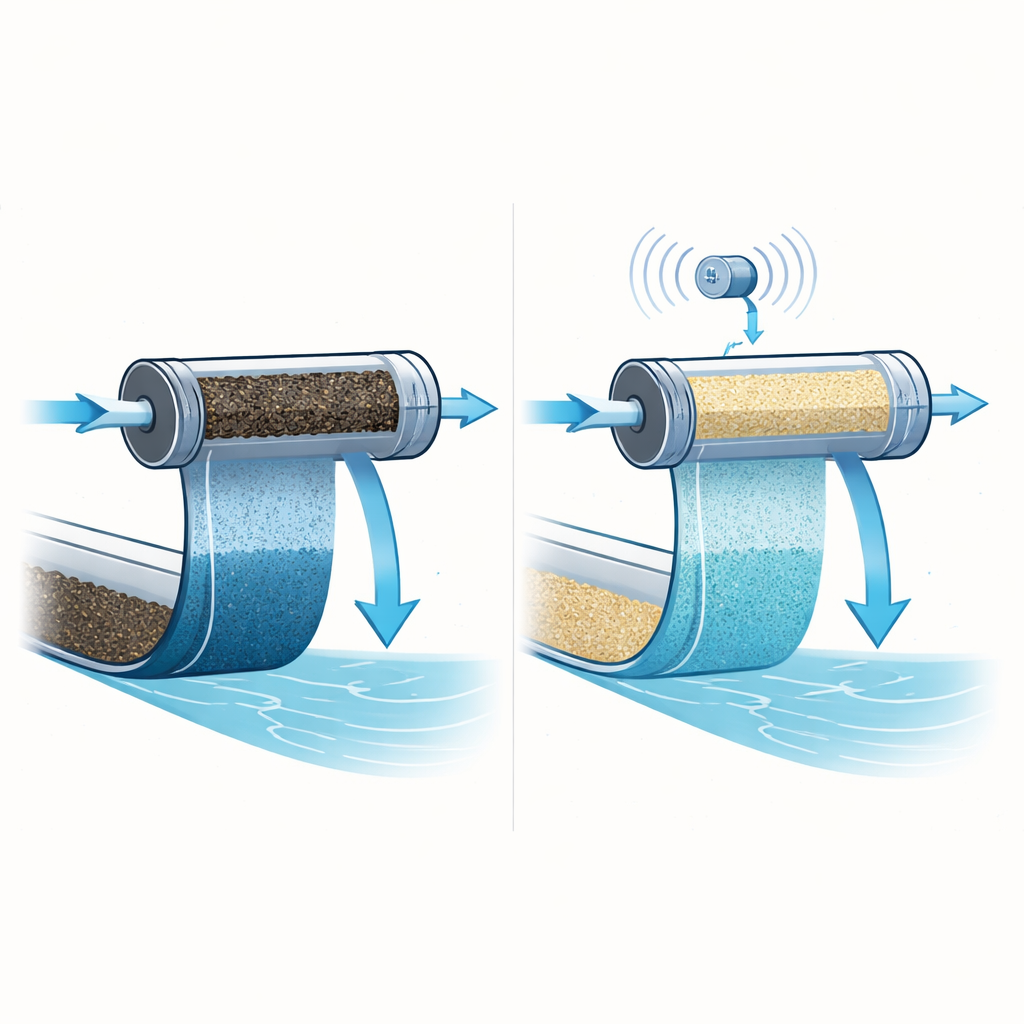
How salt and rock build up in desalination systems
RO plants work by forcing salty water through thin membranes that hold back most dissolved salts. Over time, some of those salts come out of solution as tiny crystals and grow into crusts on the membrane. Two of the most troublesome culprits are calcium carbonate (a limestone-like mineral) and gypsum (a form of calcium sulfate). They can form in the water itself or directly on the membrane surface, reducing water flow, weakening salt rejection, and shortening membrane life. Today, many plants rely on chemical additives to slow this process, which adds cost and can create new waste streams.
A non-chemical push: electromagnetic treatment
EMF devices expose flowing water to alternating electromagnetic fields just before it enters the RO modules. Earlier pilot studies suggested that EMFs could improve permeability and make scale easier to clean, but they left a key question unanswered: what exactly changes inside the water and on the membrane as scale forms over time? To answer this, the researchers ran RO experiments on real brackish groundwater rich in calcium, sulfate, carbonate, and magnesium. They stopped the runs at several water recovery levels, collected both the suspended particles in the concentrate stream and the deposits on membrane surfaces, and then examined them with electron microscopes, X-ray diffraction, and infrared spectroscopy.
Shaping scale into friendlier forms
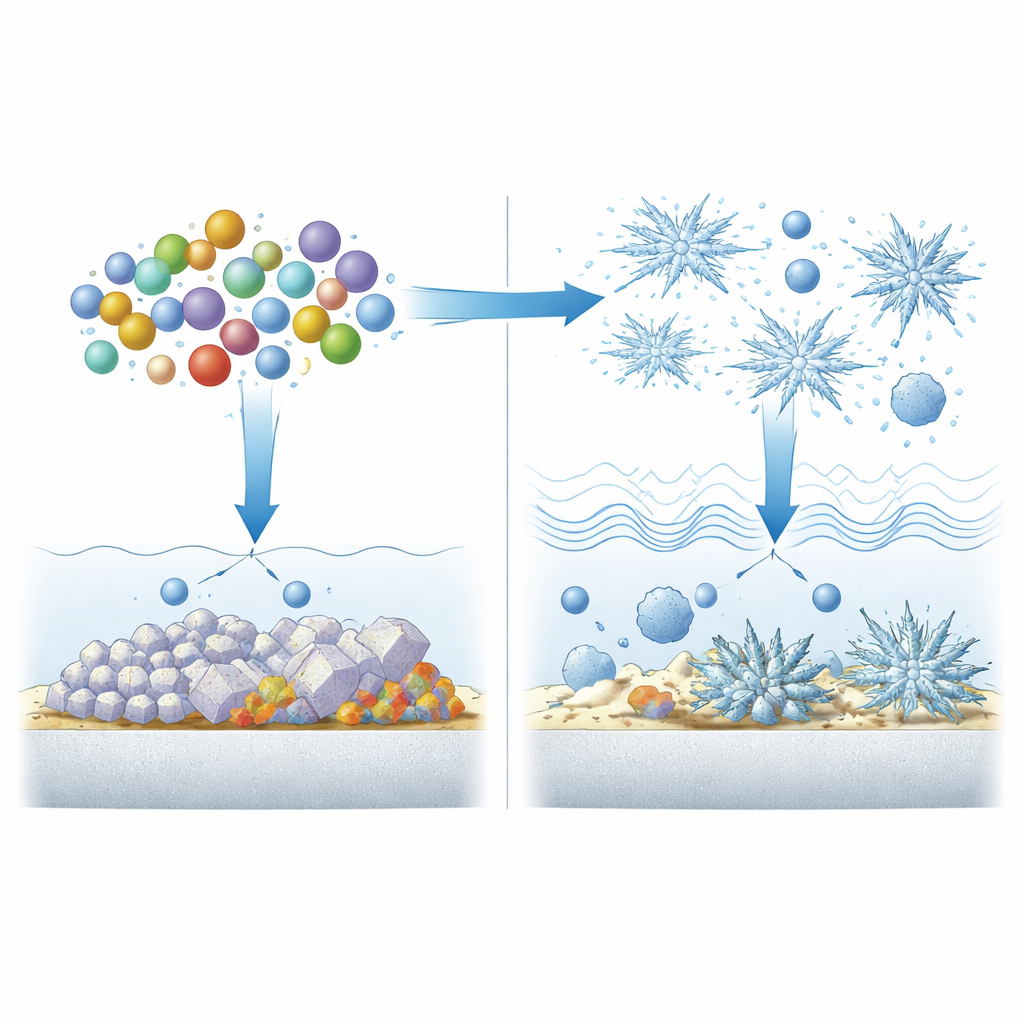
The team found that EMF treatment did not dramatically boost water flow during these short experiments, but it changed the kind of minerals that formed and where they formed. Without EMF, the water produced a mix of two calcium carbonate forms—aragonite and magnesium-rich calcite—followed by a strong shift to dense gypsum as the water became more concentrated. With EMF, scaling in the bulk water was dominated by needle-like aragonite clusters, while compact calcite was strongly suppressed and gypsum appeared later and in smaller, more porous crystals. In other words, EMF encouraged calcium carbonate to crystallize early and uniformly in the water, which used up calcium and delayed the conditions under which gypsum takes over.
Keeping damage off the membrane surface
Measurements of salt rejection showed that the membranes continued to remove over 96 percent of dissolved salts under all conditions, but EMF consistently nudged performance a bit higher, especially at higher recoveries where scaling risk is greatest. Chemical analysis revealed why: under EMF, more of the scaling minerals precipitated as loose particles in the flowing water, while fewer formed tightly attached crusts on the membrane—at least until very high concentration levels were reached. When gypsum finally did form on the membrane, its crystals were finer and more fragmented under EMF exposure, creating a fluffier, more weakly bound layer. Spectroscopic evidence indicated that EMF slightly disrupted hydrogen bonds in the gypsum structure, helping explain why the deposits became more porous and easier to dislodge.
What this means for future desalination plants
For operators and communities depending on RO for drinking water, the study’s main message is that EMF treatment acts less like an on–off switch for scaling and more like a sculptor. It steers calcium carbonate toward aragonite, keeps troublesome magnesium from locking into hard calcite, and postpones the onset of stubborn gypsum crusts. The resulting scale layers are more uniform, looser, and more responsive to routine hydraulic flushing and mild chemical cleaning. Over months or years of operation, this could translate into fewer aggressive cleanings, lower chemical use, longer membrane life, and improved prospects for recovering useful minerals from brines—all without adding new chemicals to the process.
Citation: Du, X., Perera, H., Ranasinghe, T. et al. Temporal insights into electromagnetic field-tuned scaling pathways of CaCO3 and CaSO4•2H2O during reverse osmosis desalination of real brackish water. npj Clean Water 9, 37 (2026). https://doi.org/10.1038/s41545-026-00565-8
Keywords: reverse osmosis, electromagnetic water treatment, mineral scaling, brackish groundwater, desalination membranes