Clear Sky Science · en
Structural insight into the assembly and D antigenicity of polio type 1 stabilized virus-like particles
Why a stronger polio shot still matters
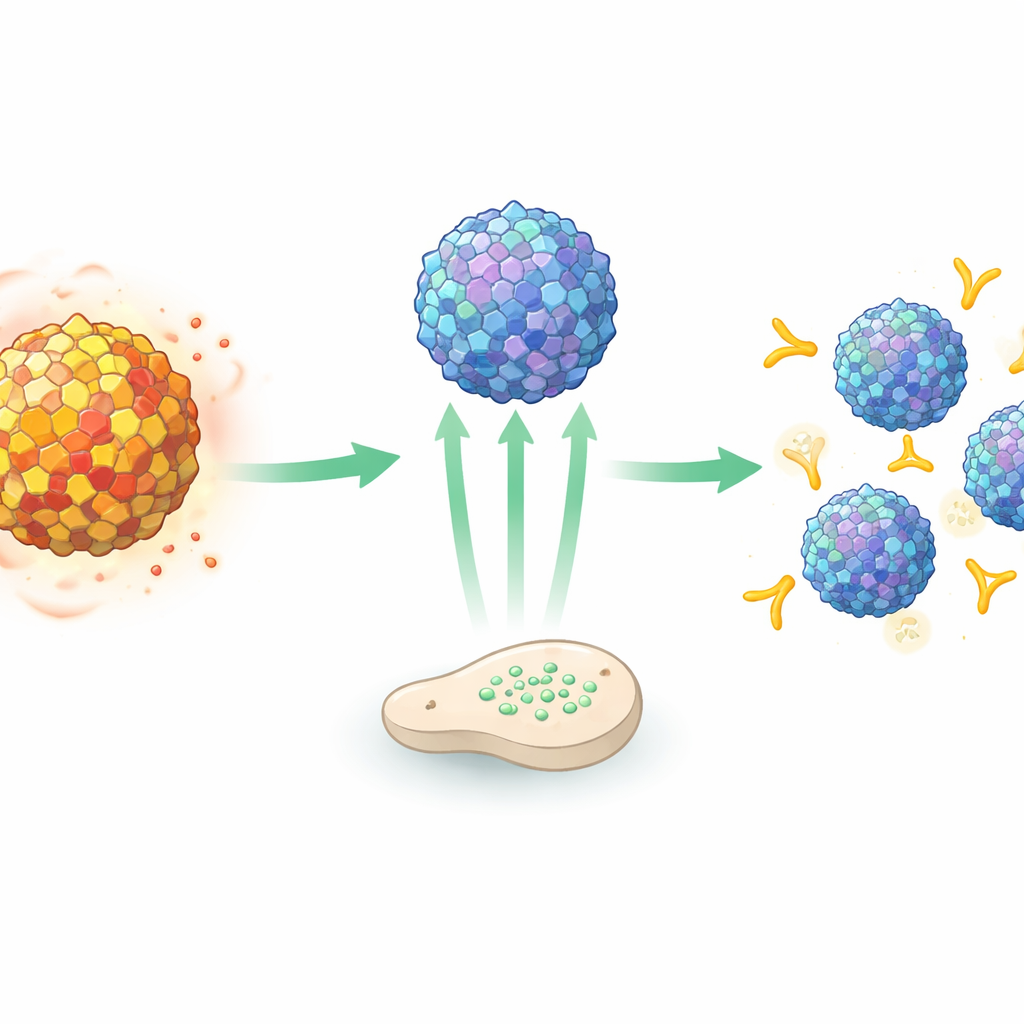
Even as the world edges closer to wiping out polio, making and monitoring safe vaccines remains tricky. Today’s polio shots are effective, but they either rely on weakened live virus that can very rarely revert and cause disease, or on killed virus that must be grown in large, highly secure factories. This study describes a safer alternative: empty, non-infectious shells of the virus that look real enough to train the immune system, and reveals at atomic detail how to build and check these shells so they stay in the most protective shape.
Building a harmless stand-in for polio
The team focused on poliovirus type 1, one of the three types that can cause paralysis. Instead of handling complete viruses, they used yeast cells to produce only the outer shell proteins, which then self-assembled into virus-like particles, or VLPs. These particles contain no genetic material and cannot replicate, but they mimic the virus surface that antibodies see. The researchers made two versions: one based on the normal virus, and one carrying seven carefully chosen changes that were previously shown to make empty shells more heat-resistant. Electron microscopy confirmed that both versions formed neat, spherical particles about 30 nanometers across.
Locking the shell in its protective pose
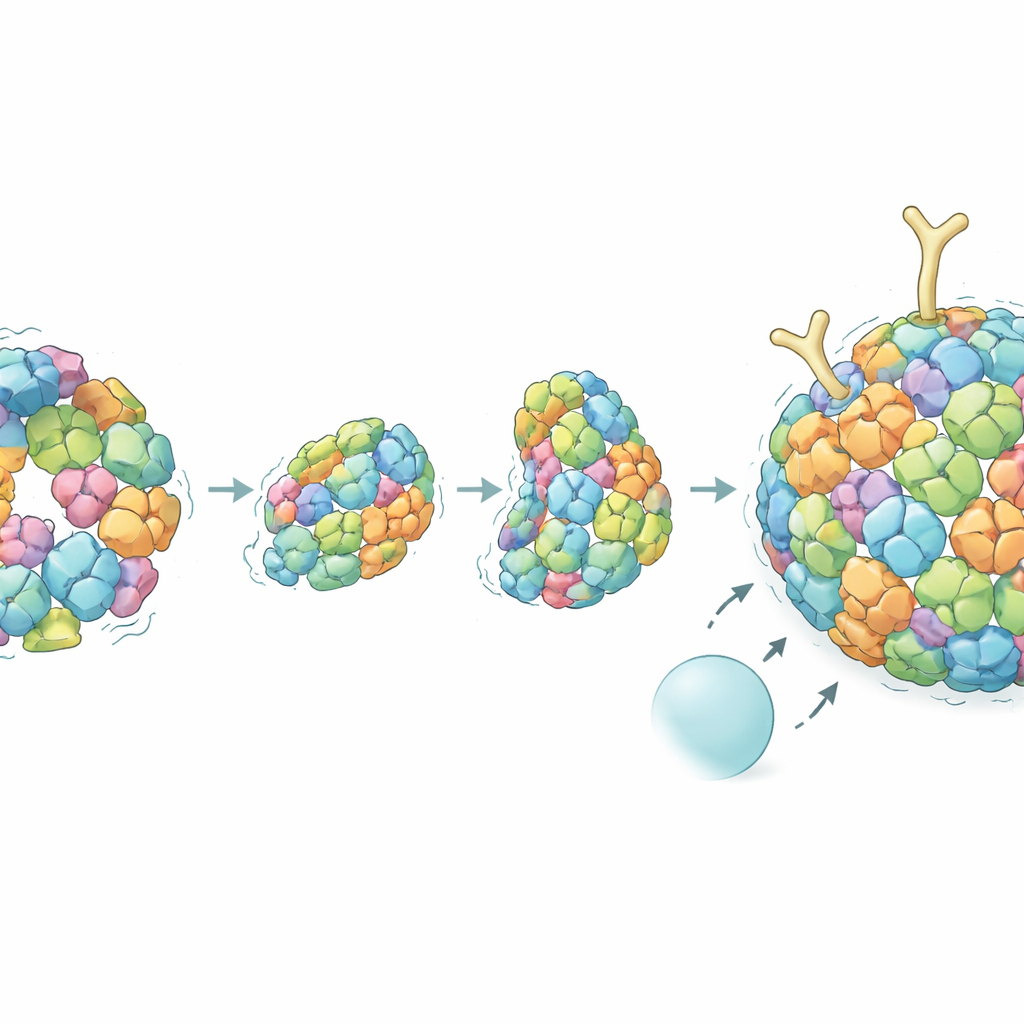
A key challenge is that polio shells naturally tend to “breathe” and can flip from a tight, protective form (called D antigen) into a floppier, expanded form (C antigen) that no longer triggers strong immunity. Using cryo–electron microscopy at near-atomic resolution, the scientists compared the unstable and stabilized particles. The standard VLP resembled an expanded, open shell with a visible channel running through it, matching a known non-protective form of poliovirus. In contrast, the stabilized VLP was slightly smaller and more compact, with the channel sealed and several surface loops held rigid. The seven mutations tightened how protein subunits pack together, especially around a pocket in one protein and at junctions where three subunits meet, effectively “locking” the shell into the D-antigen shape that vaccines need.
Testing immune responses in animals
The researchers then asked whether these design tweaks mattered in living animals. Mice received injections of either the normal VLPs, the stabilized VLPs, a standard inactivated polio vaccine, or a salt solution. Only the stabilized particles produced strong neutralizing antibodies—those that can actually prevent virus infection. After three doses, every mouse given the stabilized VLPs developed higher average neutralizing levels than mice given a half human dose of licensed vaccine, while the normal VLPs failed to generate detectable neutralization. Heat tests showed that the protective D-antigen shape of the stabilized particles remained intact up to around 40 °C, but dropped sharply above 45 °C, defining the practical stability window for vaccine storage and transport.
A molecular watchdog for vaccine quality
To ensure that future VLP-based vaccines really present the correct protective shape, the team also created and analyzed new mouse antibodies that recognize poliovirus shells. One antibody, dubbed 3G10, bound only to the stabilized, protective form and strongly neutralized both vaccine and wild-type strains. A high-resolution structure of 3G10 attached to the stabilized VLP revealed that it nestles into a groove known as the “canyon,” gripping several loops on the virus surface. This footprint almost completely overlaps the docking site for the virus’s natural cell receptor. In other words, when 3G10 is bound, the virus can no longer latch onto cells, explaining its potent neutralizing power. Because the key contact points are identical in multiple type 1 strains, 3G10 can also serve as a precise reagent in lab tests that quantify the amount of true D antigen in both experimental and existing vaccines.
What this means for future polio vaccines
Taken together, the work delivers a detailed blueprint for a safer, next-generation polio type 1 vaccine based on sturdy, non-infectious shells produced efficiently in yeast. By showing exactly how stabilizing changes reshape the particle and how a protective antibody recognizes that shape, the study points the way to reliable manufacturing and strict quality control without ever growing live poliovirus. The same principles could be extended to other types of polio and related gut viruses, helping the world maintain polio-free status with vaccines that are both secure to produce and finely tuned to trigger the right kind of immunity.
Citation: Hong, Q., Chen, T., Han, W. et al. Structural insight into the assembly and D antigenicity of polio type 1 stabilized virus-like particles. npj Vaccines 11, 79 (2026). https://doi.org/10.1038/s41541-026-01404-0
Keywords: poliovirus vaccine, virus-like particles, vaccine stability, monoclonal antibody, cryo-EM structure