Clear Sky Science · en
Decoding cellular population dynamics through mechanistic modelling and statistical data analysis
How Cells Talk and Why It Matters
Our bodies are made of countless cells that must talk to each other to build tissues, fight infections, and sometimes fuel diseases like cancer. Today, powerful tools can read the activity of thousands of individual cells at once, but turning this flood of information into clear stories about how cells communicate is difficult. This article explains how scientists combine experiments with mathematical models to follow crowds of cells over time, uncover hidden rules in their conversations, and move beyond oversimplified views of biology as calm and unchanging.
From Messy Measurements to Clear Pictures
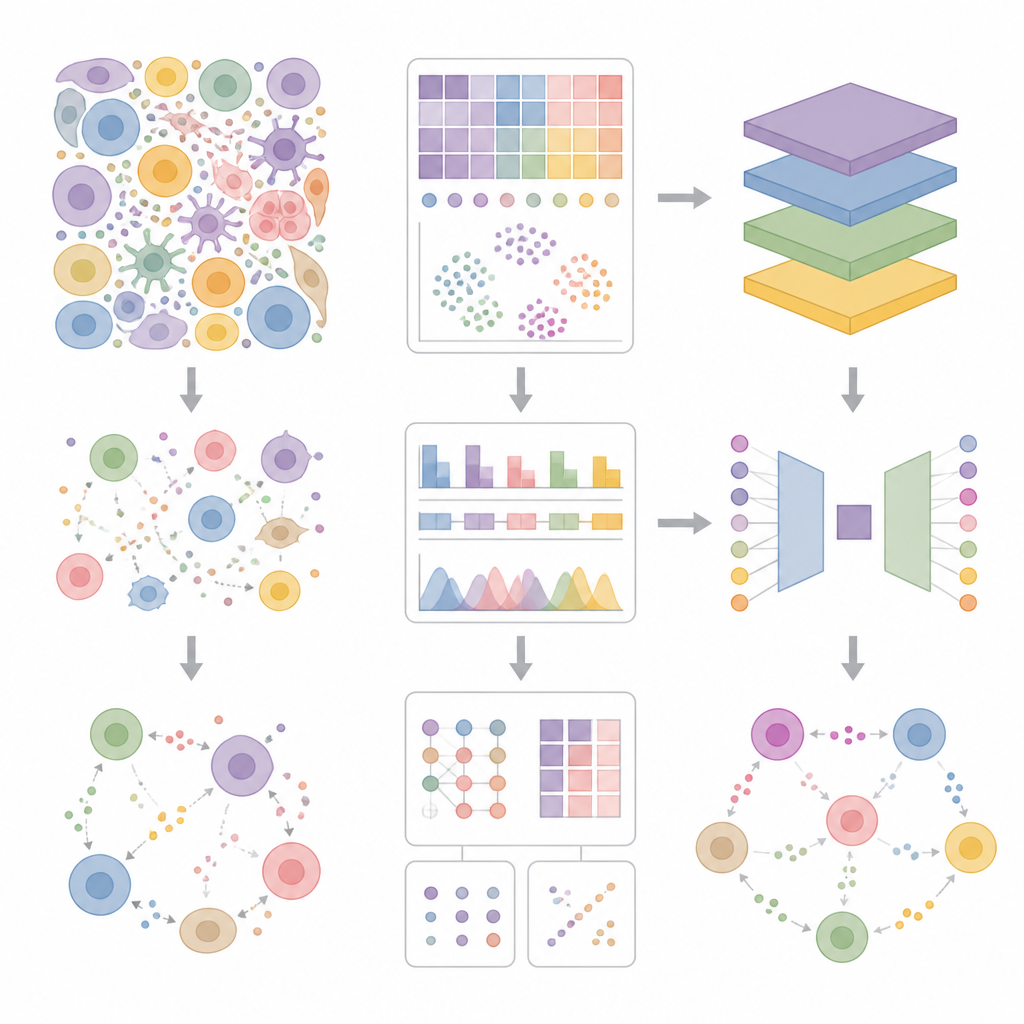
Modern instruments can measure which genes and proteins are active in each cell and where those cells sit inside tissues. These snapshots, taken across space and time, reveal many cell types and states but do not automatically explain how signals flow between them. To bridge this gap, researchers use data analysis methods that compress the information into easier-to-read maps, trace cell development paths, and link observed states to the underlying processes that move cells from one state to another. Such approaches have helped describe how immune cells mature, how they respond to infections, and how cells in developing embryos choose their future roles.
Why Mathematics Joins the Conversation
Experiments show what is happening, but they rarely explain why. Mathematical models turn ideas about cell behavior into precise rules that can be simulated and tested. At simple levels, these rules describe how the average number of cells or molecules changes over time; more advanced versions consider random differences between cells and how signals spread through space. By comparing model outputs with data, scientists can identify key feedback loops, such as circuits that cause signals to pulse or switch suddenly, and can test which designs make immune responses stable, flexible, or prone to failure. When models match data, they sharpen our understanding; when they do not, they point to missing pieces in our picture of cell communication.
Following Cells in a Changing World
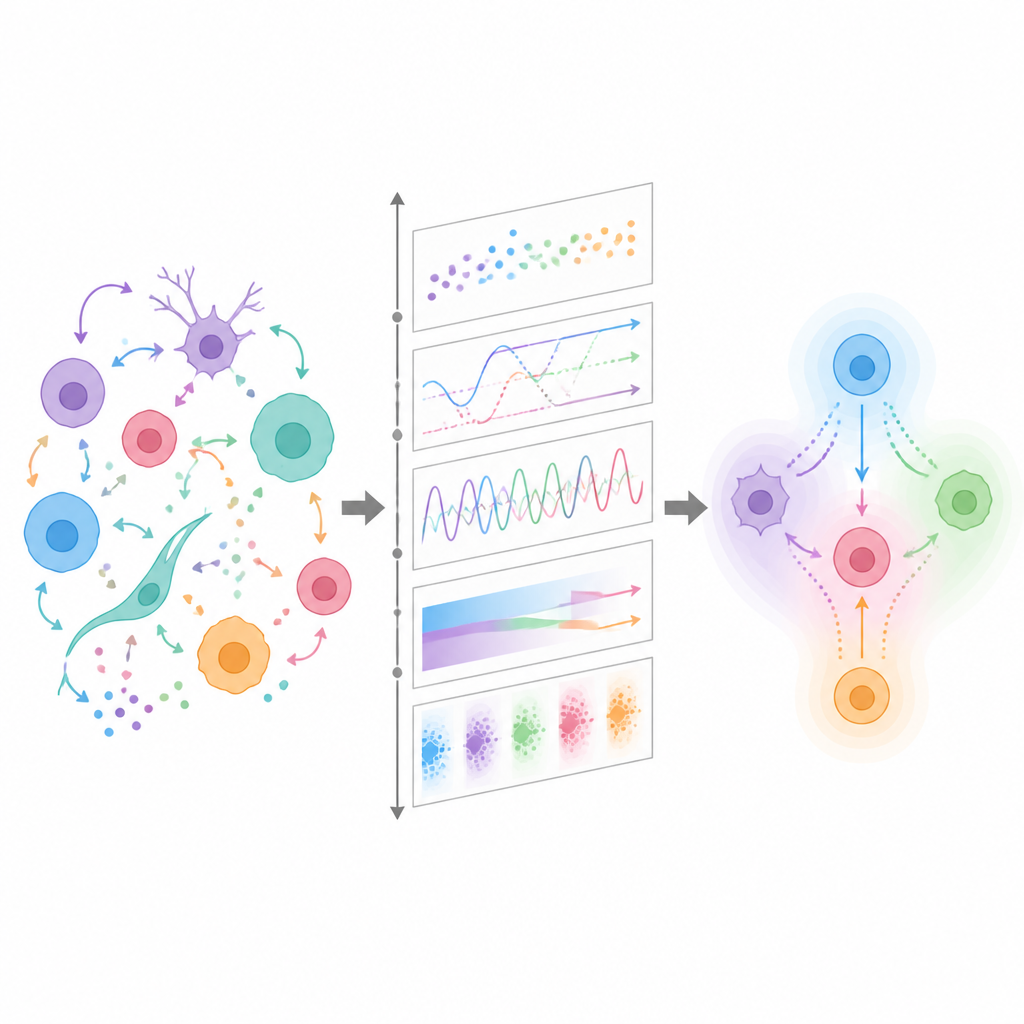
Many classic models treat tissues as if they eventually settle into a steady, unchanging state. The article argues that this view is often too simple. In real tissues, signals rise and fall, cells move and divide, and delays inside cells create memory-like effects. New modelling strategies therefore allow for long-lasting transients, delays, and spatial patterns, all of which can shape how cells respond to changing conditions. For example, models that incorporate realistic waiting times for gene activity can link single-cell behavior to population trends, while spatiotemporal models reveal how uneven clouds of immune signals form and influence which cells become activated or stay quiet.
Uniting Space, Time, and Chance
The review highlights how scientists are beginning to combine several layers of complexity in one framework: the randomness of single cells, the spread of signals through tissue, and the motion and division of cells themselves. In studies of infections, cancer, and development, such integrated models have been used to explain why patients vary in disease course, to test potential treatment schedules on virtual patients, and to explore how the local neighborhood of a cell affects its fate. New imaging tools and synthetic signaling systems now make it possible to track who talks to whom in living tissues, providing rich material for models that in turn guide more focused experiments.
Rethinking the Dance Between Data and Theory
Rather than treating experiments and models as separate steps, the authors argue that the most progress comes when they evolve together. They offer practical advice for how experimentalists and theorists can jointly frame questions, choose which details to include in a model, design informative experiments, and interpret mismatches between predictions and reality. Working in cycles from simple to more refined models helps identify which mechanisms are truly essential, instead of building unnecessarily complicated descriptions that are hard to test or understand.
What This Means for Future Biology
In plain terms, the article concludes that mathematical modelling is becoming a standard part of biology, not a niche specialty. By weaving models together with machine learning, spatial and single-cell measurements, and live imaging, researchers can turn complex datasets into useful, testable insights about how cell communities behave. This integrated approach does not just replay what has already been seen; it can suggest new experiments and potential treatment strategies. For lay readers, the key message is that understanding how vast populations of cells talk, adapt, and sometimes misbehave increasingly relies on the partnership between careful measurements and well-crafted mathematical stories.
Citation: Alachkar, N., Opoku, N.KD.O., Monk, N.A.M. et al. Decoding cellular population dynamics through mechanistic modelling and statistical data analysis. npj Syst Biol Appl 12, 73 (2026). https://doi.org/10.1038/s41540-026-00751-x
Keywords: cell-cell communication, mathematical modeling, single-cell data, immune dynamics, spatiotemporal biology