Clear Sky Science · en
A proteome optimal allocation model for elucidating effects of temperature on bacterial growth
Why temperature matters for tiny life
Most of us know that food spoils faster in summer and that refrigerators slow down germs, but what actually happens inside a single bacterium when the temperature changes? This study looks inside Escherichia coli, a workhorse microbe of biology and biotechnology, to see how it shuffles its limited protein “budget” across different jobs as the surroundings get colder or hotter. By building a simple mathematical model of how the cell divides up its proteins, the authors explain not just how fast E. coli grows at different temperatures, but also why its size and some of its key activities shift in predictable ways.

How cells spend their protein budget
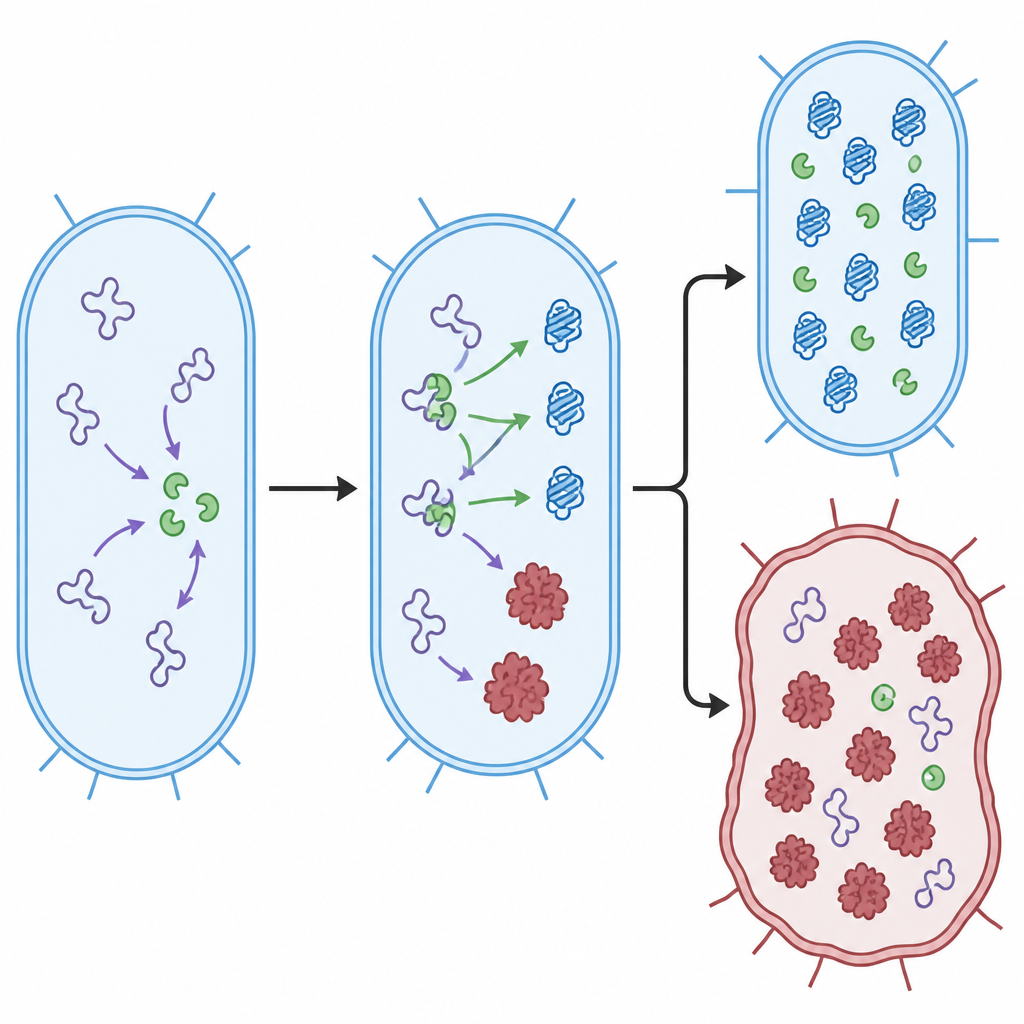
The authors treat the bacterial cell as a self-replicating machine that must decide how much of its protein mass to devote to a few major tasks. One group of proteins makes building blocks from nutrients outside the cell, another group carries out protein production, a third group helps damaged or newly made proteins fold into proper shape, a fourth breaks down misfolded proteins, and a fifth covers essential housekeeping functions that hardly change. Because the total protein mass is limited, putting more resources into one task means taking them from another. The model links these competing demands to the overall growth rate by tracking how nutrients are converted into amino acids, then into new proteins, and finally into more cell material.
Temperature, folding pressure, and growth
By fitting this model to existing measurements of how E. coli grows from cold through normal to hot conditions, the researchers identify a single hidden quantity they call folding pressure. This captures how difficult it is for proteins to adopt and maintain their correct shape. At comfortable temperatures, folding pressure is low, and the growth rate mainly reflects how quickly the cell can supply amino acids and how fast its ribosomes can translate them into proteins; this leads to the classic smooth, Arrhenius-like curve often seen in textbooks. But when temperatures stray above or below the normal range, folding pressure rises sharply. More of the newly made proteins misfold and tend to form aggregates, forcing the cell to divert extra protein mass into chaperones and related helpers and away from growth-promoting machinery. As a result, growth drops off more steeply than a simple chemical rate law would predict.
Shifting jobs inside the cell with heat and cold
The calibrated model predicts how the fractions of different protein groups change with temperature, and these predictions agree well with independent measurements under many conditions. In warm environments, E. coli increases the share of chaperone proteins that assist folding, while cutting back on proteins devoted to amino acid supply and to the translation apparatus. In the cold, slower chemistry and altered folding also push up folding pressure, although real cells appear to adjust less strongly than the model suggests, hinting at additional low-temperature tricks that are not yet fully captured. Within the moderate, everyday temperature range, the model explains why the mix of protein sectors stays nearly constant, matching the common view that bacterial physiology is fairly stable there even as growth rate changes.
Explaining enzyme activity and cell size
Beyond growth rate, the framework also sheds light on two familiar laboratory observations. First, a standard reporter enzyme, β-galactosidase, is often produced from a promoter that is always “on.” Earlier work showed that its level follows how much protein the cell can devote to one particular sector that depends on nutrient quality. Here, by combining that idea with the temperature-tuned allocation model, the authors reproduce classic measurements of β-galactosidase activity across temperatures, including its dip in cold conditions and expected decline at high heat. Second, they link cell size to the same protein sector, predicting that cells grow larger when that sector shrinks. This simple rule matches data showing that E. coli cells swell in volume when shifted away from their favored temperatures, a change that can correspond to filament-like shapes under heat stress.
What this means for bacteria and for us
To a lay reader, the key message is that temperature does not just speed up or slow down life like a simple kitchen timer. Instead, it forces bacteria to replan how they invest their protein resources, and those internal trade-offs shape growth, enzyme output, and even cell size. The model presented here captures these choices with just a few temperature-sensitive parameters, connecting molecular events such as protein folding with whole-cell behaviors that matter for ecosystems, industrial fermentations, and food safety. While it cannot yet explain every detail, especially under extreme cold, it offers a clear quantitative picture of how a microbe’s inner economy responds when the thermometer moves.
Citation: Wang, D., Zhang, Q. & Shi, H. A proteome optimal allocation model for elucidating effects of temperature on bacterial growth. npj Syst Biol Appl 12, 74 (2026). https://doi.org/10.1038/s41540-026-00693-4
Keywords: bacterial growth, protein allocation, temperature effects, E. coli, protein folding