Clear Sky Science · en
A machine learning framework reveals key drivers of cytokine responses in a healthy human cohort
Why our immune reactions differ
When two healthy people catch the same cold, one might barely sniffle while the other ends up in bed for days. A big part of this difference comes from how strongly their immune systems release signaling proteins called cytokines. This study asks a simple but important question: can we predict how a healthy person’s immune system will react, using a mix of genetics and everyday factors like season, past infections, and blood measurements?
Taking a close look at healthy immune systems
To explore this, the researchers built a carefully selected group of 406 healthy adults, all tested under standardized conditions. They collected blood in the morning after fasting, measured hormone levels and immune cell counts, and recorded factors such as sex, age, body weight, and season of sampling. They then stimulated fresh whole blood with substances that mimic germs and activate two major arms of immunity: Toll-like receptors (innate sentinels that sense broad danger signals) and T cell receptors (adaptive cells that recognize specific targets). The team measured 11 different cytokine responses, creating a rich picture of how each person’s immune system reacts under controlled laboratory challenges. 
Finding patterns of strong and weak responders
The first step was to see whether people naturally fall into recognizable immune "types." By examining how one key cytokine, IL-6, responded to several innate stimuli, the team found two main groups: high producers and low producers. Individuals who produced more IL-6 to one innate trigger generally produced more of other related cytokines as well, suggesting stable response profiles. High IL-6 producers were more often male, had higher numbers of a white blood cell type called monocytes, and were more likely to have been sampled in winter, highlighting how both biology and environment shape immune tone over the year.
Genes versus environment: who drives what?
Next, the researchers scanned the entire genome for DNA variants linked to cytokine levels and found four regions that clearly influenced certain responses, including a well-known variant that affects T cell–driven cytokines. But genes told only part of the story. They then pitted several prediction approaches against each other, from simple linear models to more flexible machine-learning techniques such as random forests and gradient boosted trees. When they tried to predict cytokine responses using genetic data alone, only a few T cell–related cytokines could be forecasted with reasonable accuracy. Once they added biological and environmental information—such as blood counts, season, and previous exposure to cytomegalovirus—the models improved, especially for innate receptor responses, where purely genetic signals were weak.
What the best models reveal
The most reliable performer was a tree-based method called random forest. By probing how much predictions deteriorated when each input was shuffled, the authors could see which features really mattered. For T cell–driven cytokines, genetic variants were the dominant drivers, with smaller roles for age and chronic viral exposure. For innate receptor–driven cytokines like IL-6 and TNF, seasonal timing and monocyte counts were far more influential than DNA markers. The team also showed how easy it is to overestimate the power of genetics if feature selection is done incorrectly, and they confirmed their main findings in an independent cohort of nearly 500 non-smokers. Interestingly, broad genetic risk scores for autoimmune diseases did not improve prediction, suggesting that genes that predispose to disease do not neatly mirror genes that tune everyday immune responses in healthy people. 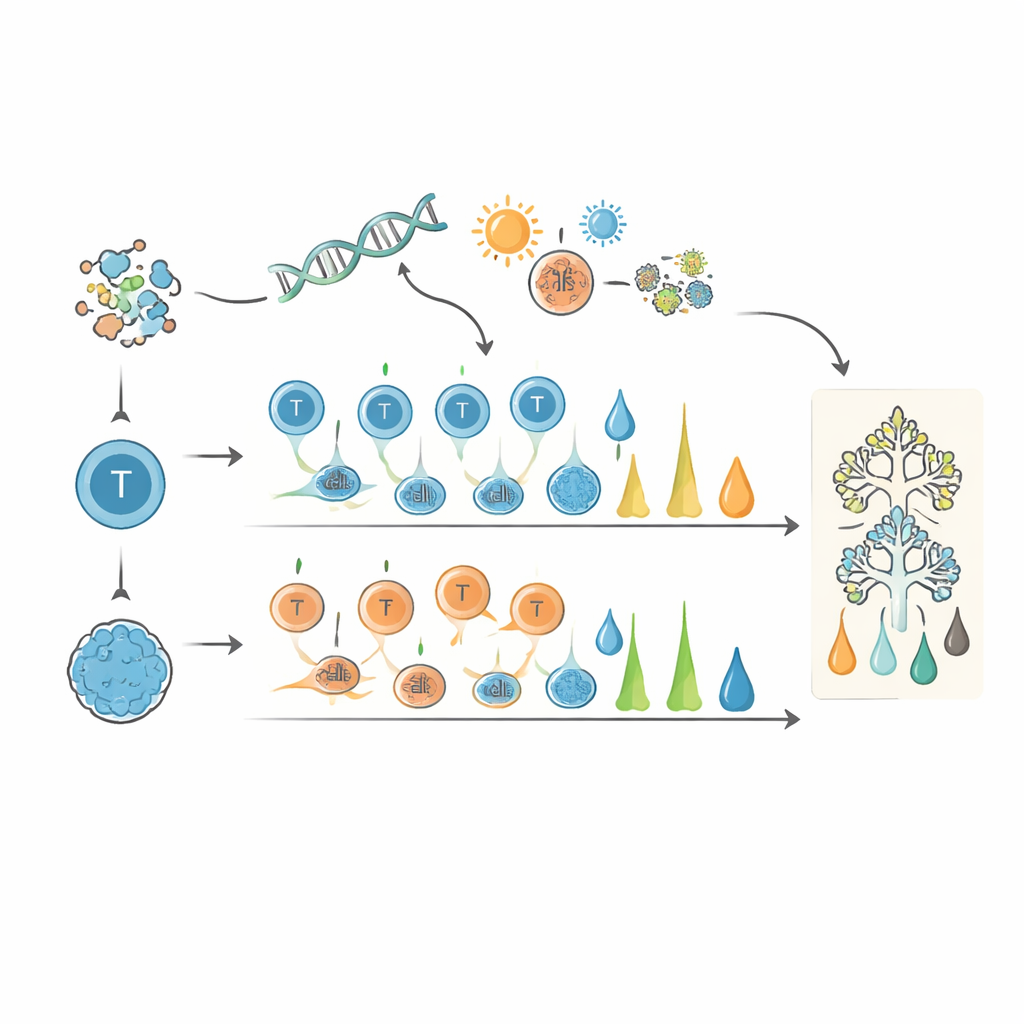
What this means for future personalized immunity
For a lay reader, the lesson is that our immune responses are not written in our genes alone. Some cytokines, especially those driven by T cells, are strongly shaped by inherited DNA changes. Others, particularly those produced by innate sensors like Toll-like receptors, depend far more on shifting factors such as season, cell counts, hormones, and past exposures. Modern machine-learning tools can weave these pieces together to rank who is likely to be a strong or weak responder, but they have limits and must be used carefully to avoid misleading optimism. Overall, this work moves us closer to forecasting individual immune behavior, while underscoring that both our genomes and our daily environments jointly script how fiercely we respond to infection.
Citation: Liefferinckx, C., Bottieau, J., Quertinmont, E. et al. A machine learning framework reveals key drivers of cytokine responses in a healthy human cohort. npj Syst Biol Appl 12, 45 (2026). https://doi.org/10.1038/s41540-026-00671-w
Keywords: cytokine responses, machine learning, immune variability, genetics and environment, systems immunology