Clear Sky Science · en
Ecological and stochastic determinants of the growth and persistence of the oral pathogen Porphyromonas gingivalis
Why Mouth Bacteria Can Matter for Your Whole Body
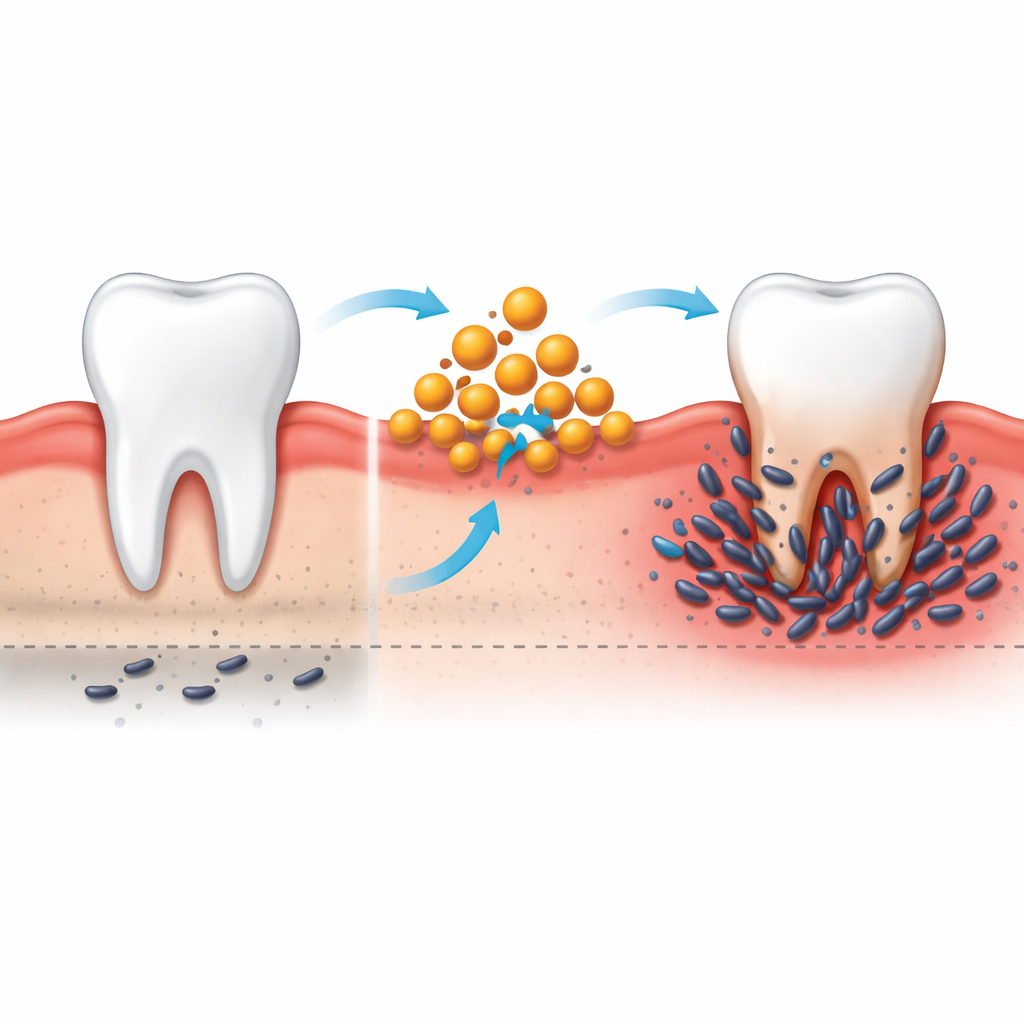
Bleeding gums and gum disease might seem like small, local problems, but they are increasingly linked to heart disease, diabetes, and even brain disorders. A key troublemaker is the bacterium Porphyromonas gingivalis, which can disrupt the normally balanced community of microbes living on our teeth and gums. This study asks a deceptively simple question with big health implications: how can this microbe linger at low levels in the mouth for years, and then suddenly surge to help trigger damaging inflammation?
A Tiny Invader That Needs Strength in Numbers
The researchers focus on a puzzling trait of P. gingivalis. In the lab, this bacterium shows what biologists call a “minimum crowd” effect: if there are too few cells, the population actually shrinks instead of grows. Only once it crosses a critical density can it thrive. Using growth measurements and a mathematical model, the team pinpointed this tipping point, or threshold, beyond which the bacteria race toward high numbers. Below that level, they should die out. Yet in people, P. gingivalis is often found at very low abundance, even in mouths that look healthy or have been carefully cleaned, suggesting something is helping it survive against the odds.
Help from Friendly Neighbors
One suspect is another common mouth bacterium, Veillonella parvula, which normally appears early when dental plaque forms. In experiments, the scientists grew P. gingivalis in liquid that had previously been used by V. parvula. That cell-free “spent” liquid still contained dissolved byproducts and nutrients. When exposed to it, P. gingivalis could now get by with a smaller starting crowd: the minimum threshold for survival dropped. This indicates that substances released by the early colonizer make the environment more welcoming, easing the path for the pathogen to establish itself, even when it begins at relatively low numbers.
Randomness Gives Weak Populations a Second Chance
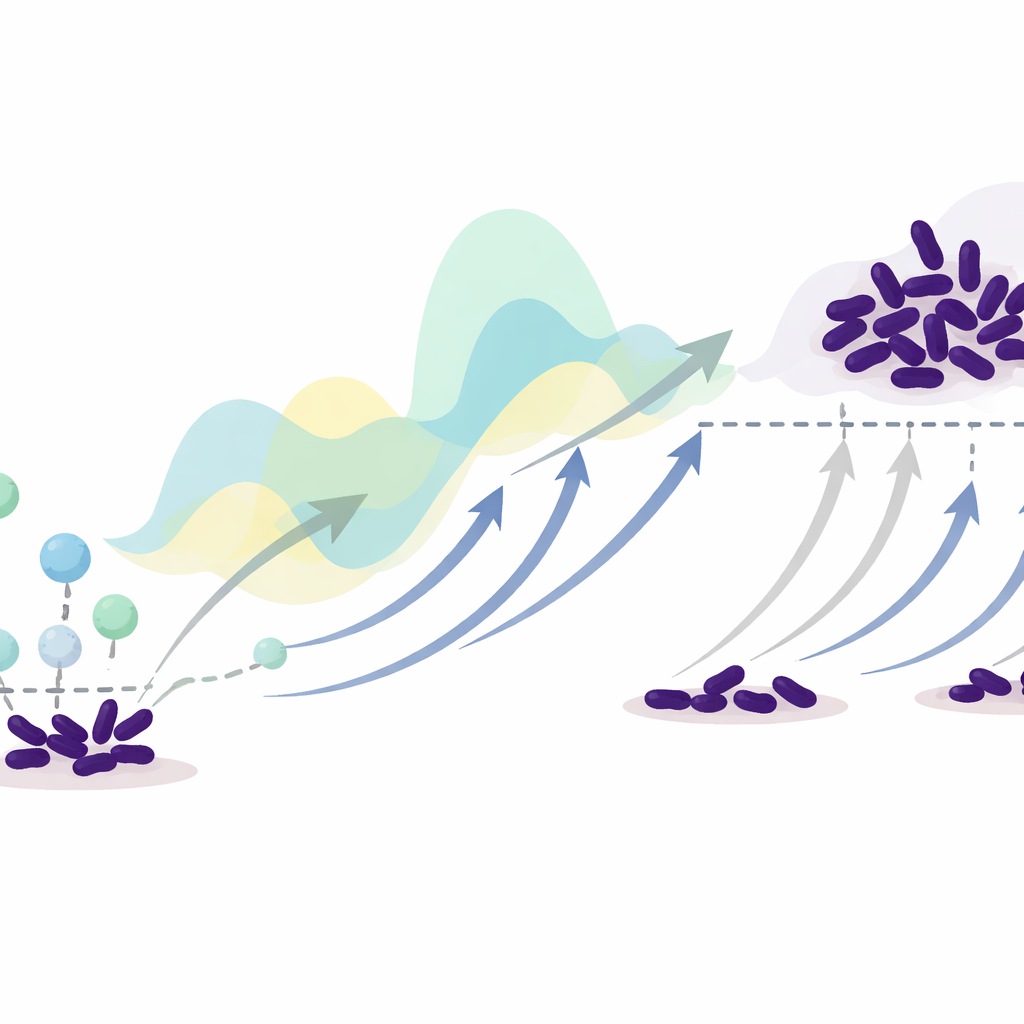
Real mouths are not uniform test tubes: nutrients, oxygen levels, and immune responses vary from place to place and moment to moment. To capture this messy reality, the team extended their model to include random fluctuations in both how fast the bacteria grow and how easily they sense their own numbers. They then tested these ideas with long-running culture experiments that started with too few P. gingivalis cells to survive under simple, predictable rules. Over a month, some cultures dwindled toward extinction, while others unexpectedly stabilized at low but steady levels. By describing these outcomes with a kind of probability landscape, the model showed how random shifts in local conditions can occasionally push a struggling population over the tipping point, allowing it to persist instead of disappearing.
When Two Species Share the Same Space
To understand how P. gingivalis and V. parvula shape each other’s fate, the researchers turned to ideas borrowed from game theory, which is usually used to study strategic choices in economics or animal behavior. They represented the two species as “players” that can either help or hinder each other’s success, and mapped out possible long-term outcomes: one species wins, they coexist, or the result depends on who gains an early edge. New co-culture experiments revealed that when V. parvula is present from the beginning, P. gingivalis almost always grows well. When V. parvula arrives later, some P. gingivalis populations are rescued while others still die out. In most cases, however, V. parvula ultimately reaches high levels, narrowing the likely futures to either stable coexistence or complete loss of the pathogen.
What This Means for Keeping Gums Healthy
Together, the findings paint a picture of gum disease as the result of a delicate ecological balance rather than the simple invasion of a single villain. P. gingivalis needs a minimum foothold to flourish, but helpers like V. parvula and random shifts in the microenvironment can lower that barrier and allow it to hang on at low levels, waiting for an opportunity to tip the community toward harmful inflammation. This systems view suggests new treatment ideas: instead of only trying to kill the pathogen, dentists and doctors might aim to weaken the support it receives from neighboring microbes or from its surroundings, and to strengthen competitors that keep it in check. By nudging the entire ecosystem of the mouth back toward a stable, healthy state, it may be possible to prevent both tooth loss and the wider health problems linked to chronic gum inflammation.
Citation: Hussein, M., Barua, A., Qasaimeh, M. et al. Ecological and stochastic determinants of the growth and persistence of the oral pathogen Porphyromonas gingivalis. npj Syst Biol Appl 12, 49 (2026). https://doi.org/10.1038/s41540-026-00662-x
Keywords: oral microbiome, gum disease, Porphyromonas gingivalis, microbial interactions, stochastic persistence