Clear Sky Science · en
Wakeful targeted memory reactivation during short rest periods modulates early motor learning
Why short breaks can boost your skills
Anyone who has practiced a musical instrument or learned to type faster has felt the power of taking short breaks: you rest for a few seconds and suddenly your fingers seem to move more smoothly. This paper explores what happens in the brain during those tiny pauses and asks a striking question: can carefully timed sounds played while you are awake and resting make you learn new finger movements even faster?
How the brain learns between the beats
Motor learning is the process by which repeated movements become quicker and more accurate. We often assume learning happens while we are actively practicing, but research shows that important changes occur in the pauses between attempts. In these brief rests, the brain quietly strengthens and refines newly formed memories of the movement pattern. This fast “in-between” improvement joins the better-known consolidation that unfolds over hours and days, including during sleep. The current study focuses on what happens in mere seconds of rest while people remain awake.
Using sound cues to nudge memories
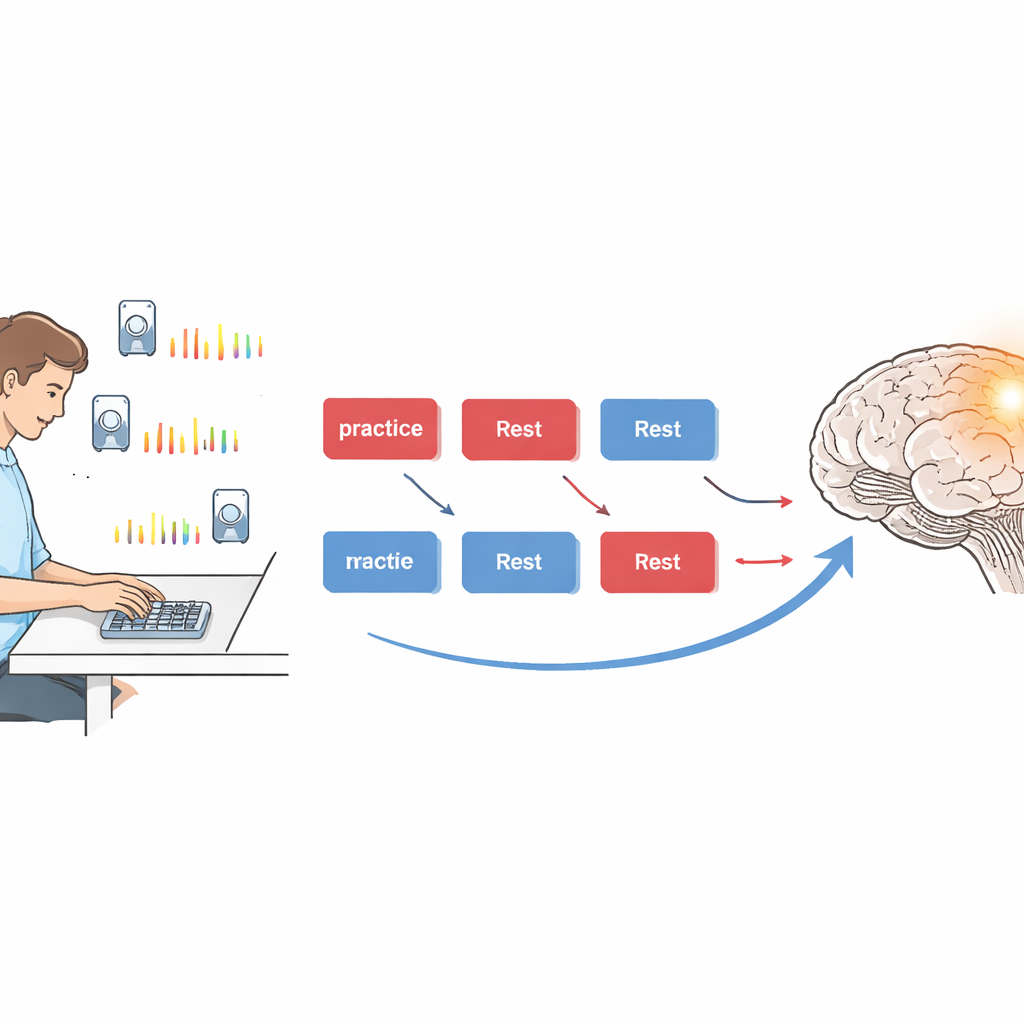
Scientists have devised a method called targeted memory reactivation, in which a specific memory is paired with a sound or smell. Presenting that cue later can “replay” the memory and strengthen it. So far, most work has used this trick during sleep. In this study, the researchers tested whether the same idea could work during very short wakeful breaks and whether the exact timing of the sound matters. Volunteers learned a simple finger-tapping sequence with their non-dominant hand while hearing piano tones linked to each key press. During ten-second rest periods between practice bouts, the computer replayed those tones in one of three ways: at the same speed as the person had just tapped, 1.3 times faster, or at the same speed but with the notes scrambled so they no longer matched the learned pattern. A separate group practiced without any sound replay at all.
Faster replay, quicker early gains
Across all groups, the biggest improvements in speed came during the short breaks, confirming that these tiny pauses are powerful learning windows. When the researchers compared the sound conditions, they found that people who heard the faster version of their own tone sequence during rest made larger gains early in training than those who heard the regular-speed replay. In contrast, hearing a scrambled pattern of notes did not help or harm performance. This suggests that two ingredients are crucial: the sounds must faithfully match the learned movement, and a modest speed-up of the replay can give the brain an extra boost. Interestingly, the overall number of tones heard was similar across conditions, pointing to timing, not sheer amount of stimulation, as the key factor.
Peeking inside the resting brain
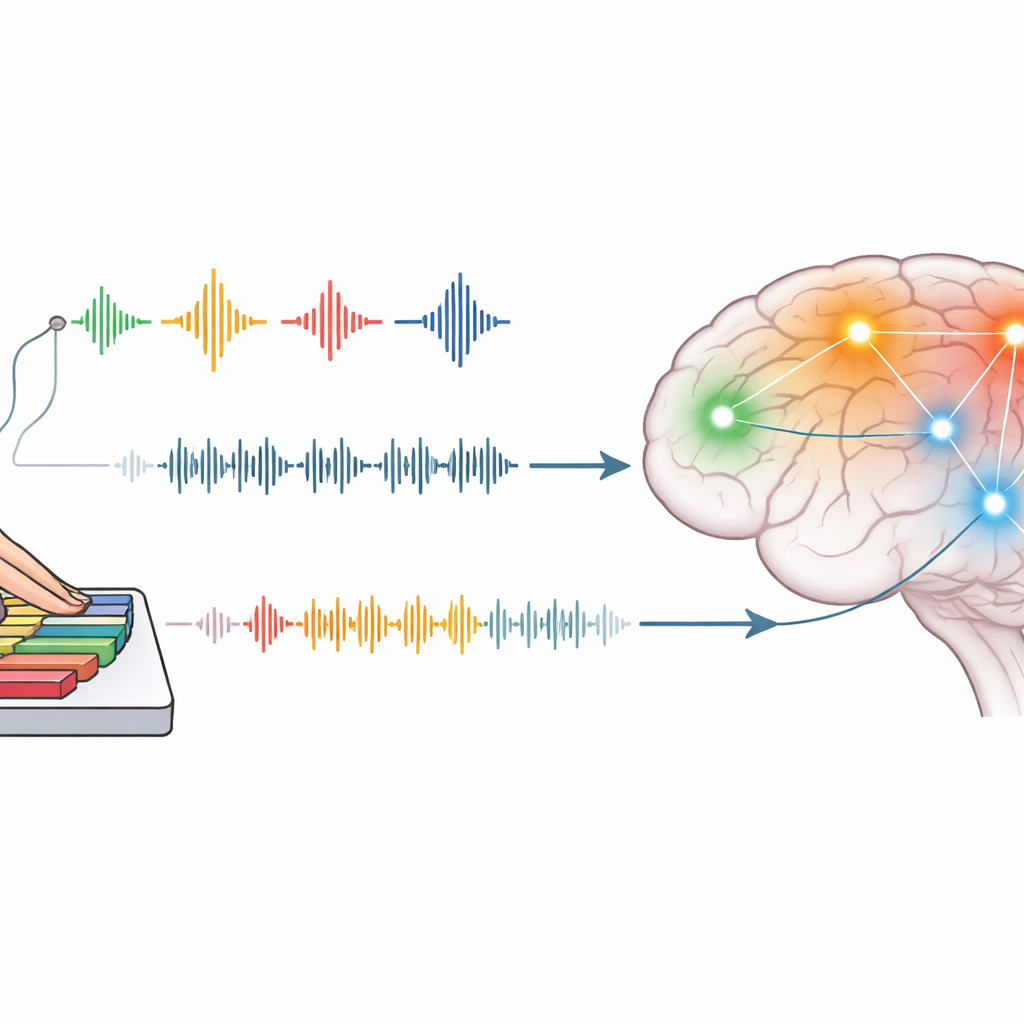
While participants practiced and rested, the team recorded their brain activity using a 64-channel electroencephalogram cap. They focused on how different brain regions synchronized their rhythmic activity, a measure called functional connectivity. During rest periods with sound replay, people in the faster-sound group showed stronger connections involving a region behind the eyes called the lateral orbitofrontal cortex and nearby frontal areas. These regions are linked to forming action plans, using feedback, holding information in mind, and supporting the rapid “replay” of recent experiences. The pattern suggests that quicker sound cues during rest help engage a higher-order network that reorganizes the just-learned finger sequence more efficiently, rather than merely driving basic hearing areas.
What this means for everyday learning
To a layperson, the take-home message is that how we spend our short breaks matters: the brain is still hard at work, and gentle, well-timed reminders of what we just practiced can speed up early learning. Playing back associated sounds a bit faster than our actual performance during wakeful rest gave participants a head start without lengthening practice time. The authors caution that their study has limits and that deeper brain structures were not directly measured, but their results point to a simple, testable idea: by tuning the timing and structure of sensory cues, we may eventually design smarter training and rehabilitation tools that make the most of the brain’s natural tendency to replay and refine skills in the quiet moments between actions.
Citation: Kawasoe, R., Matsumura, K., Shinohara, T. et al. Wakeful targeted memory reactivation during short rest periods modulates early motor learning. npj Sci. Learn. 11, 23 (2026). https://doi.org/10.1038/s41539-026-00407-9
Keywords: motor learning, memory reactivation, auditory cues, brain connectivity, skill training