Clear Sky Science · en
Neural patterns reflect conceptual grasp of novice students following first class learning in physics
Why Brain Clues About Learning Matter
Teachers usually judge whether students "get" a new idea using quizzes, homework, or exams. But these tools are noisy snapshots: a bad night’s sleep or a tricky question can hide real understanding. This study asks a striking question with big implications for education and brain science: after just a single physics lesson, do changes in the brain already reveal who truly grasps the new concepts—and do those brain patterns line up with later test performance?
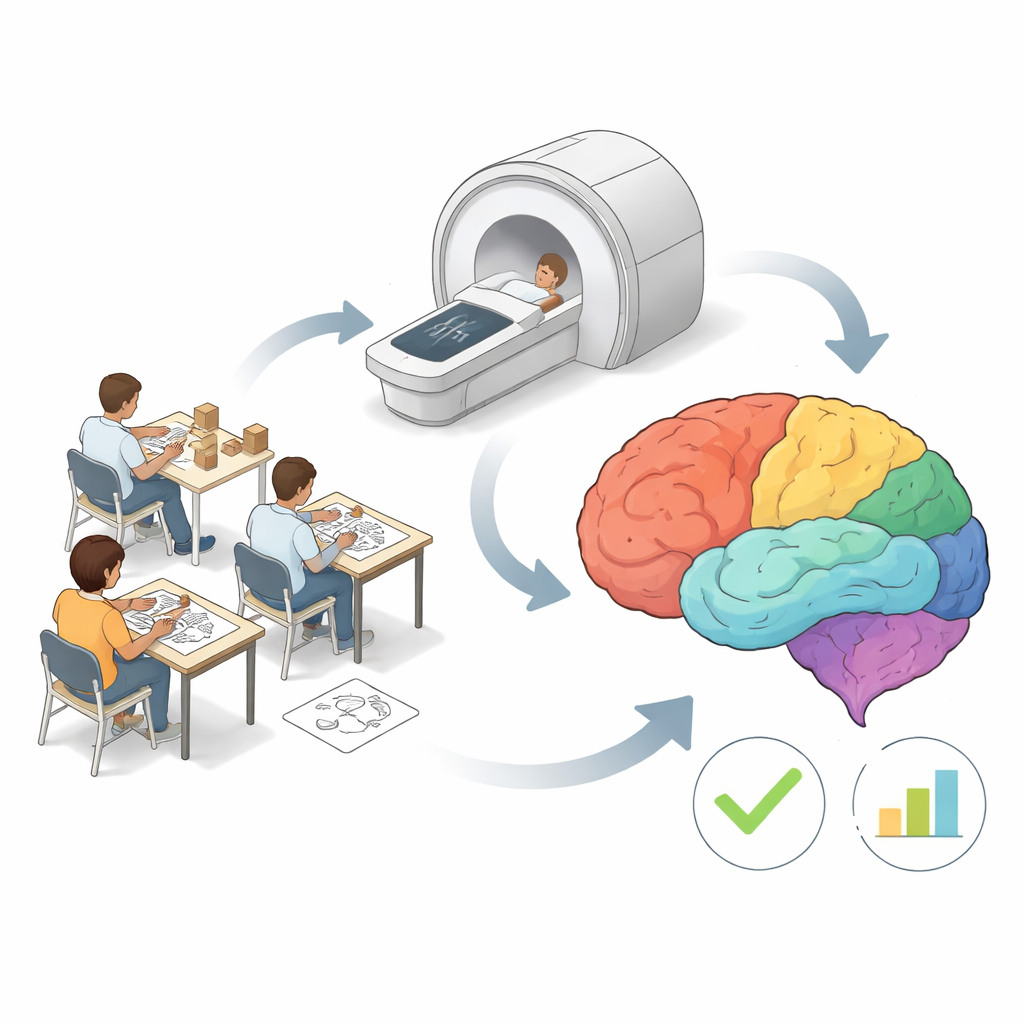
A One-Hour Physics Class, Then Into the Scanner
Researchers recruited college students who had almost no background in physics or engineering and gave them a tightly controlled, one-hour introduction to basic ideas from static mechanics—how unmoving structures like beams and bridges stay in balance. Some students learned through an interactive lab activity using simple physical materials; others studied similar examples through slide-based “textbook-style” materials. Because both groups ended up learning to a similar degree on written quizzes and a later problem-solving task, the researchers combined them into one pool of novice learners for brain analysis.
Testing Knowledge on Paper and in the Real World
To track learning over time, students completed short quizzes on two topics—straight-line forces and turning forces (“moments”)—at up to four points: before the lesson, right after, a few days later, and about a month later. Scores jumped sharply after the lesson, then slowly declined, reflecting some forgetting over time. During a brain scan taken within a week of the lesson, students also performed a “near-transfer” task: they viewed photos of real structures, such as beams or trusses, and judged whether arrows showing the forces on a highlighted part were correct or incorrect. This task required applying what they had just learned, without simply recalling a memorized answer.
Hidden Categories and Brain Patterns
Behind the scenes, engineering experts had grouped each structure into one of three mechanical types—cantilevers, trusses, and vertical loads—based on how the forces work. Crucially, students were never told these categories existed and were never asked to sort images by type. Instead, the researchers used brain imaging data to see whether patterns of activity while students viewed each structure naturally clustered into these expert-defined groups. They carved the cortex into hundreds of small regions and, within each one, trained a machine-learning classifier to recognize which category a given brain-activity pattern belonged to. Where the classifier could reliably tell the categories apart, it suggested that the student’s brain was organizing the new knowledge in a conceptually meaningful way.
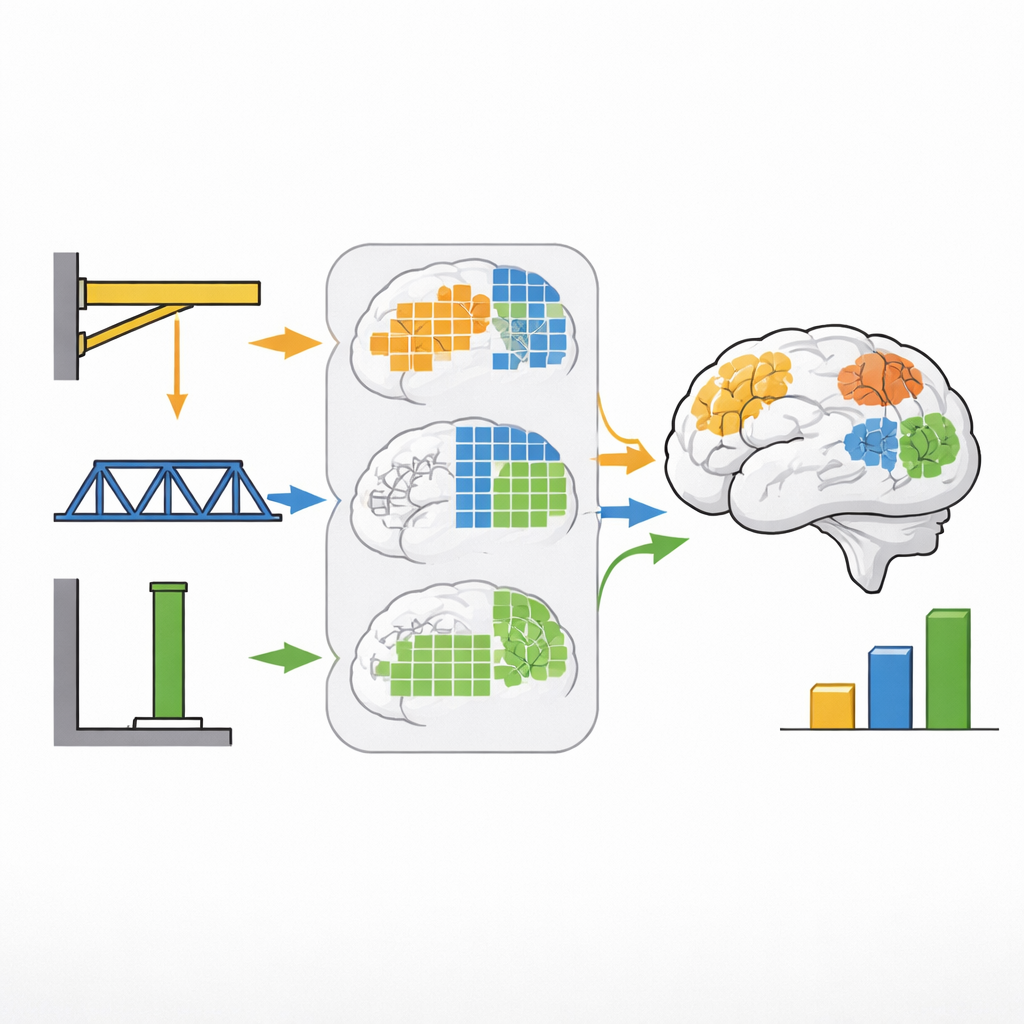
When Clearer Brain Categories Mean Better Learning
After identifying brain regions that, on average, carried strong category information, the team computed an individual “neural score” for each student—how well those hidden mechanical categories could be decoded from that person’s brain patterns. They then asked a simple question: do students whose brain activity shows cleaner separation between the three structure types also do better on traditional tests? In six regions, the answer was yes. These areas included parts of the parietal lobe involved in spatial reasoning and quantity estimation, a temporal region that helps distinguish visual categories, and a midline region linked to memory and meaning. In these spots, stronger neural category structure went hand in hand with higher quiz scores and better performance on the force-diagram task.
What This Means for Understanding Learning
The findings show that even after just one hour of instruction, the brains of true beginners begin to organize new science ideas into expertlike conceptual groupings—without students ever being told those groupings exist. Moreover, the clarity of this organization predicts how well they perform on standard paper-and-pencil assessments. While brain scans are not about to replace exams, the study demonstrates that neural patterns can offer a sensitive window into early conceptual understanding. In the long run, such methods could help researchers evaluate teaching approaches and understand how students build the mental scaffolding needed for mastering complex topics in science, math, and engineering.
Citation: Cetron, J.S., Hillis, M.E., Diamond, S.G. et al. Neural patterns reflect conceptual grasp of novice students following first class learning in physics. npj Sci. Learn. 11, 20 (2026). https://doi.org/10.1038/s41539-025-00394-3
Keywords: concept learning, physics education, brain imaging, STEM learning, neural patterns