Clear Sky Science · en
3D bio-screen printing for high-throughput production of scaffolds for meat alternatives
Why turning beans into steaks matters
For people who enjoy the taste and texture of meat but worry about animal welfare, climate change, or resource use, a big question remains: how do we make realistic “steaks” without raising animals? This study introduces a way to build meat-like pieces using a familiar industrial tool from printing and packaging, aiming to make structured meat alternatives cheaper, faster, and closer in bite to the real thing.
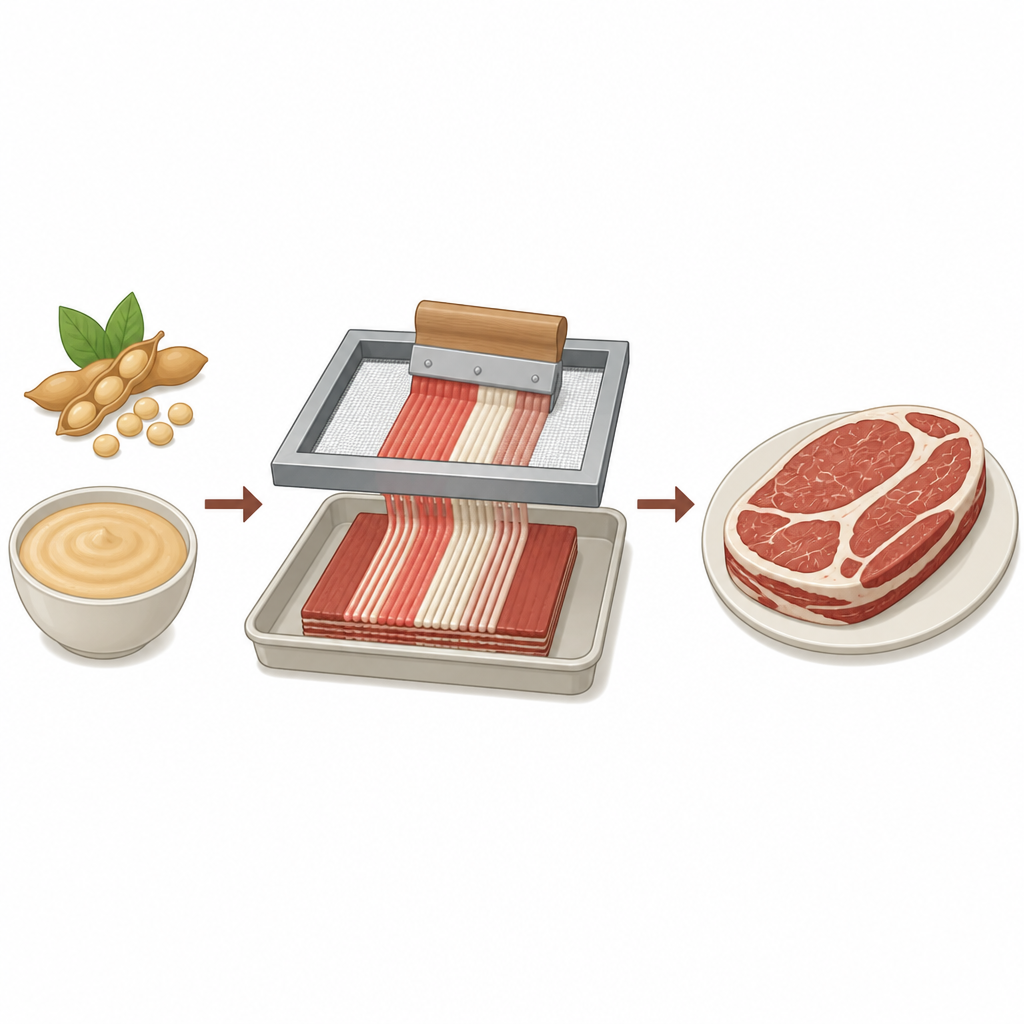
Borrowing a tool from the printing shop
The researchers adapted screen printing, a long used technique for decorating T-shirts and electronics, to create three dimensional edible structures. Instead of ink, they use thick pastes made from food ingredients, especially soy protein. A fine mesh or metal stencil defines where the paste is pressed through, adding very thin layers on top of each other. By carefully timing drying and stacking, these layers build up a small “scaffold” whose internal pattern and thickness can be tuned to resemble the connective tissue and marbling seen in a steak. Because screen printing is already used at industrial scale, the same idea could one day be run on large machines to produce many kilograms of product per hour.
Designing edible building blocks
To turn soy protein into a printable material, the team studied how it flows under pressure. High protein content usually makes pastes too stiff to pass through fine openings. The authors tackled this with food grade reducing agents such as sodium sulphite, which gently loosen the protein network so the paste becomes easier to push through the mesh without heating. They also blended in a small amount of alginate, a plant based thickener from seaweed, to help the printed layers keep their shape and to bind different components together. This recipe allowed protein rich pastes to behave like classic screen printing inks, maintaining high resolution down to about a tenth of a millimetre while still forming solid gels after drying and crosslinking.
From patterned scaffolds to marbled steaks
With these inks, the team printed grids of bars and cavities that mimic the supporting tissue in meat. They could reliably produce circular, rectangular, and hexagonal pores across a range of sizes, with only tiny deviations from the planned dimensions. Using a second, softer soy and oil based material, they then added plant based “fat” into the gaps in a single pass, creating marbled prototypes. By stacking individually printed layers and re linking them with calcium solutions, they built pieces thicker than half a centimetre. Tests showed that these stacked and printed samples soaked up liquid, lost mass, and changed in height during pan frying in ways comparable to conventional meat, and their hardness, springiness, and chewiness fell within or close to ranges reported for cooked animal muscle.
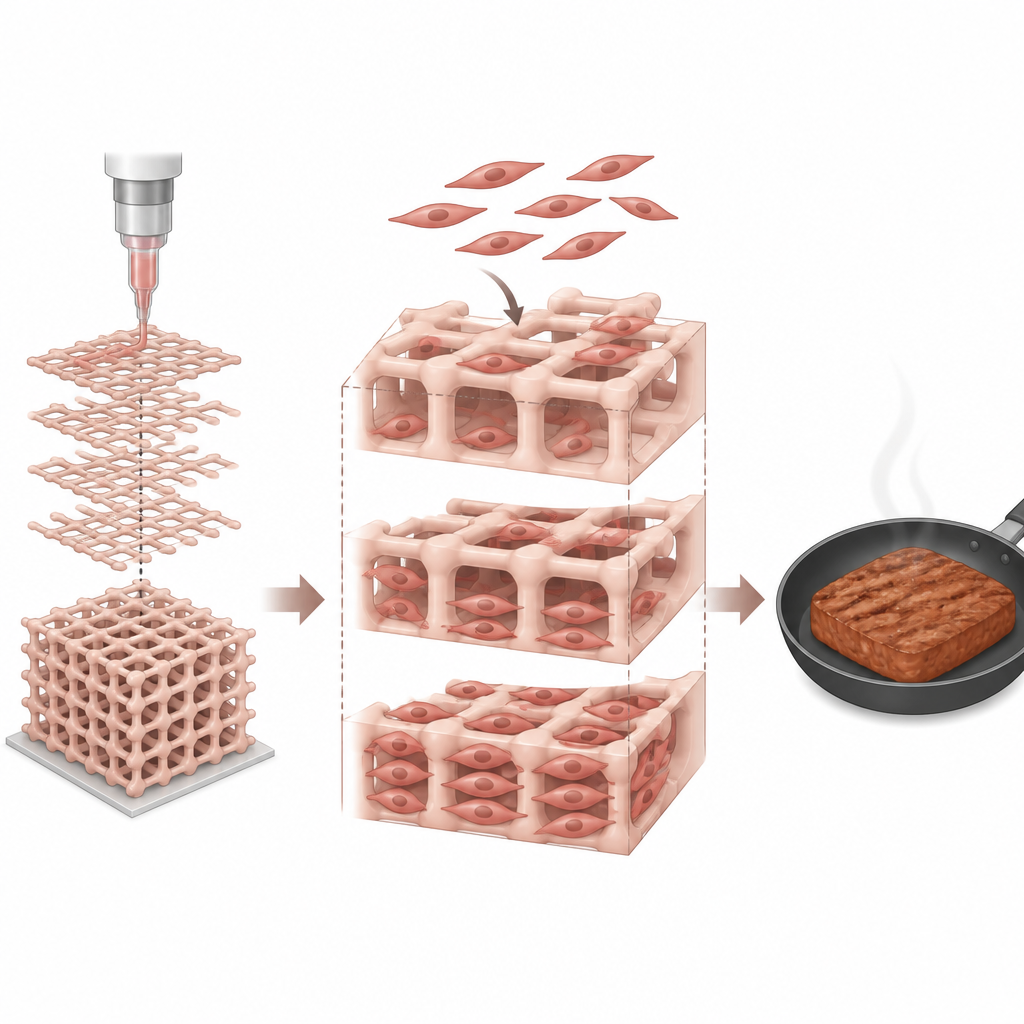
Inviting living cells into the structure
A key goal of cultivated meat is to include real animal cells. The authors grew mouse muscle precursor cells on and inside the soy based scaffolds to see whether the printed structures could act as a home for future hybrid products. After washing steps to remove excess reducing agents, the scaffolds supported healthy cell growth on their surfaces, with cells spreading out, aligning along the printed bars, and fusing into early muscle fibres. When cells were mixed into a soft collagen and gel matrix and pipetted into the scaffold cavities, they also survived in three dimensions, especially if they were partially matured beforehand. Although the total animal protein added this way is still low compared with a steak, the approach shows that both plant material and muscle cells can be combined in a single printed object.
What this could mean for your plate
In simple terms, this work shows that a common printing method can be reimagined as a food making tool that shapes thick plant protein pastes and living cells into steak like pieces. The process can handle high protein content, create fine internal patterns without sacrificing speed, and produce scaffolds that withstand cooking while giving a familiar mouthfeel. If adapted to full scale industrial machines and paired with improved cell growth methods and fully plant based cell feeds, 3D bio screen printing could help bring structured, affordable meat alternatives and hybrid cultivated meat closer to everyday meals.
Citation: Maatz, R., Karnop, P., Sylvia, R. et al. 3D bio-screen printing for high-throughput production of scaffolds for meat alternatives. npj Sci Food 10, 155 (2026). https://doi.org/10.1038/s41538-026-00853-0
Keywords: cultivated meat, 3D bio-screen printing, soy protein scaffold, meat alternatives, hybrid cultured meat