Clear Sky Science · en
Deep learning enable precision authentication of seasonal and processing signatures in tieguanyin tea
Why this tea story matters
For many tea lovers, a favorite oolong is worth paying extra for, but it can be hard to know whether what is in the cup truly matches the label. This study focuses on Tieguanyin, a famous Chinese oolong, and shows how modern data science can help tell apart teas from different seasons and processing styles, even when traditional tasting and lab methods struggle. The work points toward smarter tools to protect both consumers and honest producers in the premium tea market.
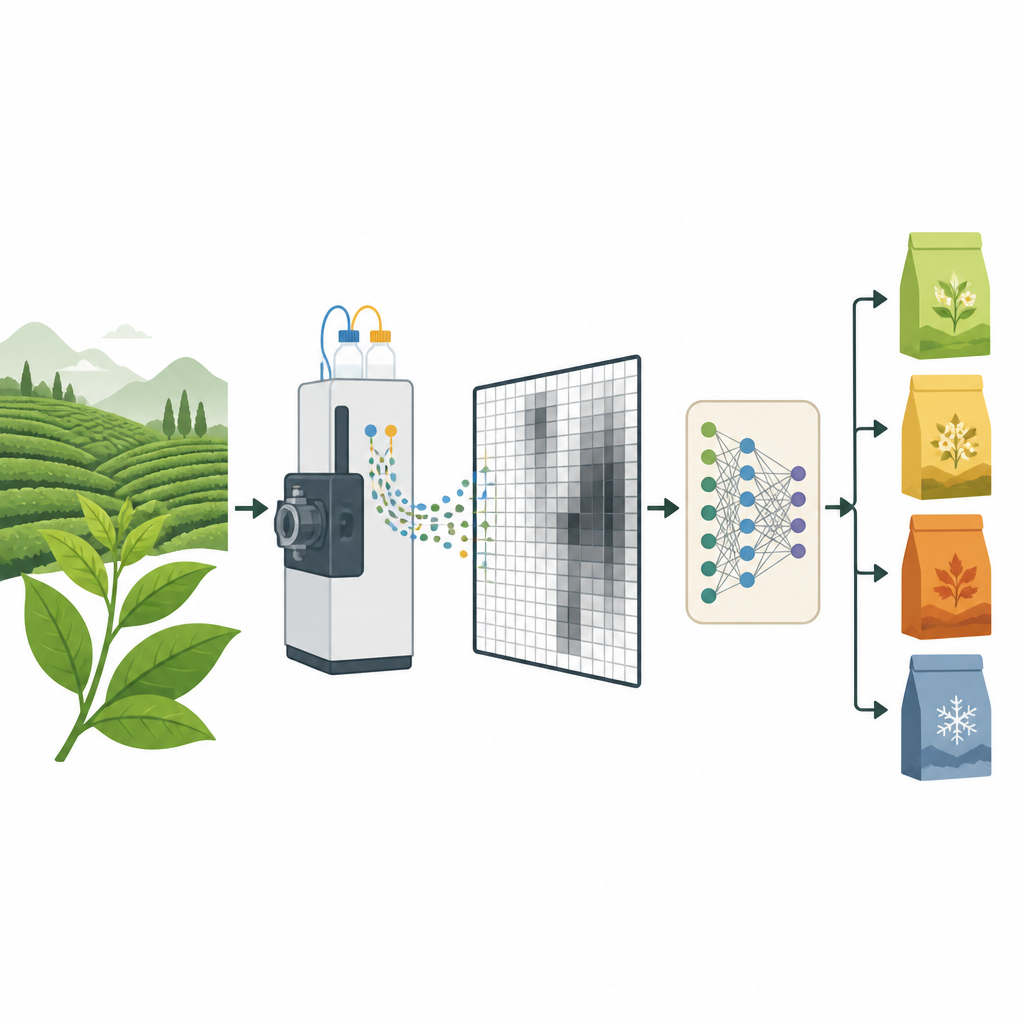
How the flavor of Tieguanyin is shaped
Tieguanyin’s taste comes from a dense mix of natural chemicals that change with the season and how the leaves are processed. Spring leaves usually give a softer, more delicate brew, while autumn leaves tend to produce stronger aromas. After harvest, producers can make light-scented teas with gentle roasting or strong-scented teas with heavier roasting at higher temperatures. Mild treatment keeps many original plant compounds intact, whereas intense roasting breaks some down and creates new ones, adding complexity but also blurring the seasonal signature.
Turning tea chemistry into pictures
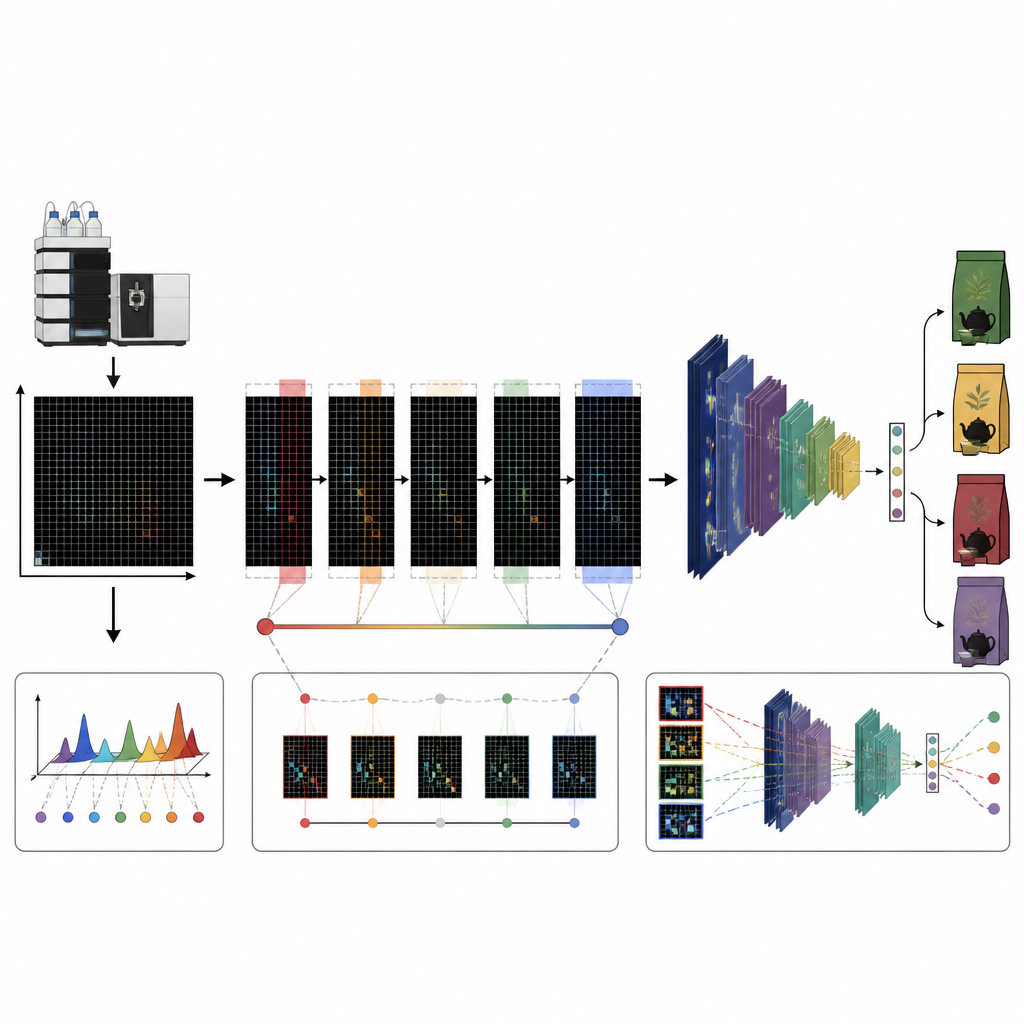
To study these differences, the researchers analyzed 274 Tieguanyin samples from spring and autumn, each made in both light and strong styles. They used a common lab technique that separates and weighs thousands of tiny molecules in each tea. Rather than looking at this as a long list of numbers, they converted the results into simple gray-scale images, where each pixel captures the combined signal of molecules in a small window of the analysis. In these images, closely related molecules sit near one another, allowing computer vision tools to spot patterns in how teas differ by season and processing.
Comparing smart algorithms
The team first applied established statistical tools and a popular machine learning method called random forest to these chemical fingerprints. These approaches could tell the four tea types apart with over 85 percent accuracy, especially for lightly roasted teas, whose seasonal differences remain clear. Most of the mistakes happened when trying to separate strongly roasted spring and autumn teas, since heavy roasting tends to erase some seasonal clues and push the chemistry toward a shared profile.
Deep learning stands up to real-world noise
The standout technique was deep learning, which uses layered networks inspired by image recognition. After converting the lab data into images, the researchers trained several deep models and found that a particular architecture, VGG19, performed best at a modest image size. To mimic real laboratory conditions, they also created artificial “noise,” such as shifts in when molecules appear during the measurement. By feeding the model many slightly altered versions of the same sample, it learned to focus on stable patterns instead of fragile details. This deep learning model correctly classified about 91 percent of test teas under normal conditions and kept nearly 80 percent accuracy when the measurements were distorted, while the more traditional methods dropped much more.
What this means for tea and beyond
In everyday terms, the study shows that it is possible to give each batch of Tieguanyin a reliable digital fingerprint that remains readable even when instruments drift and processing varies. Lightly roasted teas keep their seasonal identity clearly, while heavily roasted teas share more common features but still leave enough trace for a careful algorithm to sort them. The same strategy could be adapted to other crops and foods where subtle chemical patterns signal origin and quality, offering a new way to support fair labeling and trustworthy supply chains.
Citation: Zheng, C., Zhou, X., Shao, N. et al. Deep learning enable precision authentication of seasonal and processing signatures in tieguanyin tea. npj Sci Food 10, 152 (2026). https://doi.org/10.1038/s41538-026-00837-0
Keywords: Tieguanyin tea, food authentication, deep learning, metabolomics, tea quality