Clear Sky Science · en
Elucidating odorant synergy in red wine: through olfactory receptor-based profiling
Why Some Wines Smell More Than the Sum of Their Parts
Anyone who enjoys a glass of red wine knows that its aroma can seem surprisingly rich for a simple mixture of grapes, yeast, and time. This study asks a deceptively simple question behind that magic: when two specific smell molecules in wine meet our nose at the same time, can they team up to create a stronger, more vivid aroma than either could alone—and if so, how does this happen inside our smell receptors?
Two Key Smell Notes in a Glass of Red
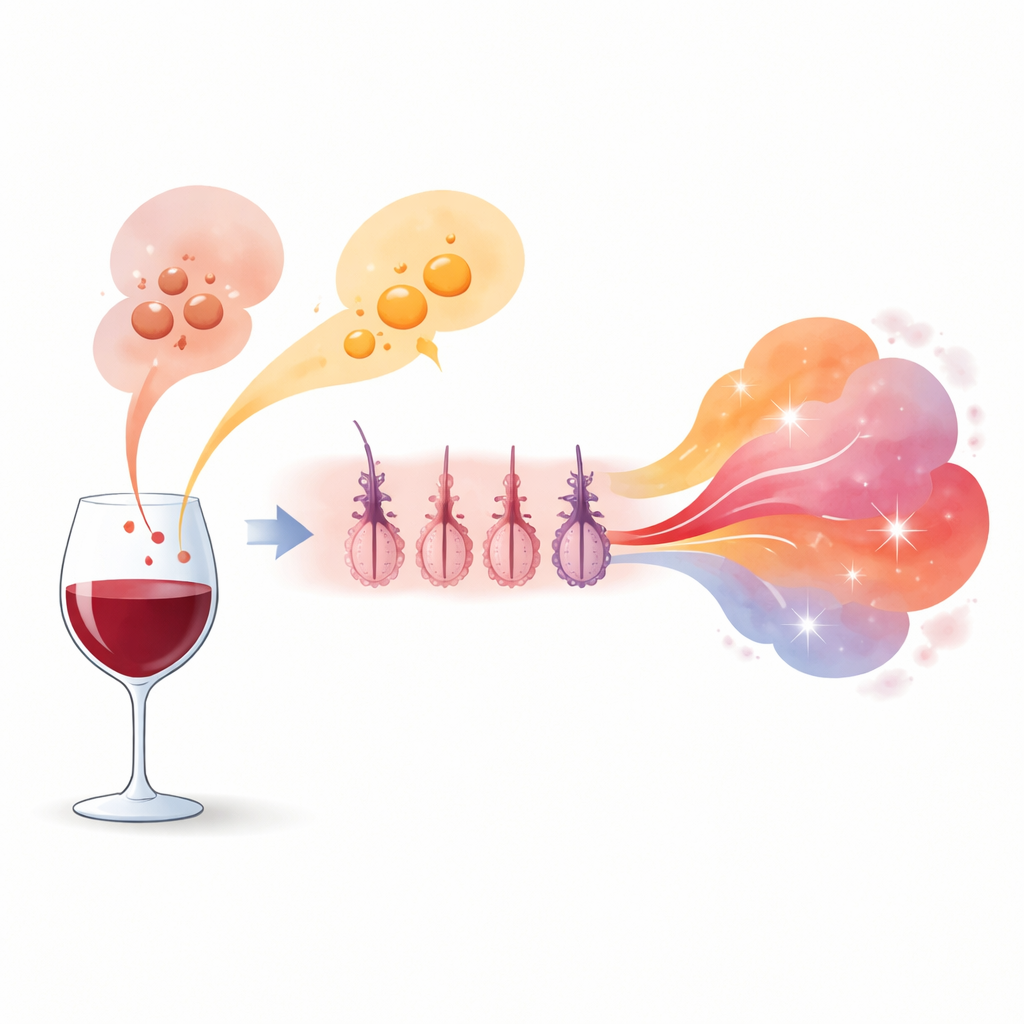
Red wine contains hundreds of volatile molecules that evaporate from the glass and reach our nose. Among them, two stand out for their roasted, warm character. One, called 2,3,5-trimethylpyrazine, is linked with nutty, coffee-like notes. The other, furfuryl alcohol, brings sweet, caramel-like tones formed during heating and aging. Both are present only in tiny amounts in real wines, but they contribute strongly to the “toasty” side of a wine’s bouquet. The researchers focused on these two compounds as a model pair to explore how specific aroma ingredients can interact in our perception instead of simply adding up like separate musical notes.
How Human Tasters Perceived the Aroma Pair
The team first turned to a trained sensory panel to see how people actually experience these smells. Volunteers were asked to detect each molecule alone at different concentrations and then the same molecules mixed together. The lowest concentration at which panelists could reliably notice an odor is called the detection threshold. When the two compounds were combined in equal amounts, the panelists could detect each one at substantially lower levels than when the compounds were presented on their own. The same pattern held even when one compound was kept constant and the other was varied. In every case, the mixture behaved “better than expected,” meaning both roasted and caramel notes became easier to perceive. This pattern points to a true synergy, where two smells enhance each other instead of competing.
Looking Inside Smell Receptors in Cells
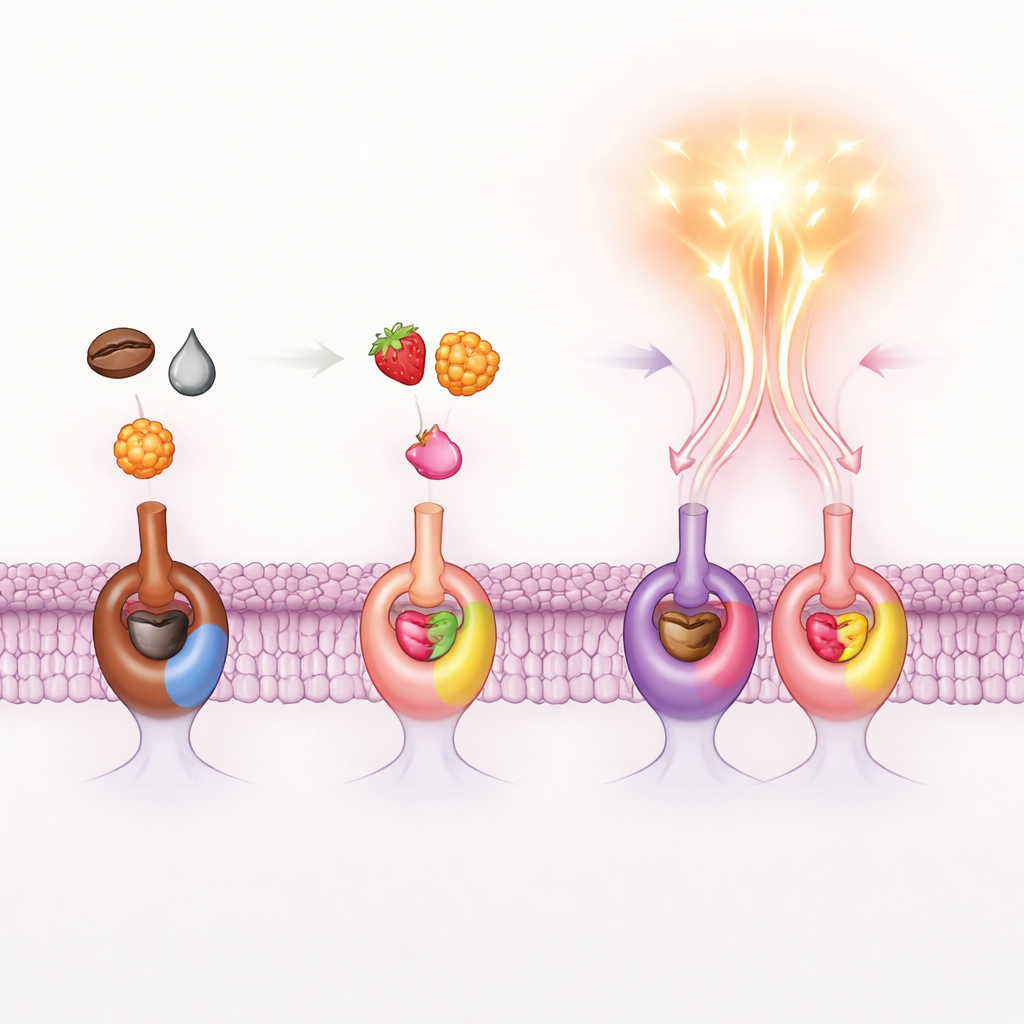
To move beyond human impressions, the scientists recreated parts of the nose in cell culture. They engineered human cells to carry known odor receptors: OR5K1, which responds strongly to the roasted compound, and OR2W1, a more generalist receptor that responds well to the caramel-like molecule. By measuring a light signal tied to receptor activation, they could track how strongly each receptor reacted to its preferred odor. As expected, OR5K1 lit up in response to the roasted compound but not the caramel-like one, while OR2W1 did the opposite. When both smell molecules were added together, each receptor produced a stronger signal than with its favorite odor alone—up to about 20% more for the roasted receptor and about 40% more for the caramel receptor. This confirmed that synergy seen in people also appears directly at the first step of smell detection.
Untangling the Molecular Dance
To understand how two different molecules could boost each other without getting in each other’s way, the team used modern structure-prediction software and computer simulations. They modeled each receptor interacting with both smell molecules over hundreds of nanoseconds of simulated time. The roasted compound nestled deeply and stably into the binding pocket of its favored receptor, forming several snug contacts. The caramel-like molecule, by contrast, attached loosely there and tended to drift away, explaining why it cannot activate that receptor alone. The opposite held true in the more broadly tuned receptor. Crucially, the models suggested that when both molecules are present, they can occupy distinct regions rather than fighting for a single spot. This “non-competitive” co-binding is consistent with the stronger signals seen in the cell assays.
What This Means for Wine and Beyond
Taken together, the sensory tests, cell experiments, and computer modeling paint a coherent picture: the roasted and caramel-like aroma molecules in red wine can simultaneously latch onto different parts of our smell receptors in ways that amplify the outgoing signal. That amplification shows up first as stronger receptor activity in cells and ultimately as a more vivid, easier-to-detect aroma in the glass. Although the study uses higher concentrations than those typically found in real wines and looks only at a small slice of the nose’s 400-plus receptors, it offers a concrete molecular explanation for why certain flavor combinations feel “richer” than expected. In practical terms, this framework could help winemakers and food developers fine-tune complex aromas by deliberately pairing compounds that cooperate at the receptor level, rather than simply increasing the amount of a single ingredient.
Citation: Hu, B., Zheng, H., Shen, Y. et al. Elucidating odorant synergy in red wine: through olfactory receptor-based profiling. npj Sci Food 10, 141 (2026). https://doi.org/10.1038/s41538-026-00793-9
Keywords: red wine aroma, odorant synergy, olfactory receptors, food flavor chemistry, sensory perception