Clear Sky Science · en
AI-driven prediction of consumer liking of coffee from sensory data
Why your daily coffee tastes “just right”
Coffee lovers know that some cups feel magical while others fall flat, even when they look the same. This study asks a simple question with big implications for drinkers and roasters alike: can we use data and artificial intelligence (AI) to predict whether people will actually enjoy a cup of black drip coffee, just from how it tastes and how it was brewed? By unpacking which sensory traits matter most, the research points toward more reliably delicious coffee for a wide range of palates.
How the researchers tasted all that coffee
To explore what drives enjoyment, the team reanalyzed a large consumer study of 27 different black drip coffees, all made from the same beans but brewed with different settings for strength, extraction, and temperature. A total of 118 regular coffee drinkers rated how much they liked each sample on a nine-point scale. They also judged whether three sensations—overall flavor strength, acidity, and mouthfeel—were “too little,” “too much,” or “just about right,” and checked off which of 17 flavor descriptions (like “sweet,” “nutty,” or “fruity”) applied to each cup. On top of that, the brews were measured in the lab for properties such as acidity (pH), total dissolved solids, and other brewing parameters. 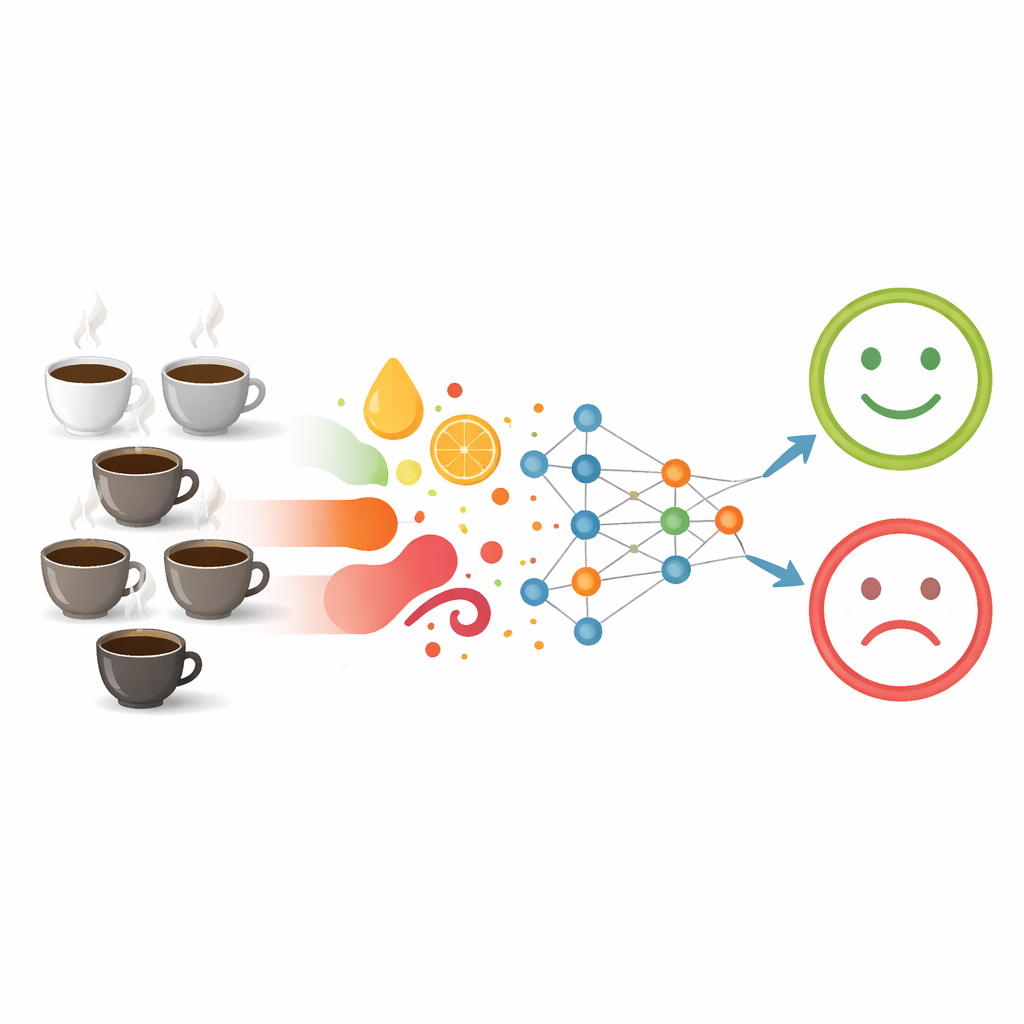
The few taste clues that matter most
Rather than assume which traits mattered, the researchers let the data speak. They ranked every measured feature by how strongly it tracked with people’s liking scores, using several statistical and machine-learning methods. Across the whole group of drinkers, three simple sensory impressions stood out as the strongest predictors of enjoyment: whether the flavor intensity felt “just about right,” whether the acidity felt “just about right,” and whether the coffee seemed sweet. Cups that were judged as having badly off-target flavor strength or acidity—either too weak or too strong—tended to score lower. Sweet-tasting coffees, and those described with notes like dark chocolate, roasted, and nutty, were generally liked more, while sour, burnt, and bitter impressions hurt liking. Interestingly, chemical and physical measures such as brew temperature rarely lined up with liking on their own, except for pH, where less acidic (higher pH) coffees were favored in some views of the data.
Teaching AI to guess if you’ll like a cup
Armed with these ranked features, the team trained AI models to predict either a person’s liking score or simply whether they would like or dislike a given coffee. Remarkably, they found that just three inputs—perceived flavor intensity, perceived acidity, and perceived sweetness—were enough to make solid predictions. A model using only these three sensory cues correctly guessed like-versus-dislike about three-quarters of the time, and could estimate liking scores within roughly one point on the nine-point scale on average. Even when the models were fed only objective brew measurements, such as total dissolved solids, pH, pour temperature, and a measure of titratable acidity, they still performed much better than chance at predicting which brews would appeal to consumers. 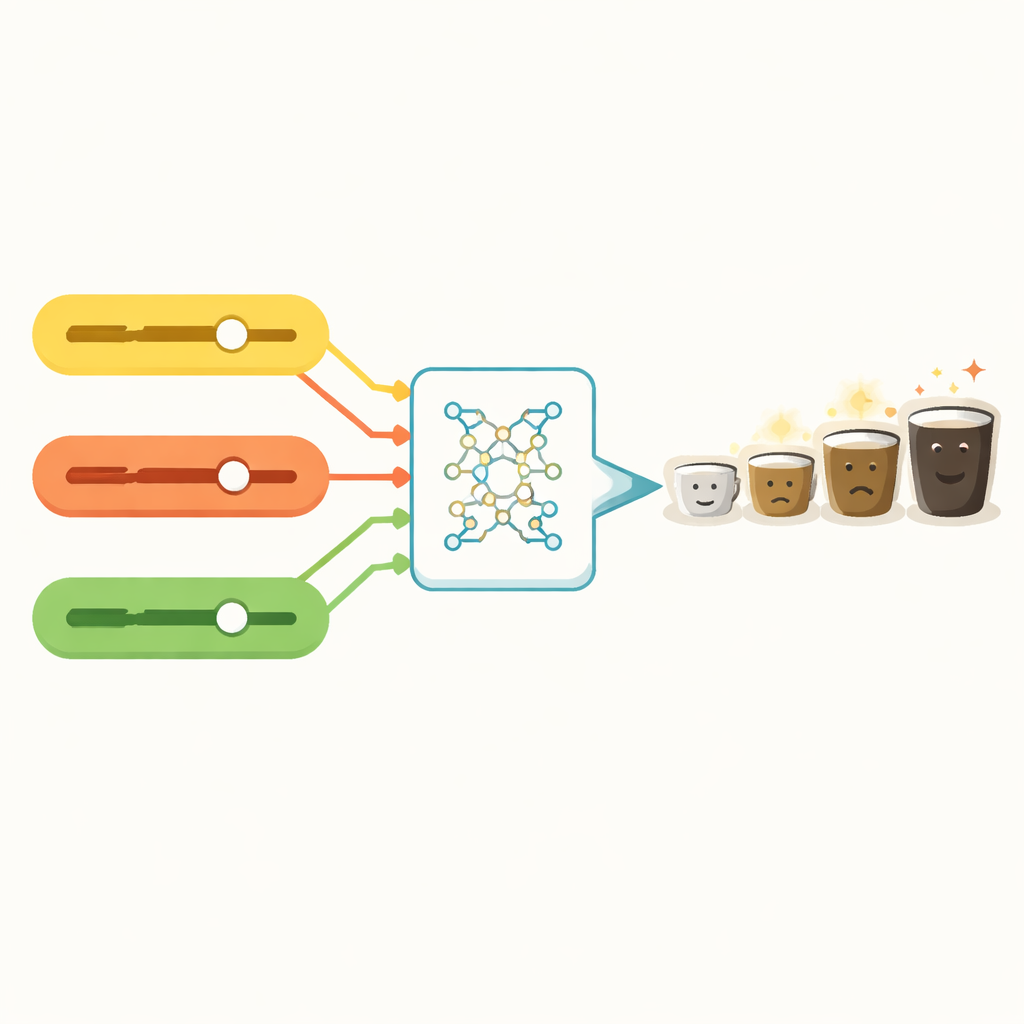
Not all coffee drinkers want the same thing
Of course, coffee preferences are famously personal. To probe this, the researchers created a new way to group consumers based on how each person’s liking moved up or down with specific flavor tags. They turned every drinker into a “preference fingerprint” that captured how strongly they tended to like or dislike coffees described as sweet, roasted, fruity, and so on. Using a clustering technique, they found two main segments. One group leaned toward classic comfort notes like dark chocolate, roasted, nutty, and caramel. The other group was more open to tea-like, fruity, floral, and citrus flavors, and more tolerant of certain bitter or sour elements. Surprisingly, the two segments sometimes linked the same brewing changes—such as higher strength or higher pH—to different sensory impressions, suggesting that people may literally experience the same coffee differently.
What this means for your next cup
For everyday coffee drinkers, the takeaway is reassuringly simple: the best-liked black drip coffees strike a careful balance. They have enough flavor intensity to feel satisfying but not overwhelming, acidity that feels bright but not harsh or dull, and an overall impression of sweetness, often tied to chocolatey or roasted notes rather than sugar. This study shows that AI can capture those preferences with only a handful of sensory clues and use them to predict which brews people will enjoy. For roasters, cafes, and home brewers, that could eventually mean smarter tools for dialing in recipes to match different taste segments—whether you crave a smooth, nutty comfort cup or a more adventurous, fruity and floral brew.
Citation: Gunning, M., Laforgue, M.P.S., Guinard, JX. et al. AI-driven prediction of consumer liking of coffee from sensory data. npj Sci Food 10, 142 (2026). https://doi.org/10.1038/s41538-026-00779-7
Keywords: coffee preference, sensory analysis, consumer liking, machine learning, brew strength and acidity