Clear Sky Science · en
Subcritical water hydrolysis for food applications: Temperature-dependent conversion and bioactivities of meat proteins
Turning Meat Leftovers into Smart Food Ingredients
Many parts of animals never make it onto our plates, even though they are rich in valuable proteins. This study explores a greener way to transform pork meat, including lower-value cuts, into concentrated ingredients that could quietly boost the nutrition, shelf life, and even the taste of everyday foods. By using only hot pressurized water instead of added chemicals or costly enzymes, the researchers show how to unlock health-related benefits from meat proteins while supporting more sustainable use of resources.
Hot Water Under Pressure as a Green Tool
The core of the work is a technique called subcritical water processing, where ordinary water is heated well above boiling but kept liquid by pressure. In this altered state, water behaves more like a gentle chemical reactor: it flows more easily, dissolves different substances, and can break large biological molecules apart. The team compared this method with a standard approach that uses a commercial enzyme to cut meat proteins into smaller pieces. Pork loin served as the model material, with treatments ranging from mild heating at 100 °C up to an intense 300 °C. They then measured how much protein moved into solution, how many small building blocks were released, and how the resulting mixtures behaved in biological and taste tests. 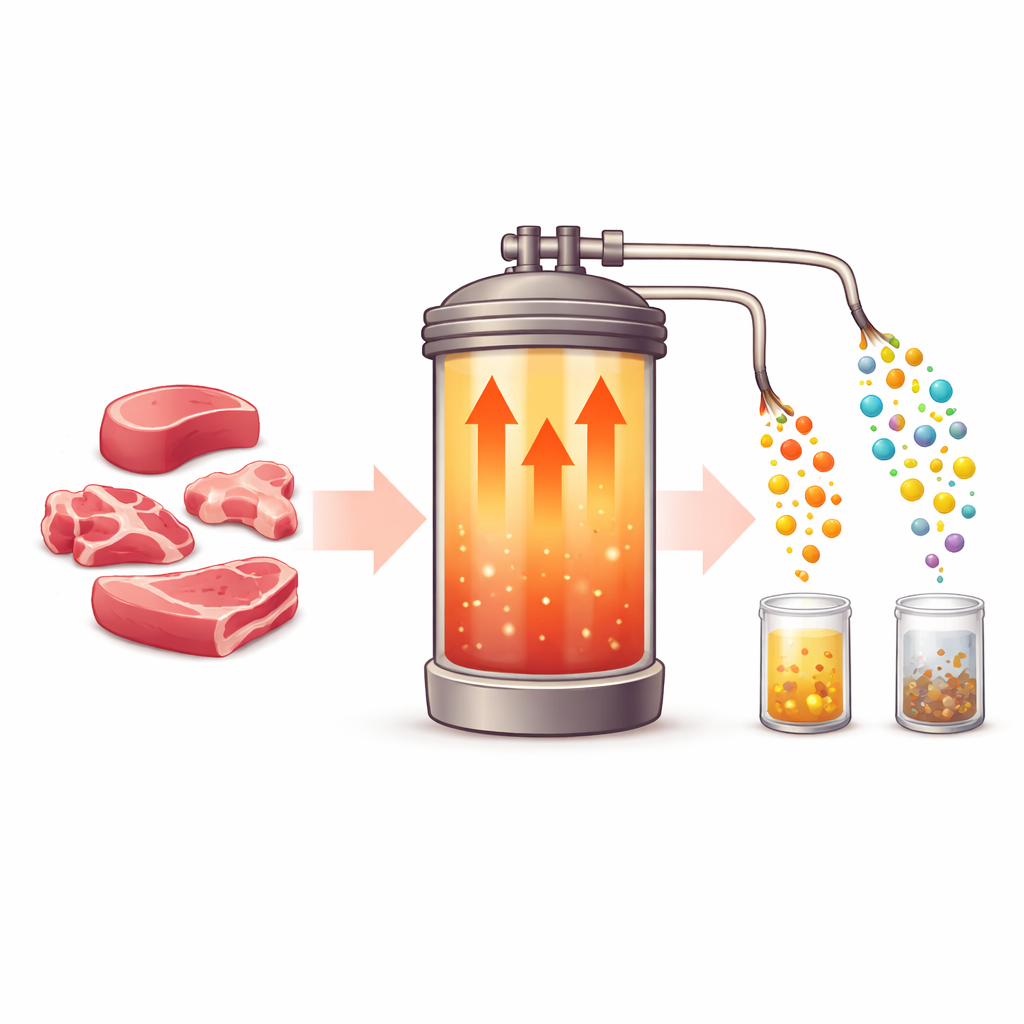
Finding the Sweet Spot for Breaking Proteins
At lower temperatures, the hot water alone did a poor job: proteins tended to clump together instead of dissolving, leading to low recovery. Once the water reached around 200 °C, the picture changed sharply. Most of the meat proteins were now converted into soluble fragments, and at 250–300 °C nearly all of them were liquefied. Analysis of fragment size showed that higher temperatures shifted the mixture toward short chains of amino acids, the tiny units that make up proteins. Above 250 °C, the pattern of fragments resembled what enzymes usually produce, meaning that carefully controlled hot water could stand in for specialized protein-cutting tools, but with faster action and without added chemicals.
Health-Linked Activities Without Added Toxicity
The researchers then asked whether these meat-derived fragments might actually be useful for health. In cell tests, mixtures produced at 200–250 °C supported normal cell survival, while even the harshest 300 °C treatment remained within accepted safety limits, though with some decline in cell vitality. The fragments strongly neutralized free radicals, which are linked to cell damage, and they blocked angiotensin-converting enzyme, a target related to blood pressure control. These helpful effects were weak or absent at low temperatures but rose steeply once the treatment reached 200 °C, peaking around 250 °C. Changes in the types and lengths of the peptide chains, and in the balance of specific amino acids, appeared to underlie this surge in activity. 
Balancing Flavor, Friendly Microbes, and Function
Beyond lab assays, the team considered how such ingredients might behave in real foods. An electronic “tongue” showed that extreme conditions (300 °C) created more bitterness, similar to what is often seen with standard enzyme treatments. In contrast, subcritical water below 250 °C tended to maintain or enhance savory, umami-like notes and dampen harsh bitter tones, suggesting that these hydrolysates could be added to foods with less need for masking flavors. When tested with probiotic gut bacteria, milder treatments allowed normal growth, but mixtures from above 250 °C suppressed both tested strains. While this raises questions about effects on the microbiome, it also hints at selective antimicrobial properties that could help preserve foods.
Practical Promise for Future Foods
Overall, the study shows that carefully controlled hot pressurized water can transform pork proteins into concentrated mixtures rich in small peptides that act as antioxidants, potential blood pressure helpers, and flavor contributors. A treatment temperature around 250 °C emerged as a practical compromise: protein recovery was high, health-linked activities were strong, taste was favorable, and no clear toxicity was detected. This approach could turn underused meat cuts and trimmings into versatile, high-value ingredients for processed meats, sauces, and specialized diets, advancing both sustainability and the quiet fortification of everyday foods.
Citation: Lee, J.W., Lee, S. & Hong, GP. Subcritical water hydrolysis for food applications: Temperature-dependent conversion and bioactivities of meat proteins. npj Sci Food 10, 114 (2026). https://doi.org/10.1038/s41538-026-00770-2
Keywords: subcritical water, meat protein hydrolysates, bioactive peptides, functional foods, upcycling