Clear Sky Science · en
Spatiotemporal moisture digital reconstruction of root zone and precision irrigation using FDR-HY2D for facility-based strawberry
Why Smarter Watering Matters for Strawberries
Strawberries are famously thirsty plants, but in many farms much of the irrigation water never reaches the berries. Instead, it leaks deep into the soil, out of reach of the roots, wasting water and carrying fertilizer with it. This study presents a new way to “see” how water moves around strawberry roots in real time and to use that insight to irrigate more precisely. The result is a system that keeps plants better hydrated with less water, while cutting waste and supporting healthier growth.
The Problem with Guesswork Watering
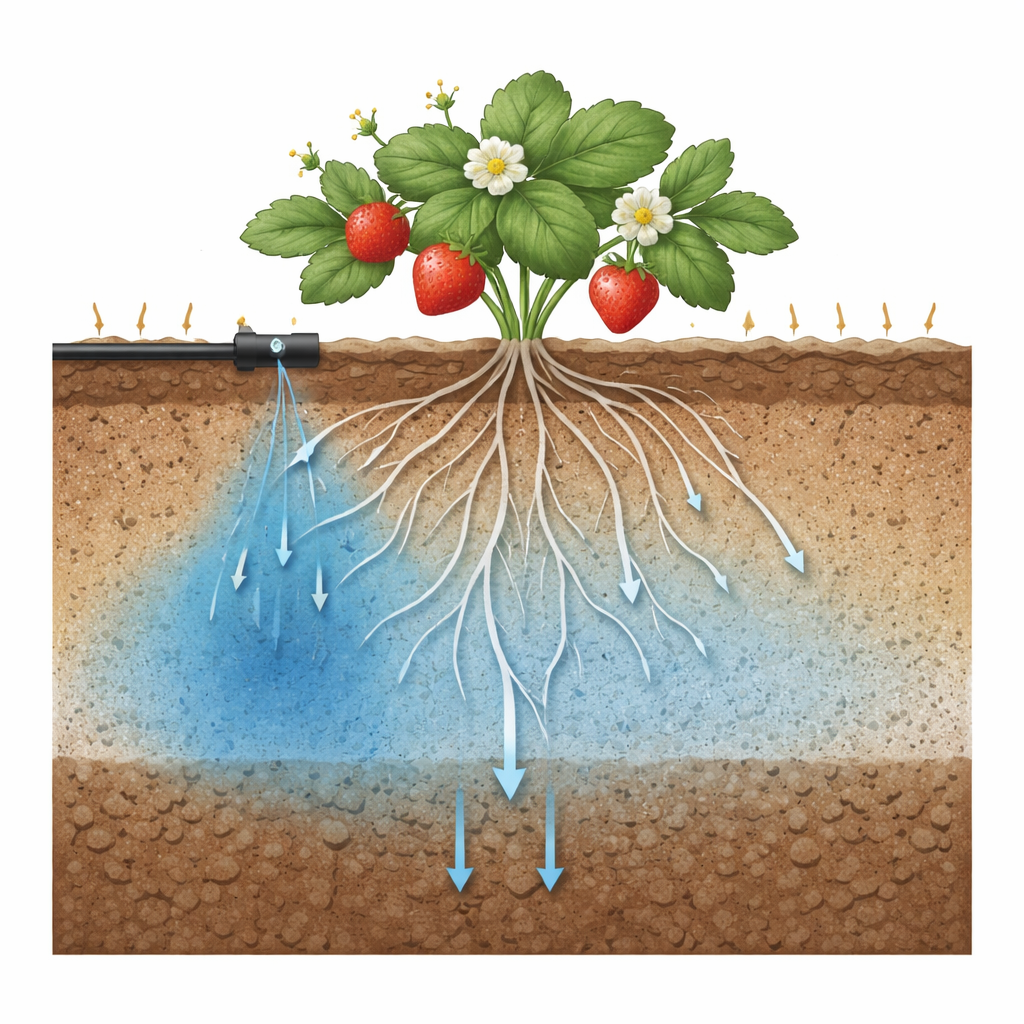
Traditional drip irrigation for strawberries often relies on fixed schedules or simple moisture thresholds. That approach ignores how shallow and sensitive strawberry roots are, and how unevenly water spreads under drip lines and plastic mulch. As a result, a large share of irrigation water can sink below 60 cm, where roots cannot reach it. Earlier work has shown that in some systems more than half of the applied water is lost this way, reducing water-use efficiency and increasing the risk of nutrients leaching into deeper soil layers.
Bringing Sensors and Physics Together
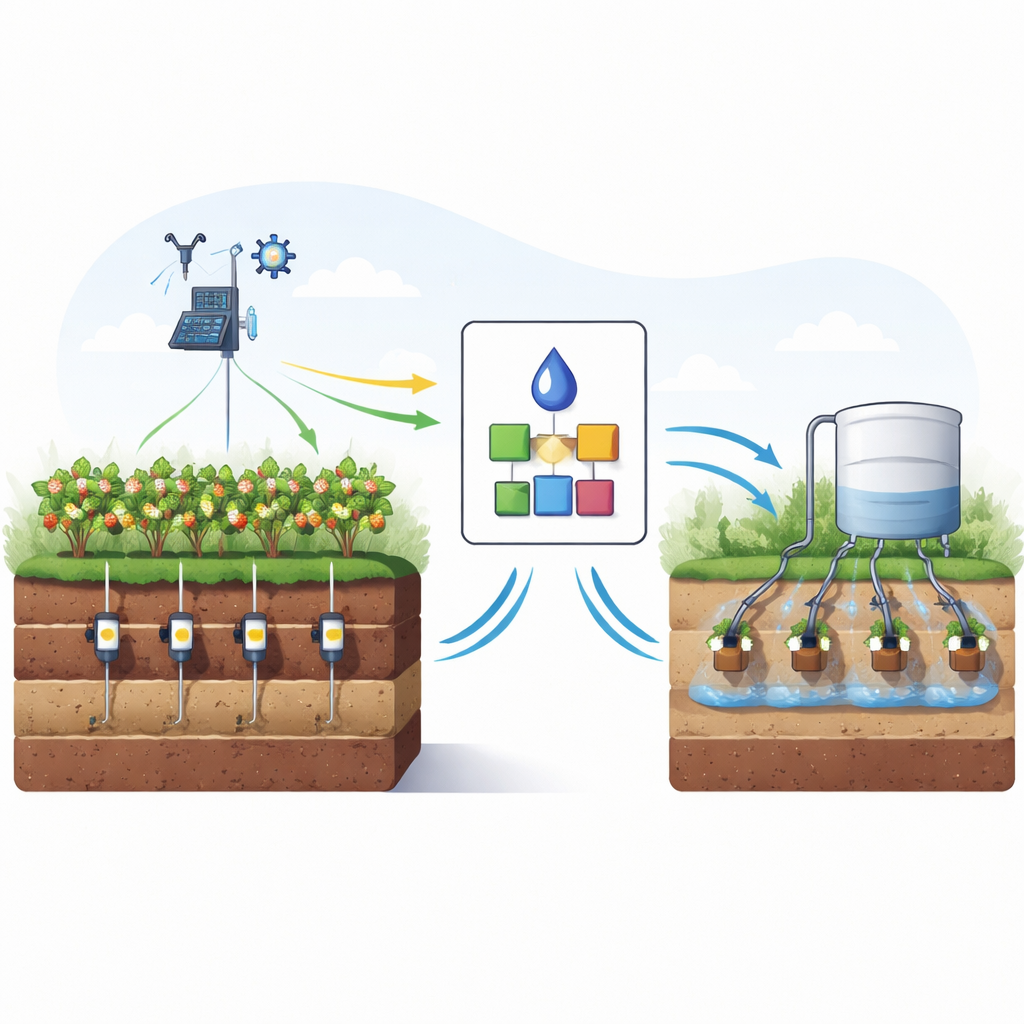
The researchers tackled this by tightly coupling field sensors with a detailed computer model of water movement in soil. They used frequency domain reflectometry (FDR) probes placed at several depths in the root zone to measure soil moisture frequently over time. These data streams were continuously fed into a two-dimensional soil–water model called HYDRUS-2D. Instead of treating soil as a simple “bucket,” this model represents how water from drip emitters spreads sideways and downward, how roots take it up, how much evaporates from the surface, and how much leaks past the root zone. The team calls this combined approach FDR-HY2D.
Testing Against Existing Irrigation Models
To see whether their method really captured reality better, the authors compared FDR-HY2D with two widely used crop water models, SIMDualKc and AquaCrop. They checked how well each model could reproduce measured soil moisture at 25, 40, and 60 cm under different irrigation strategies. The simpler models, which rely on one‑dimensional water balance calculations, tended to exaggerate deep percolation and either overreact or underreact to irrigation events. In contrast, FDR-HY2D closely matched the observed rapid rises in soil moisture after watering and the more gradual, stage‑dependent drying. Statistical tests showed that FDR-HY2D had higher agreement with measurements and lower error than the other two models across depths and treatments.
Following the Water: From Waste to Productivity
Beyond tracking moisture, the key question is where the water actually goes. By reconstructing the full water balance, the study showed that conventional, empirically scheduled irrigation leads to a “deep seepage–dominated” pattern: only about a third of the water supports plant evapotranspiration, while most drains away. AquaCrop improved this somewhat but still allowed around one‑third of the water to escape below the roots. With FDR-HY2D‑guided irrigation, the total irrigation volume was cut while keeping plant water use similar. More than four‑fifths of the applied water was converted into crop evapotranspiration, and deep seepage dropped to roughly one‑tenth of the total. Evaporation from bare soil was also reduced, especially in later growth stages.
Healthier Plants with Less Water
The researchers then asked whether this smarter redistribution of water actually helped the strawberries themselves. Under FDR-HY2D‑based irrigation, plants developed a larger leaf area, maintained strong photosynthesis, and showed more favorable stomatal behavior—signs of good hydration and active gas exchange—across all growth stages. Instantaneous water-use efficiency, defined as how much carbon the plant gains per unit of water it transpires, was consistently higher than under the other two irrigation schemes. A correlation analysis confirmed that higher crop transpiration, when paired with controlled deep seepage, went hand in hand with taller plants, denser canopies, stronger photosynthesis, and better overall water-use efficiency.
What This Means for Farmers and Food
Put simply, this work shows that irrigation can be both smarter and leaner. By continuously blending sensor readings with a physics-based picture of how water moves in soil, the FDR-HY2D framework helps farmers shift from “watering more” to “watering where and when it counts.” In strawberries, that means directing water into the top 60 cm where roots are most active, sharply cutting losses to deep drainage, and supporting vigorous growth and efficient photosynthesis even with reduced irrigation totals. The authors argue that this sensor‑and‑model approach can become a digital decision-support tool for precision irrigation in many crops, paving the way toward farms that save water, protect soils, and still deliver high yields.
Citation: Tang, R., Luen, L.C., Tang, J. et al. Spatiotemporal moisture digital reconstruction of root zone and precision irrigation using FDR-HY2D for facility-based strawberry. npj Sci Food 10, 84 (2026). https://doi.org/10.1038/s41538-026-00758-y
Keywords: precision irrigation, strawberry cultivation, soil moisture sensing, water use efficiency, drip irrigation