Clear Sky Science · en
Immunomodulatory and anabolic biphasic scaffold with hierarchical biomimetic structure directed osteochondral defect repair
Helping Worn Joints Heal Themselves
Wear-and-tear in the knee joint is one of the main reasons people struggle with pain, stiffness, and arthritis. Once the smooth cartilage that cushions our bones is damaged, it does not grow back easily, and the underlying bone can also deteriorate. This study presents a new type of two-layer implant designed to nudge the body into repairing both cartilage and bone at the same time, while also calming harmful inflammation inside the joint.
A Two-Layer Patch for Damaged Knees
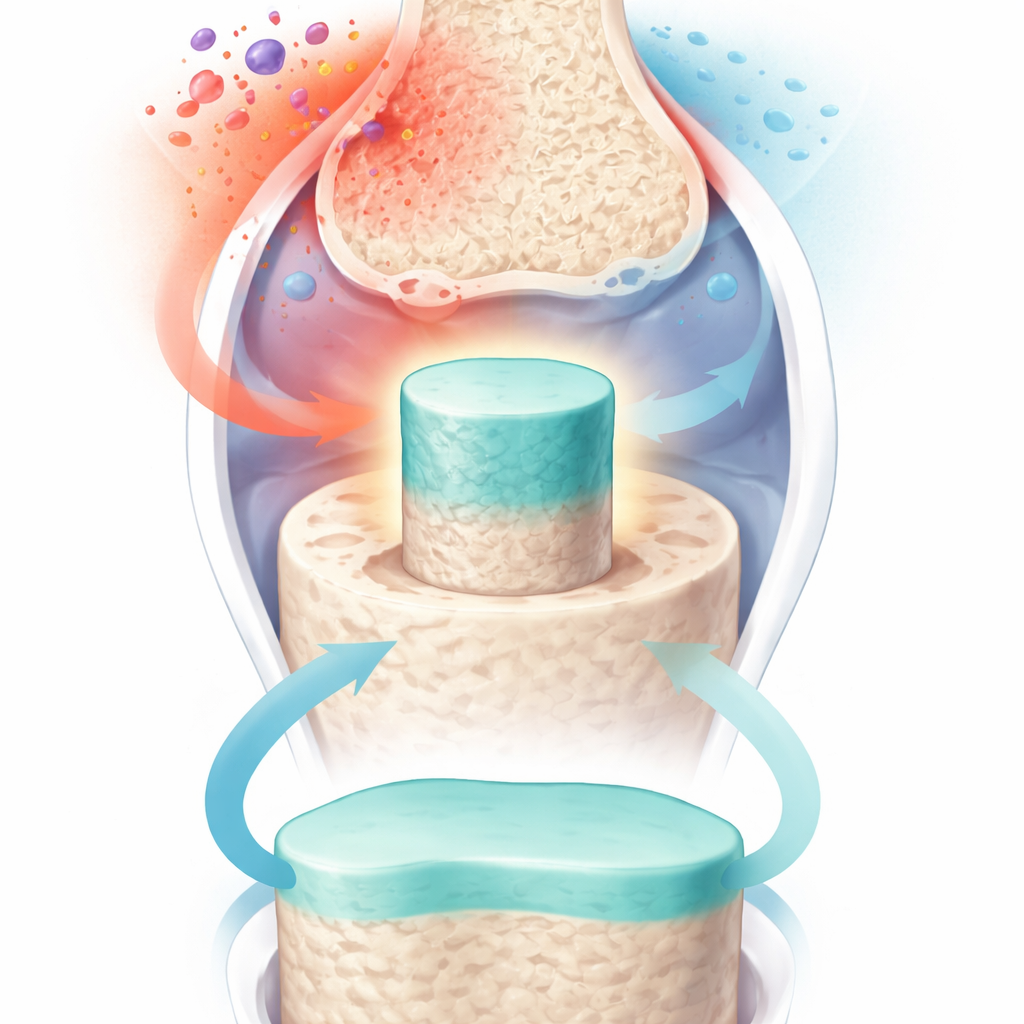
Cartilage and the bone beneath it form a tightly connected, yet very different, pair of tissues: one is smooth and springy, the other is hard and load-bearing. Traditional implants often fail because they cannot mimic both parts at once. The researchers created a “biphasic,” or two-layer, scaffold that imitates this natural structure. The top layer is a soft, water-rich gel meant to resemble cartilage, while the bottom layer is a sturdy, porous glass-like material that behaves more like bone. These layers are gently interwoven at their interface, forming a gradual transition instead of a sharp boundary, which helps the construct stay intact under the forces of walking and movement.
Smart Cartilage Layer That Guides Healing
The upper, cartilage-mimicking layer is more than a passive filler. It is a hydrogel based on a modified version of hyaluronic acid—the same molecule often used in eye drops and cosmetic fillers—within which the team dispersed tiny engineered particles. These particles are built from a porous metal-organic framework coated with a thin shell inspired by mussel adhesive. They slowly release a growth factor called IGF-1, which encourages the body’s own stem cells to migrate into the injury, multiply, and turn into cartilage cells. At the same time, the coating helps shift local immune cells, called macrophages, away from an aggressive, tissue-damaging state and toward a healing, supportive state, creating a more hospitable environment for regeneration.
Bone Support Layer That Builds Strength
The lower layer of the scaffold is a three-dimensional bioglass structure whose pores allow new tissue and blood vessels to grow inward. To further enhance its performance, the authors mixed in a small amount of nanoclay. As this layer gradually breaks down, it releases elements such as silicon, lithium, and magnesium ions that encourage stem cells to adopt a bone-forming identity. Tests with rat bone marrow stem cells showed that extracts from this layer boosted early and late markers of bone formation and led to more mineral deposits, suggesting that the scaffold can actively coax the body into rebuilding strong supporting bone under the repaired cartilage.
Tuning Inflammation to Protect New Tissue
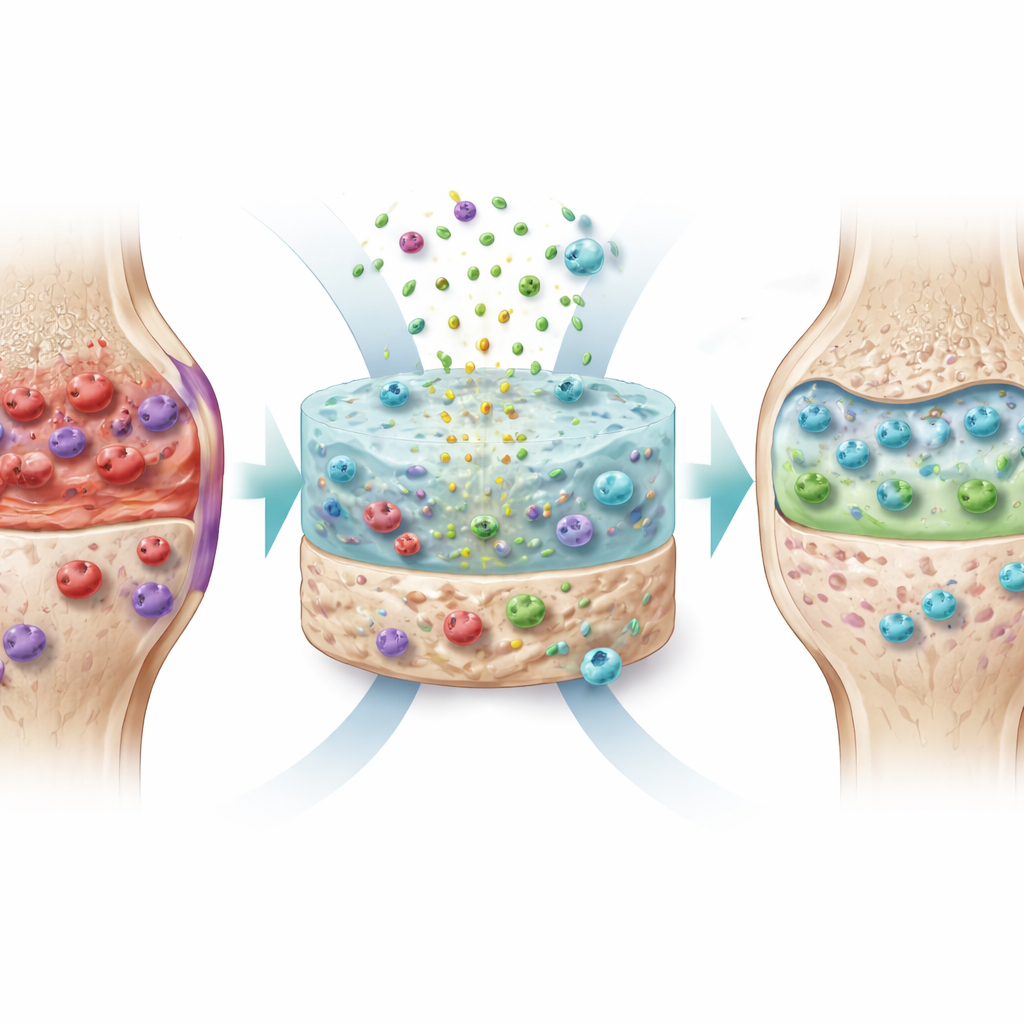
Inflammation is a major obstacle in joint repair: the same signals that rush in to clean up damage can also destroy cartilage and derail stem cells. The team showed that their coated nanoparticles could push macrophages toward a calming, “M2-like” behavior, reducing molecules linked to pain and tissue breakdown while increasing factors associated with wound healing. Notably, these immune cells were stimulated to make a powerful cartilage-friendly signal called TGF-β3, which, together with the released IGF-1, strongly promoted the formation of key cartilage building blocks. In laboratory experiments, stem cells exposed to the full hydrogel system ramped up genes tied to cartilage production and dialed down those that drive cartilage erosion.
Bringing the Strategy Into Living Joints
To test the approach in a living system, the researchers implanted the two-layer scaffolds into small, precisely drilled defects in the knee joints of rats. Over ten weeks, imaging and tissue staining revealed that the defects treated with the full system developed smooth, cartilage-like surfaces rich in the molecules that give cartilage its spring, alongside well-formed underlying bone. This combined scaffold even outperformed a comparison implant loaded with two powerful laboratory growth factors, suggesting that carefully orchestrating the body’s own immune and stem cell responses may be more effective than simply adding more external signals.
What This Could Mean for Aching Joints
In everyday terms, the work outlines a smart, layered “patch” that both supports the joint mechanically and teaches surrounding cells how to rebuild it correctly. By blending controlled release of helpful proteins with gentle steering of the immune system, the scaffold encourages the body to regrow both cartilage and bone in a coordinated way. While more studies in larger animals and over longer time frames are needed, this strategy points toward future treatments that could repair early joint damage and potentially delay or reduce the need for artificial joint replacements.
Citation: Yu, H., Wang, W., Wang, H. et al. Immunomodulatory and anabolic biphasic scaffold with hierarchical biomimetic structure directed osteochondral defect repair. npj Regen Med 11, 17 (2026). https://doi.org/10.1038/s41536-026-00463-0
Keywords: osteochondral repair, cartilage regeneration, bone scaffold, immune modulation, growth factor delivery