Clear Sky Science · en
Phases of quasi-one-dimensional fractional quantum anomalous Hall -- superconductor heterostructures
Strange particles in ultra-thin quantum wires
Physicists are searching for new kinds of quantum particles that could store information in especially robust ways. This study looks at ultra-thin "wires" carved out of exotic two-dimensional materials where electric charge behaves in fractions of the electron charge and where superconductivity can be switched on and off. The work asks a simple question with deep consequences: when these two unusual states of matter meet and the superconducting order becomes very wobbly, what kinds of phases and transitions can appear, and do the sought-after exotic particles survive?
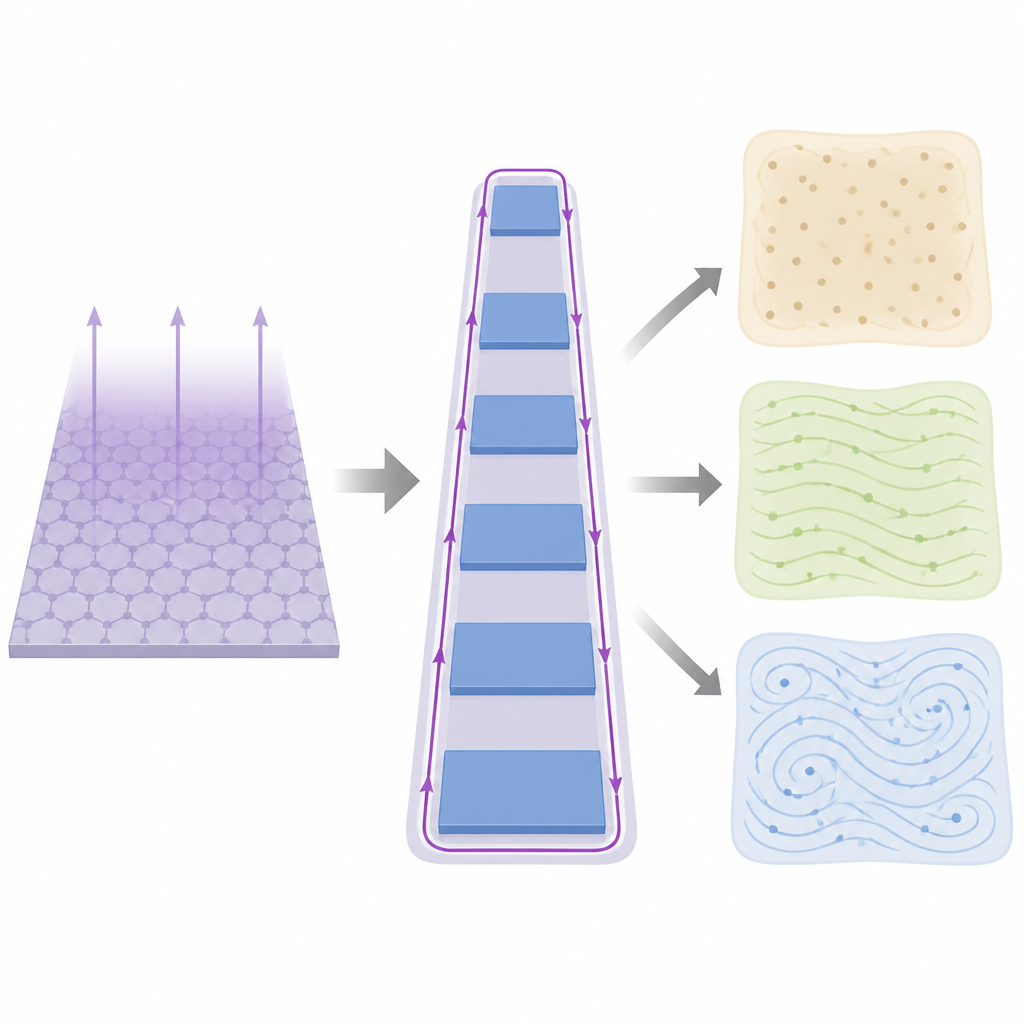
When fractional currents meet fragile superconductors
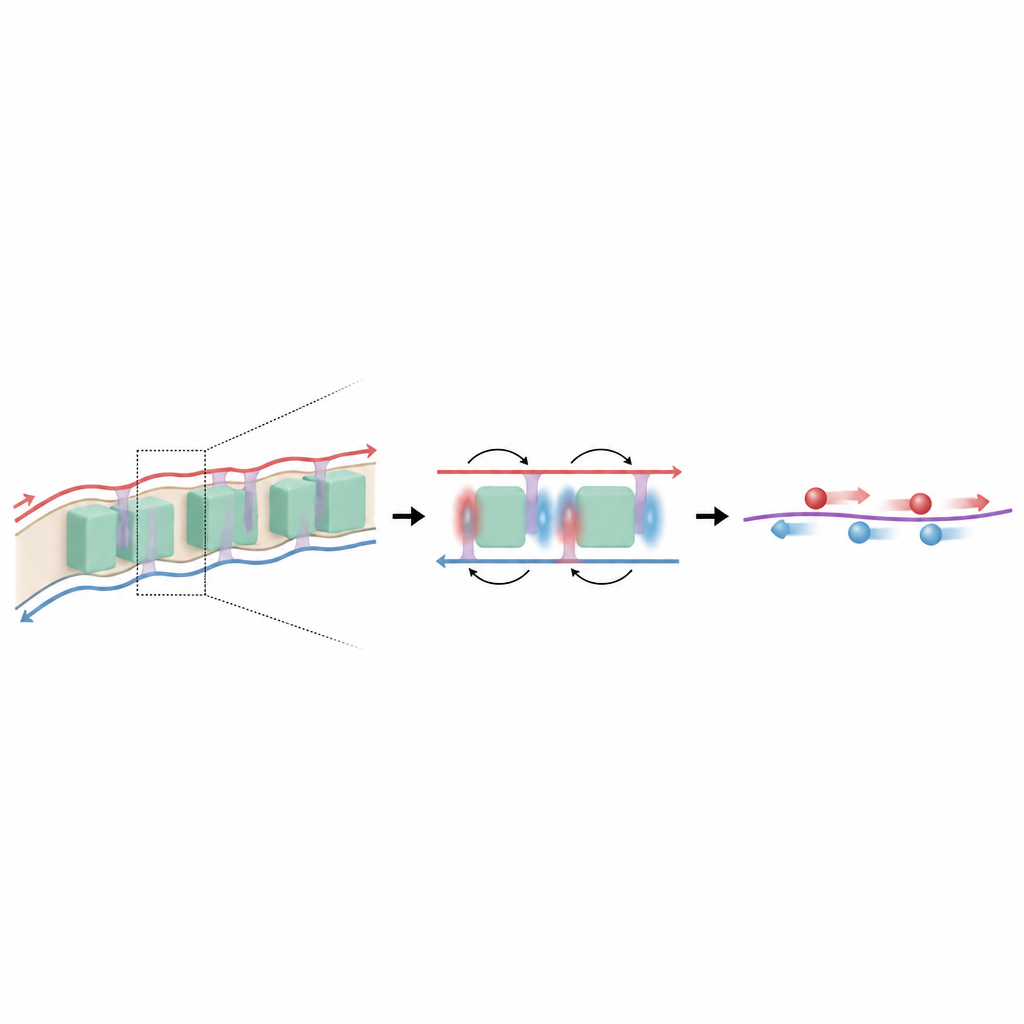
The starting point is a new class of materials that host the fractional quantum anomalous Hall effect. In them, electric current flows around the edges in one direction and carries fractional charge, such as two-thirds of an electron. Experiments have shown that these materials can also become superconducting nearby, and that the transition into the superconducting state is unusually broad, a sign of strong fluctuations in the superconducting order. The authors imagine carving a long, narrow gated region inside such a material, creating an alternating pattern of superconducting strips and ordinary regions threaded by fractional edge channels. At the borders between regions where pairing dominates and where ordinary tunneling dominates, theory predicts localized "parafermion" modes, cousins of the better known Majorana quasiparticles.
From a complex quantum strip to a simpler chain model
Because the full system is extremely complicated, the team maps it onto a simpler one-dimensional model that still captures the essential physics. In this picture, each floating superconducting island can host fractional charge in steps of two-thirds of the electron charge, and neighboring islands are coupled by two basic processes: whole Cooper pairs can hop between islands, and fractional quasiparticles can tunnel along the edge. These processes are encoded in a so-called topological Josephson junction chain that includes parafermion operators on each link. The researchers then convert this chain into a rotor model, which treats the charge on each island and the superconducting phase as a pair of conjugate variables, and study it numerically using powerful density matrix renormalization group techniques.
Three kinds of quantum fluid and how they transform
The numerical analysis reveals a rich phase diagram with three main regimes. In one, the system behaves as a Mott insulator, where charge is pinned to each island and charge motion is gapped. In a second regime, charge flows in units of 2e, the charge of a Cooper pair, forming a one-dimensional superconducting-like state known as a 2e Luttinger liquid. In the third regime, the low-energy excitations carry charge 2e/3, reflecting the underlying fractional Hall physics, and form a 2e/3 Luttinger liquid. By tuning the strengths of Cooper-pair hopping, fractional tunneling, and charging energy, the system can be driven smoothly or abruptly between these states. The authors identify familiar Berezinskii–Kosterlitz–Thouless transitions between the insulating and conducting regimes, as well as a more unusual continuous transition where both an internal three-fold structure and a fluid-like mode become critical at once.
Subtle signs of exotic edge behavior
To probe whether truly exotic edge states appear, the team studies how correlation functions and entanglement entropy decay along the chain. In the 2e/3 liquid, certain nonlocal correlation functions fall off only with a power law, signaling extended parafermion-like behavior, whereas in insulating regions they decay exponentially. At the special transition between the 2e and 2e/3 liquids, the scaling of entanglement points to a combined critical theory with a central charge of 9/5, consistent with a three-fold internal sector loosely coupled to a conventional quantum fluid. The analysis also finds a characteristic shift in the entanglement constant by the logarithm of three, hinting at a three-fold ground-state structure that may be tied to parafermion modes at the chain boundaries.
What this means for future quantum devices
For non-specialists, the key message is that a very thin line of material hosting fractional edge currents and fluctuating superconductivity can realize several distinct quantum phases, including one where fractional charges flow freely and carry subtle parafermion signatures. The work shows that even when superconductivity is not rigid but strongly fluctuating, parafermion physics and sharp phase transitions can survive. This provides a roadmap for interpreting future experiments in twisted transition metal dichalcogenides and graphene-based moiré systems, where patterned gates could create and tune these one-dimensional structures and use simple transport measurements to distinguish between ordinary Cooper-pair flow, fractional charge flow, and insulating behavior.
Citation: Bollmann, S., Haller, A., Väyrynen, J.I. et al. Phases of quasi-one-dimensional fractional quantum anomalous Hall -- superconductor heterostructures. npj Quantum Mater. 11, 43 (2026). https://doi.org/10.1038/s41535-026-00897-1
Keywords: fractional quantum anomalous Hall, superconductor heterostructure, parafermions, Luttinger liquid, Josephson junction chain