Clear Sky Science · en
Phonon thermal Hall effect: the roles of disorder, annealing, and metallic contacts
Heat that bends sideways
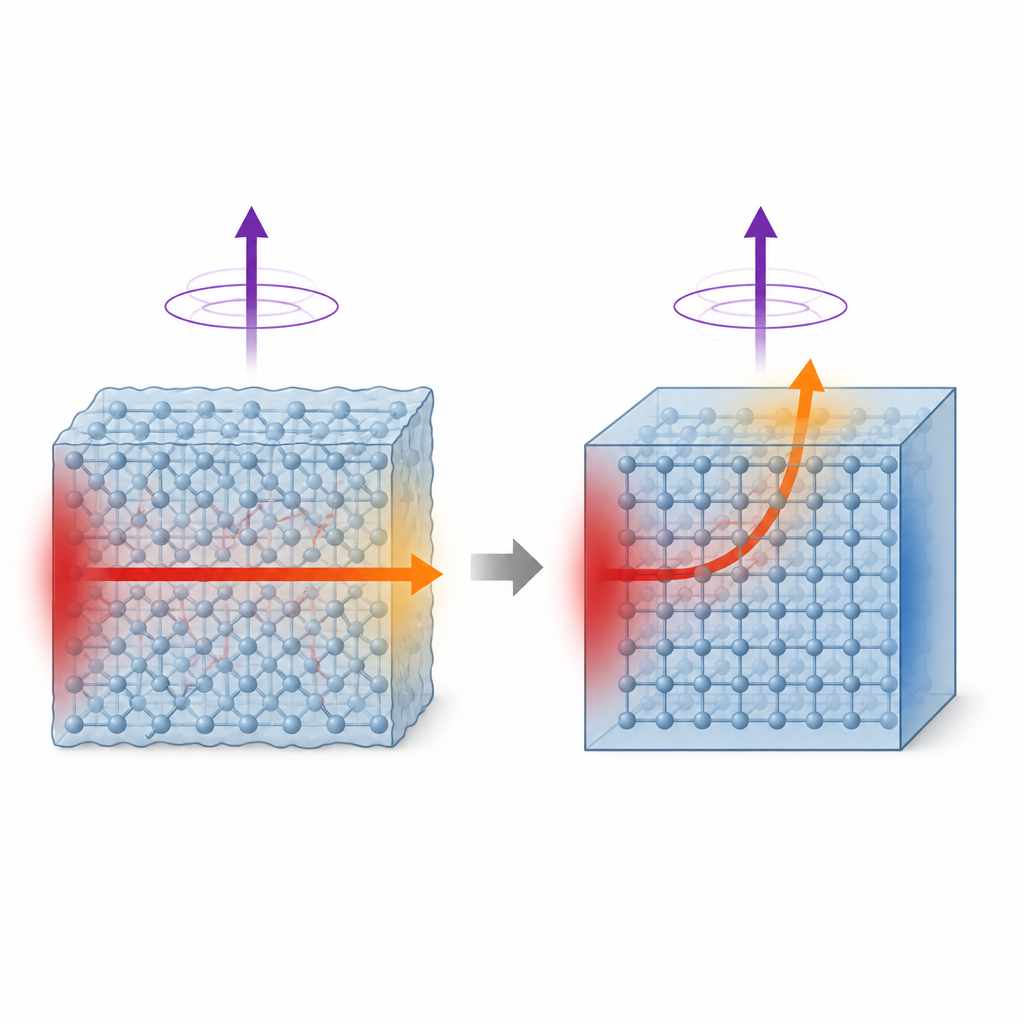
When heat flows through a solid, we normally expect it to move straight from hot to cold. In some crystals, however, a magnetic field can make part of that heat flow veer sideways, a puzzling effect that seems to be carried not by electrons but by the vibrations of the crystal itself. This study asks a simple but crucial question for this strange sideways heat flow: is it a fragile quirk of imperfect samples, or a built‑in trait of the crystal lattice?
Sideways heat in an electrical insulator
The work focuses on strontium titanate, an electrical insulator where this sideways flow of heat, called the thermal Hall effect, had been seen before. Because there are no mobile charges, the heat is carried mainly by phonons, the quantum vibrations of the crystal. The surprise is that, under a magnetic field, some of this phonon heat current runs perpendicular to the imposed temperature gradient. The authors set out to clarify how this signal depends on crystal quality, mechanical strain inside the sample, and the way the measuring wires are attached.
Clean crystals, strong signal
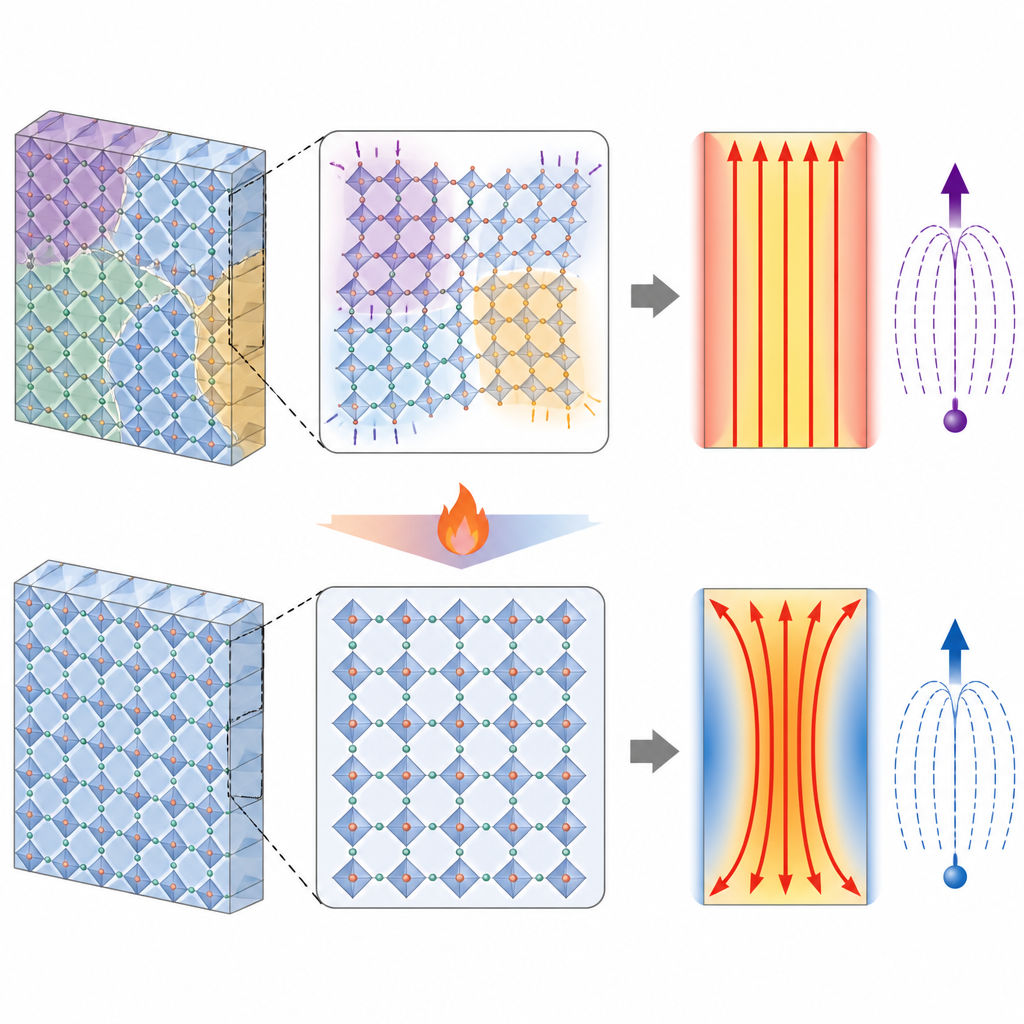
The team measured heat flow in four crystals of strontium titanate from different suppliers, spanning a range from relatively disordered to very clean. All behaved similarly at room temperature, but at low temperatures the cleaner crystals carried heat much more efficiently along the main direction, a sign of longer phonon paths. The sideways response, however, showed an even sharper contrast: high‑quality crystals displayed a clear transverse signal, while in the more disordered samples it was nearly absent. This strong anticorrelation between disorder and sideways heat flow points to the effect being an intrinsic property of an ideal crystal that is easily suppressed when the atomic arrangement is disturbed.
Heat treatment that repairs the effect
To probe the role of internal strain and extended defects, the researchers heated the more disordered crystals in air at high temperature, a process known as annealing. After this treatment, the usual along‑the‑gradient thermal conductivity changed very little, indicating that the average distance phonons travel between collisions stayed about the same. Yet the sideways thermal Hall signal, previously too small to resolve, reappeared clearly. In one sample, repeating the annealing step first produced an uneven signal across different probe positions, then eventually made it uniform, consistent with strain becoming more homogeneous. This decoupling shows that the strength of the sideways heat flow is not set simply by how far phonons travel, but by how coherently the crystal responds across its internal domains.
Checking that the wiring is not fooling us
Some recent theoretical work questioned whether metallic contact pads, often made from silver paste, could themselves create false sideways temperature signals. The authors tackled this concern by comparing measurements on the same crystal using both metallic contacts and insulating, thermally conductive grease. They saw no meaningful difference in either the direct or sideways heat responses. In their geometry and for the relatively large signals observed, any contribution from the contacts appears negligible, suggesting that previously reported phonon thermal Hall signals in similar conditions are not artifacts of the wiring.
What this means for sideways heat
Altogether, the experiments show that in strontium titanate the sideways flow of heat carried by phonons is a genuine property of the crystal lattice, highly sensitive to disorder and internal strain but largely unaffected by the type of contacts used to measure it. By sharpening these practical constraints, the work narrows the space of possible microscopic explanations and provides a clearer foundation for future theories that seek to explain how neutral vibrations in a solid can be nudged sideways by a magnetic field.
Citation: Xiang, Q., Li, X., Guo, X. et al. Phonon thermal Hall effect: the roles of disorder, annealing, and metallic contacts. npj Quantum Mater. 11, 40 (2026). https://doi.org/10.1038/s41535-026-00876-6
Keywords: phonon thermal Hall effect, strontium titanate, heat transport, crystal disorder, annealing