Clear Sky Science · en
Fermi liquid and isotropic superconductivity of Hund scenario for bilayer nickelates
Why this new superconductor story matters
Nickelate superconductors are among the newest contenders in the race to carry electricity without loss at high temperatures. In these materials, electrons live in stacked atomic layers and can team up in different ways to form a superconducting state. This paper asks a basic but crucial question: which kind of electron teamwork is really responsible for the behavior seen in recent experiments, and can one popular idea alone account for what scientists observe?
Two ways electrons can team up
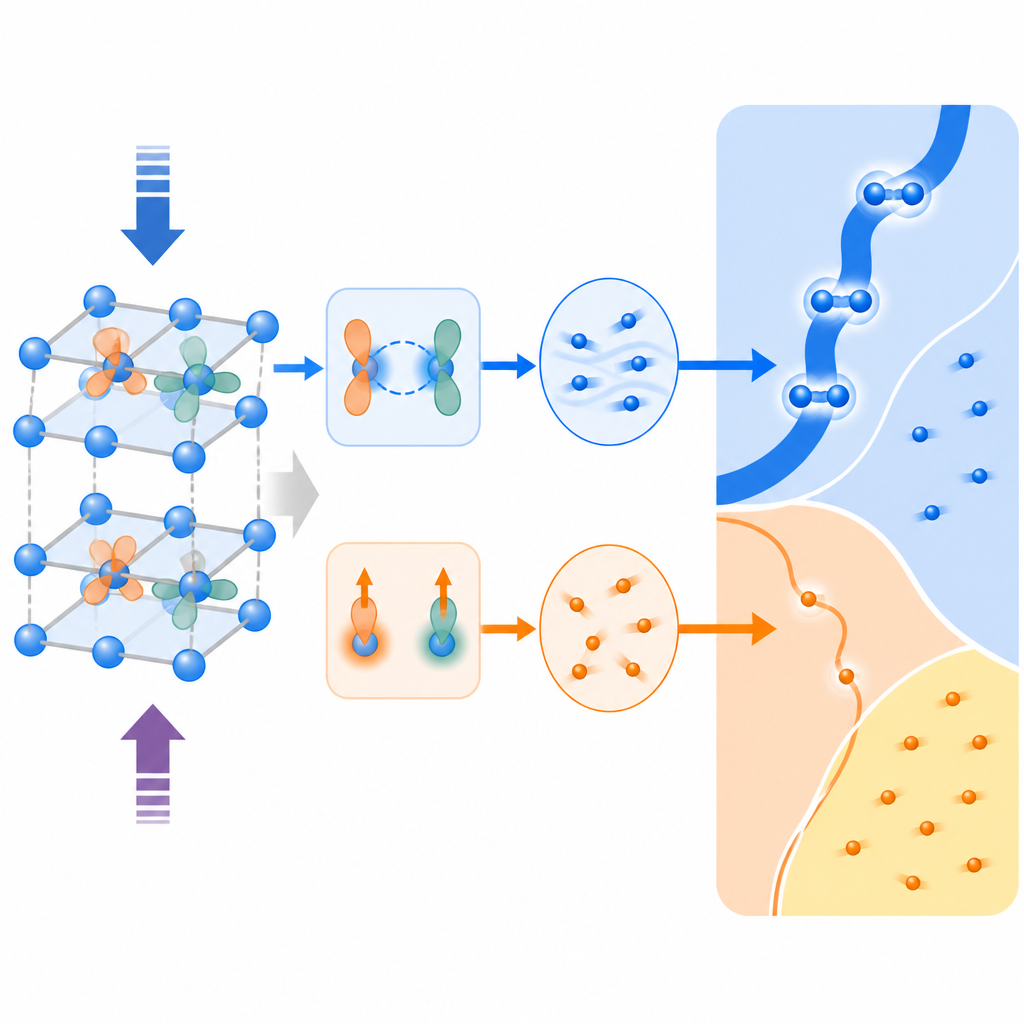
In bilayer nickelates, electrons occupy two main kinds of atomic orbitals within each nickel atom and two closely spaced layers. One school of thought says that superconductivity mainly comes from electrons hopping and mixing between these orbitals across the layers. Another competing view focuses on Hund coupling, a local tendency for electrons in different orbitals on the same atom to align their spins, which then helps build pairs between layers. The authors build a detailed theoretical model that isolates the Hund route and compare it directly with the earlier hybridization picture, using the same computational framework to keep the comparison fair.
What the Hund-only picture predicts
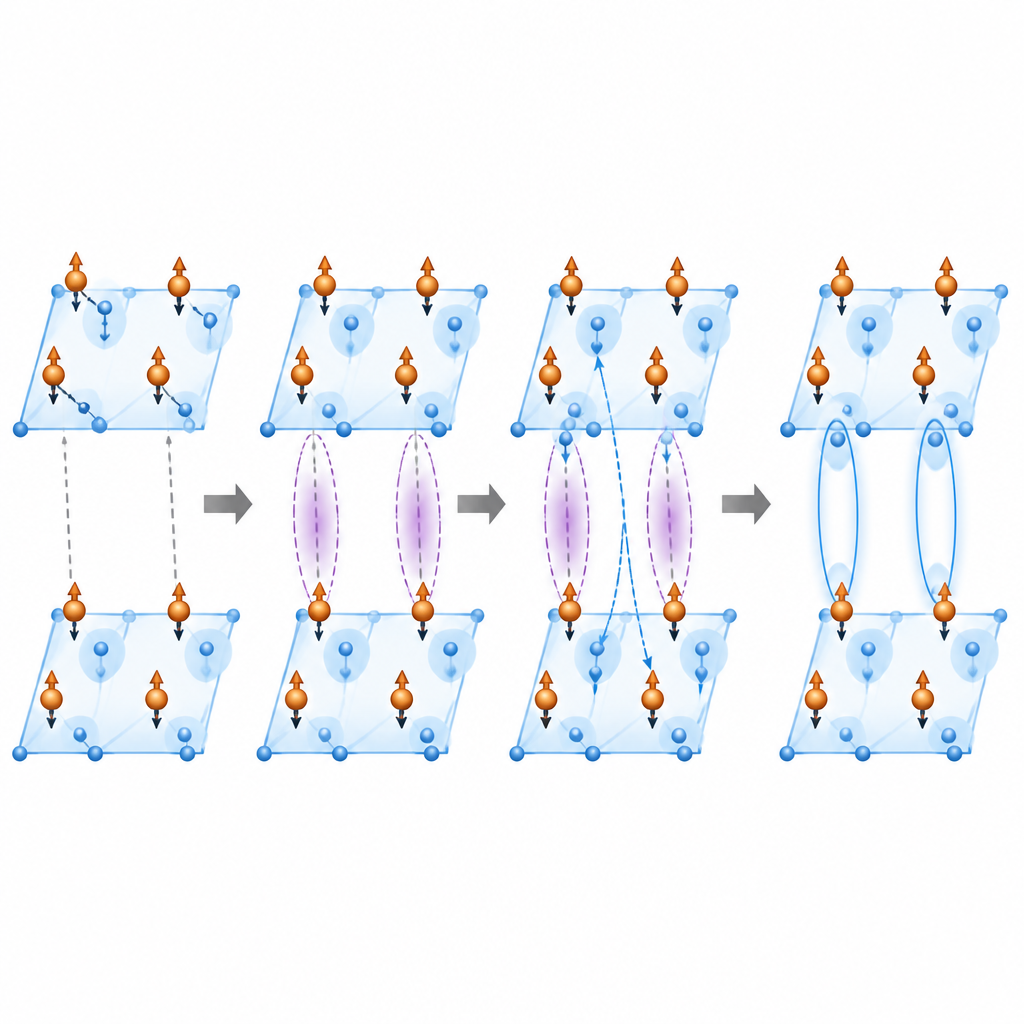
Using a technique called the dynamic Schwinger boson approach, the authors study a model where one orbital carries localized spins and the other hosts mobile electrons. Hund coupling ties the two together, while an interaction between layers favors singlet pairs of the localized spins. When they track how this setup develops as temperature is lowered, they find that the localized spins first form interlayer singlets, and only later transmit pairing to the mobile electrons if the Hund coupling is strong enough. In this scenario the energy gap that marks superconductivity is fully isotropic on the mobile electrons’ Fermi surface, with equal size in all directions but with opposite signs in the two coupled layers.
Lower transition temperatures and gentle metals
The model reveals that the highest possible critical temperature reachable through Hund coupling alone is significantly lower than in the hybridization-based model studied earlier with the same method. In simple terms, Hund coupling is less efficient at passing the pairing glue from localized spins to the mobile electrons. The authors show that the transition temperature rises only once Hund coupling passes a threshold and then saturates at a value about 40 percent below the hybridization case, when measured against the same basic energy scale. They also probe how adding holes to the second orbital affects pairing and find that, within the Hund picture, such hole doping steadily weakens superconductivity instead of helping it.
Always a conventional metallic background
The normal, non-superconducting state in the Hund-based model looks like a textbook Fermi liquid. The distribution of electrons in momentum space shows a sharp Fermi surface and well-defined quasiparticles. The calculated self-energy and density of states show no signs of a pseudogap or the strange metallic behavior seen in some experiments, where resistivity varies linearly with temperature and standard quasiparticle ideas break down. This contrast arises because Hund coupling acts like a ferromagnetic Kondo interaction that flows to weak coupling, while hybridization behaves like an antiferromagnetic Kondo term that grows stronger at low energies and can produce non-Fermi-liquid features.
How theory stacks up against experiments
When these Hund-only predictions are compared with measurements on bulk and thin film bilayer nickelates, several mismatches appear. Experiments report anisotropic energy gaps, where the gap size depends strongly on direction, and both conventional and strange metallic behavior depending on pressure and strain. They also show evidence that mobile bands from both orbitals are involved, even when one Fermi surface pocket is missing. The purely Hund-based model instead gives an isotropic gap on the mobile electrons, a uniformly Fermi-liquid normal state, and a reduced transition temperature that becomes even smaller when realistic parameter changes in thin films are taken into account.
What this means for future studies
To a non-specialist, the takeaway is that a “Hund-only” explanation of superconductivity in these bilayer nickelates does not fit the full experimental picture. Hund coupling can help, but by itself it predicts too simple a metal and too symmetric a superconducting state, and it struggles to reach the observed critical temperatures. The results support the view that orbital mixing across the layers must play a central role, possibly working hand in hand with Hund coupling rather than being replaced by it. Future measurements of how the layers interact and how the energy gap varies around the Fermi surface will be key to pinning down the true mechanism.
Citation: Wang, J., Yang, Yf. Fermi liquid and isotropic superconductivity of Hund scenario for bilayer nickelates. npj Quantum Mater. 11, 39 (2026). https://doi.org/10.1038/s41535-026-00871-x
Keywords: bilayer nickelate, Hund coupling, superconductivity mechanism, Fermi liquid, orbital hybridization