Clear Sky Science · en
Magnetic excitations of the Kitaev model candidate RuBr3
Why strange magnets matter
Some crystals behave like tiny forests of compass needles, with each atomic "needle" interacting with its neighbors in surprising ways. Physicists are searching for special magnets where these interactions create a quantum spin liquid, a state that could help future quantum technologies. This article explores a new material, RuBr3, that was expected to host such an exotic state, and reveals why its magnetism instead locks into a more conventional pattern.
From ideal theory to real materials
The work starts from the Kitaev model, a theoretical recipe for building a quantum spin liquid on a honeycomb lattice, where each bond between atoms favors a different kind of magnetic alignment. In this ideal picture, the magnetic moments behave collectively like two types of emergent particles, including elusive Majorana fermions, and never settle into a fixed pattern even at very low temperatures. Real compounds that might realize this physics use transition metals such as ruthenium or iridium surrounded by halogen ions like chlorine or bromine. The way electrons hop through these surrounding ions controls the unusual bond-specific interactions that the Kitaev model requires.
Swapping chlorine for bromine
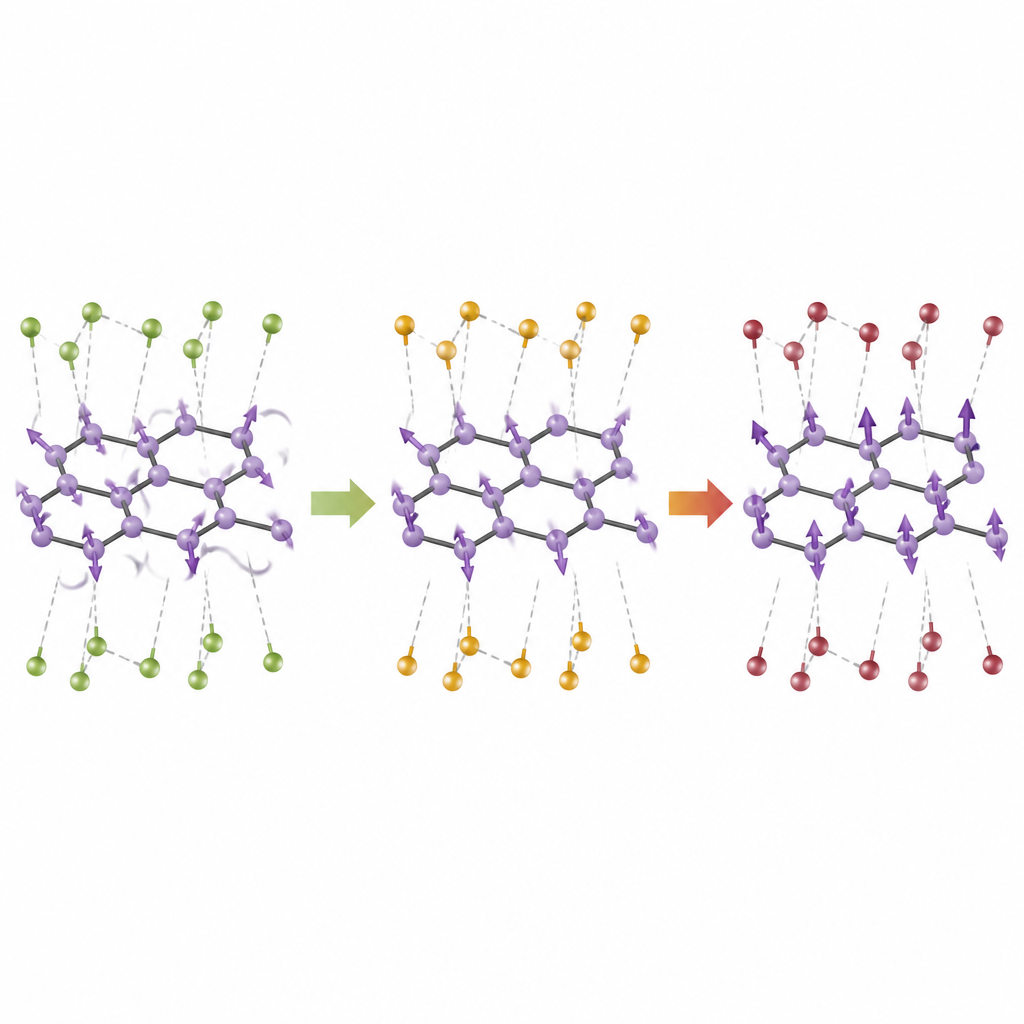
The researchers focus on RuBr3, a cousin of the widely studied Kitaev candidate α-RuCl3. Both materials share a layered honeycomb arrangement of Ru ions, but bromine changes the electronic landscape compared with chlorine. Experiments and prior studies show that replacing Cl with Br shrinks the energy gap between ruthenium and halogen orbitals, increases their hybridization, and makes RuBr3 more conductive. At the same time, its magnetic response points to stronger antiferromagnetic tendencies, meaning neighboring moments prefer to point in opposite directions more strongly than in α-RuCl3.
Taking a snapshot of moving spins
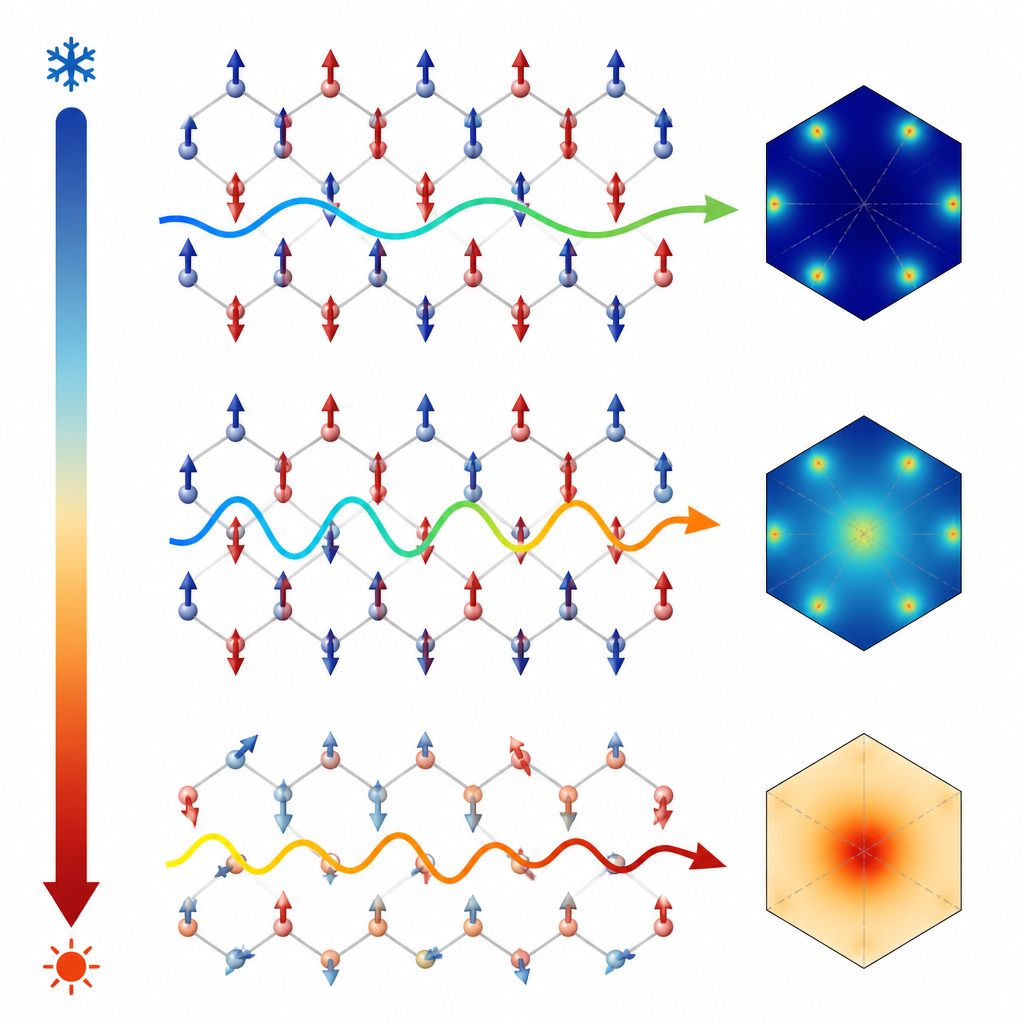
To see how the spins in RuBr3 actually move and interact, the team used powder inelastic neutron scattering, a technique where a beam of neutrons probes how the crystal absorbs and emits tiny packets of energy and momentum. Below about 34 kelvin, RuBr3 forms a zigzag antiferromagnetic pattern, and the measurements reveal strongly dispersive magnetic modes centered at specific wavevectors, a signature of magnons, or collective spin waves, typical of ordered magnets. As the temperature rises above the ordering point, these excitations persist near the same wavevectors before gradually shifting toward the zone center at about three times the ordering temperature, and finally fading out at room temperature.
Hidden forces behind the pattern
The detailed shape and temperature evolution of these excitations carry information about the underlying magnetic forces. In a pure Kitaev spin liquid, spin excitations would be short-ranged in space, only weakly dependent on wavevector, and spread to high energies. Instead, RuBr3 shows strong wavevector dependence and clear magnon bands, indicating that additional antiferromagnetic interactions compete with and outweigh the ferromagnetic Kitaev term. By comparing the data with calculations from linear spin wave theory, the authors find that either strong off-diagonal nearest-neighbor couplings or substantial third-neighbor interactions can reproduce the spectra, with the evidence favoring a model dominated by long-range antiferromagnetic links between third neighbors on the honeycomb lattice.
What this means for quantum spin liquids
Putting the pieces together, the study concludes that in RuBr3 the same bromine substitution that preserves ferromagnetic Kitaev-like interactions also greatly boosts antiferromagnetic couplings that stabilize the zigzag order. Rather than sitting near the delicate balance needed for a quantum spin liquid, RuBr3 is pushed deeper into a conventional ordered phase. For a lay reader, the key message is that small chemical changes in a material’s environment can dramatically reshape the invisible tug-of-war between atomic magnets, steering a system either toward exotic quantum behavior or back toward more familiar magnetic order.
Citation: Nawa, K., Imai, Y., Kofu, M. et al. Magnetic excitations of the Kitaev model candidate RuBr3. npj Quantum Mater. 11, 42 (2026). https://doi.org/10.1038/s41535-026-00868-6
Keywords: quantum spin liquid, Kitaev magnet, honeycomb lattice, inelastic neutron scattering, RuBr3