Clear Sky Science · en
Anomalous Landau levels and quantum oscillation in rotation-invariant insulators
Why solid insulators can act like metals in a magnetic field
When scientists place metals in a strong magnetic field, key properties such as electrical resistance and magnetization start to rise and fall in a regular pattern. These "quantum oscillations" are a classic fingerprint of the sea of mobile electrons at the Fermi surface. Surprisingly, similar oscillations have been observed in some electrical insulators, materials that should have no such free electrons at all. This paper explores how that can happen, and develops a simple way to predict when an insulator will secretly behave like a metal in a magnetic field.
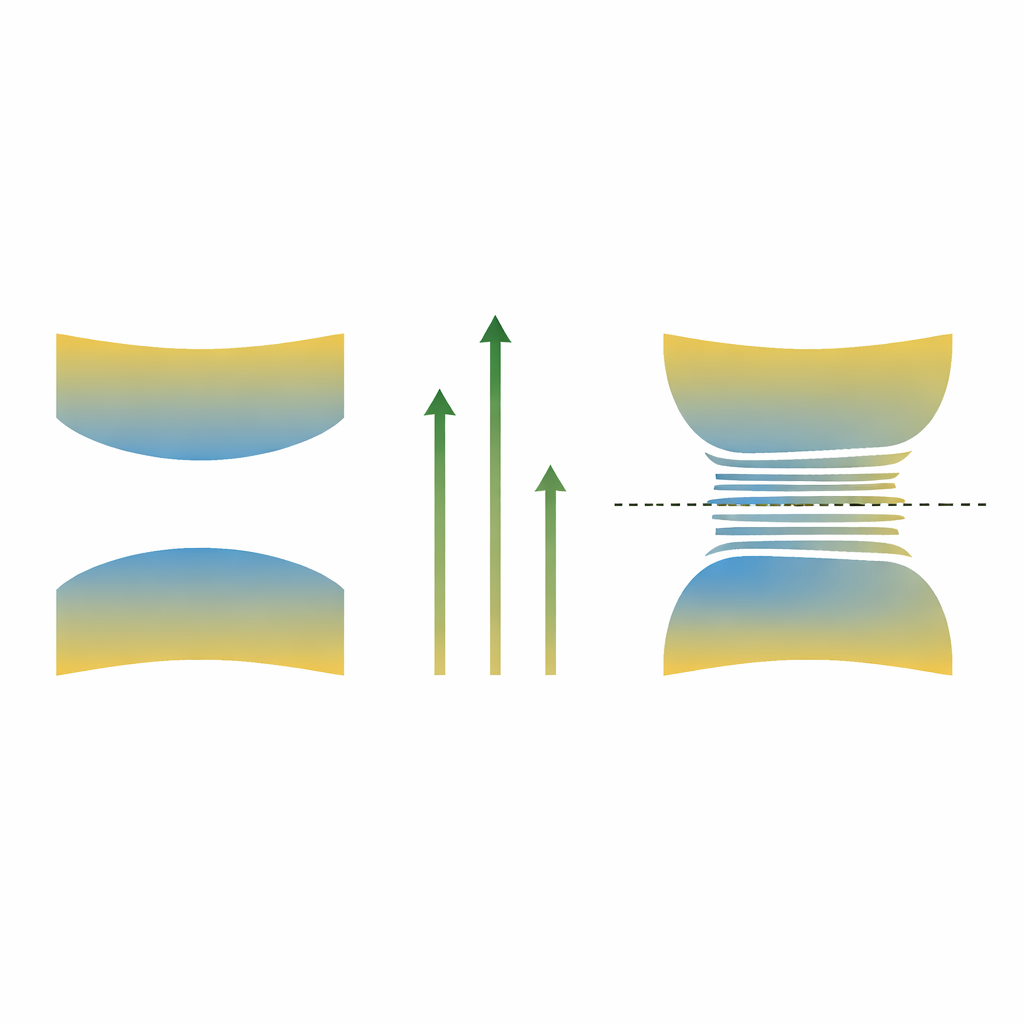
From neat energy bands to hidden levels
In standard textbook pictures, electrons in a crystal fill smooth energy bands separated by forbidden gaps. In a magnetic field, these bands break up into a ladder of sharply defined Landau levels, and quantum oscillations arise when these levels repeatedly cross the energy of the electrons at the Fermi surface. In an ideal insulator, the Fermi surface is absent: the highest filled band is separated from the lowest empty band by a clean gap, so no oscillations are expected. The authors focus on a counterintuitive possibility: that certain Landau levels can be pushed into this gap and wander across the original chemical potential, even though no ordinary electron states exist there at zero field.
How rotation and angular momentum reshape the spectrum
The work concentrates on two-dimensional models whose low-energy behavior is the same in every in-plane direction, a property called continuous rotation invariance. In such systems, each band carries a kind of angular momentum label. When a magnetic field is applied, these labels control how states from different bands can mix, and how their energies shift. The authors show that one can trade the usual, abstract "number" description of Landau levels for an effective-band picture: a magnetic-field–dependent band structure in momentum space, accompanied by a simple quantization rule for allowed momenta. In this view, the magnetic field both bends and shifts the bands in a way that can drive discrete levels into the zero-field gap, creating so‑called anomalous Landau levels.
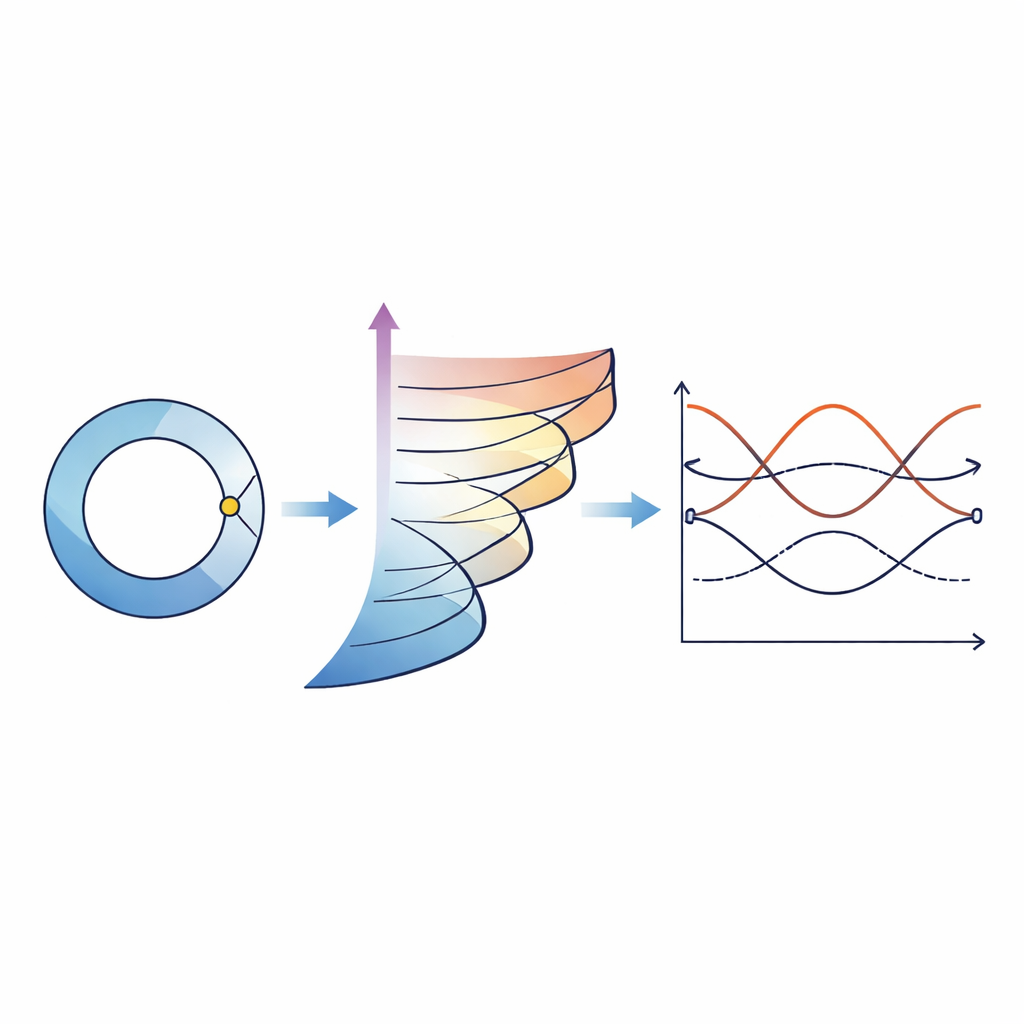
Counting the hidden levels and their oscillations
Once the effective bands are constructed, the problem of predicting oscillations becomes highly visual. As the field grows, the gaps between effective bands can slide up or down relative to the chemical potential. If the gap moves away from the chemical potential, a crowd of Landau levels from a nearby band can spill into the gap and cross that energy one after another. The authors derive a compact formula that estimates how many such levels will do so before the system reaches the extreme, or "quantum limit," where only a few levels remain. When this number is large, the insulator produces Fermi-surface–like quantum oscillations that are regular and well defined, much like in a metal; when it is small, only a few irregular peaks appear.
Model systems from lattices to real materials
To test and illustrate their framework, the authors apply it to several increasingly realistic models. They begin with simple two- and three-band toy systems, where the effective bands and anomalous levels can be drawn and followed by eye. They then turn to a lattice known as the Lieb lattice, whose electrons form an exactly flat band at zero field. In a magnetic field this flat band gently broadens and leaks into the gap, producing anomalous levels whose positions match detailed numerical calculations of the full spectrum. Finally, they analyze thin films of magnetic topological insulators, such as magnetically doped (Bi,Sb)₂Te₃, and identify parameter ranges where the effective bands should generate observable in-gap oscillations, suggesting concrete targets for experiments.
What this means for puzzling experiments
The main message to a non-specialist reader is that an insulator in a magnetic field need not be as inert as it looks. When its bands carry different angular momenta, the field can sculpt new, discrete energy levels inside the original gap. If there are many such levels and they move through the chemical potential in an orderly way, the material will exhibit magnetic-field oscillations that closely mimic those of a metal, even though it remains insulating at zero field. The effective-band recipe developed here provides a practical roadmap for recognizing and designing such behavior in real two-dimensional materials, helping to interpret puzzling experiments and to guide the search for new quantum phases of matter.
Citation: Fu, J., Weng, C.Y. & Po, H.C. Anomalous Landau levels and quantum oscillation in rotation-invariant insulators. npj Quantum Mater. 11, 36 (2026). https://doi.org/10.1038/s41535-026-00867-7
Keywords: anomalous Landau levels, quantum oscillations, topological insulators, magnetic fields, two-dimensional materials