Clear Sky Science · en
A wide-range topological thermometer with Ta2Pd3Te5: from power-law response to application prospects
Measuring the Coldest Places
Understanding how matter behaves at extremely low temperatures is central to modern physics, from quantum computers to exotic new states of matter. But there is a surprisingly basic obstacle: taking a reliable temperature in these ultra-cold environments is very hard. This paper introduces a new kind of thermometer, built from a quantum material called Ta2Pd3Te5, that promises accurate readings from room temperature all the way down toward the coldest temperatures ever reached in the lab.
Why Current Thermometers Fall Short
Most electronic thermometers used in cryogenic laboratories rely on semiconductors, whose electrical resistance increases sharply as they get colder. That sharp rise is useful because small temperature changes create easily measurable resistance changes. However, as temperatures approach a thousandth of a degree above absolute zero, the resistance in these sensors can become effectively infinite, making them unusable. Different commercial sensors cover different temperature intervals, so experimentalists often must switch between several devices with slightly mismatched readings. This patchwork approach complicates experiments that track how materials evolve smoothly across a wide span of temperatures.
A Quantum Material with a Split Personality
The authors focus on Ta2Pd3Te5, a material already known for unusual quantum properties at its surface. When they measure its resistance across temperature, they find a split personality that is ideal for thermometry. At higher temperatures it behaves like a normal semiconductor: resistance drops as things heat up, providing strong sensitivity. But below about 20 kelvin, it departs from the usual exponential increase seen in standard sensors. Instead, its resistance follows a gentle power-law rise as the material cools, increasing much more slowly. This behavior is likely tied to special one-dimensional edge pathways at the material’s boundary, where electrons move collectively in a way known in physics as a Luttinger liquid. For practical purposes, this gentle low-temperature trend means the thermometer never “locks up” with unmeasurably large resistance, yet still responds clearly to temperature. 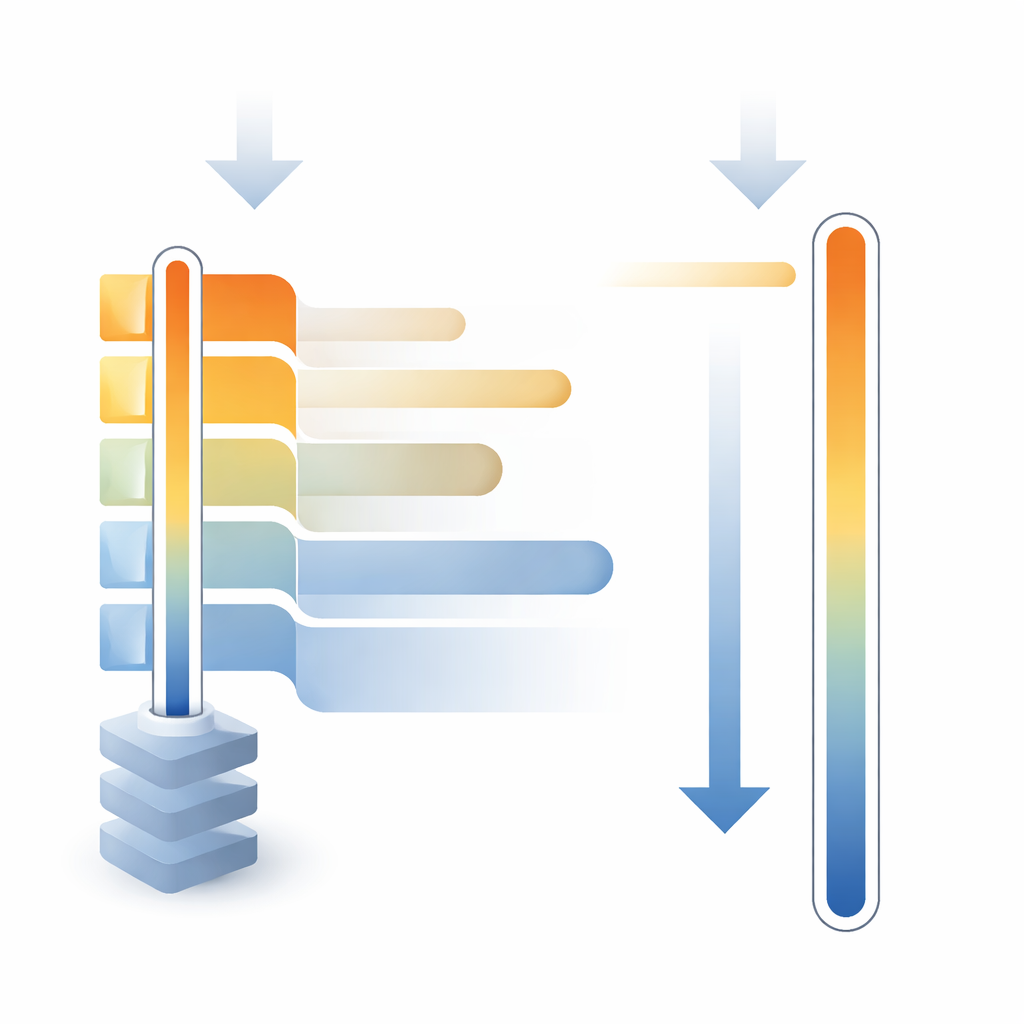
Fine-Tuning Sensitivity and Range
To turn this raw behavior into a practical device, the team systematically tests bulk crystals, thin films, and samples with a small amount of chromium added. They show that the temperature sensitivity—the change in resistance per change in temperature—stays high over a wide range, especially in thin-film devices. These films can be engineered with different thicknesses so that their useful range stretches from millikelvin temperatures up to room temperature, while keeping resistance values in a sweet spot for standard electronics. By applying an electric gate voltage, they can further nudge the balance between edge-driven and bulk-driven behavior, allowing the same kind of device to be optimized either for the very lowest temperatures or for broader coverage. The result is a single material platform that can be tuned rather than swapped out, greatly simplifying the design of experiments and even enabling micron-scale local temperature sensing on chips.
Working in Powerful Magnetic Fields
Many cutting-edge experiments at low temperature also use intense magnetic fields, which can distort thermometer readings. The researchers therefore study how Ta2Pd3Te5 responds up to fields of 31 tesla—stronger than most hospital MRI machines by an order of magnitude. In its pure form the material shows a moderate change in resistance with field, which could shift the apparent temperature at the very coldest points. But when they adjust the number of charge carriers by adding chromium or moving away from a special “charge neutral” condition, this magnetic sensitivity drops sharply. Under these tuned conditions, the error in indicated temperature becomes comparable to or better than some widely used commercial sensors, suggesting that the new thermometer could operate reliably even in magnet-heavy experiments.
From Lab Concept to Practical Tool
Although further work is needed—especially to systematically explore performance below one-tenth of a kelvin and to mass-produce thin films—the study demonstrates that Ta2Pd3Te5 can act as a “topological thermometer” covering an unusually broad temperature range with strong sensitivity. Its gentle low-temperature resistance growth avoids the dead-end behavior of conventional semiconductor thermometers, while its high-temperature response remains sharp. For non-specialists, the key message is that a single, quantum-material-based sensor may soon replace a whole family of specialized devices, making it easier to probe the strangest and coldest corners of the physical world. 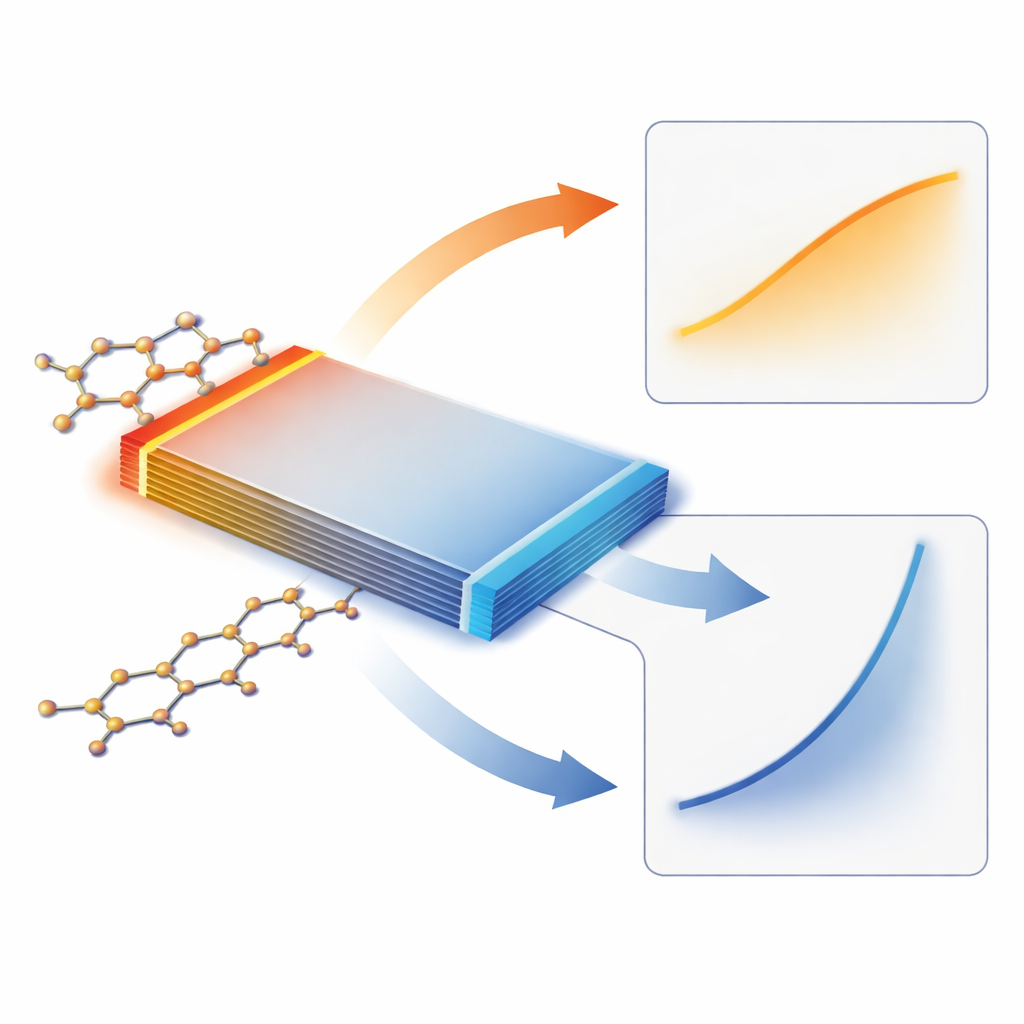
Citation: Li, Y., Wang, A., Pan, S. et al. A wide-range topological thermometer with Ta2Pd3Te5: from power-law response to application prospects. npj Quantum Mater. 11, 33 (2026). https://doi.org/10.1038/s41535-026-00866-8
Keywords: quantum materials, cryogenic thermometer, topological insulator, low temperature physics, thin film sensors