Clear Sky Science · en
Quantum theory of magnetic octupole in periodic crystals and application to d-wave altermagnets
Why hidden magnetism matters
Electronics built on magnetism usually rely on simple bar-magnet behavior: materials with a net north and south pole. But a fast-growing field called altermagnetism has revealed crystals that are antiferromagnetic—so their net magnetization cancels out—yet still behave in many ways like ferromagnets, including producing Hall currents. This paper develops a precise quantum-mechanical language for describing a subtle kind of “hidden” magnetism in such materials, based on a quantity called the magnetic octupole. That language could help guide the search for new spintronic materials that move information with spins instead of charges, potentially with less energy loss.
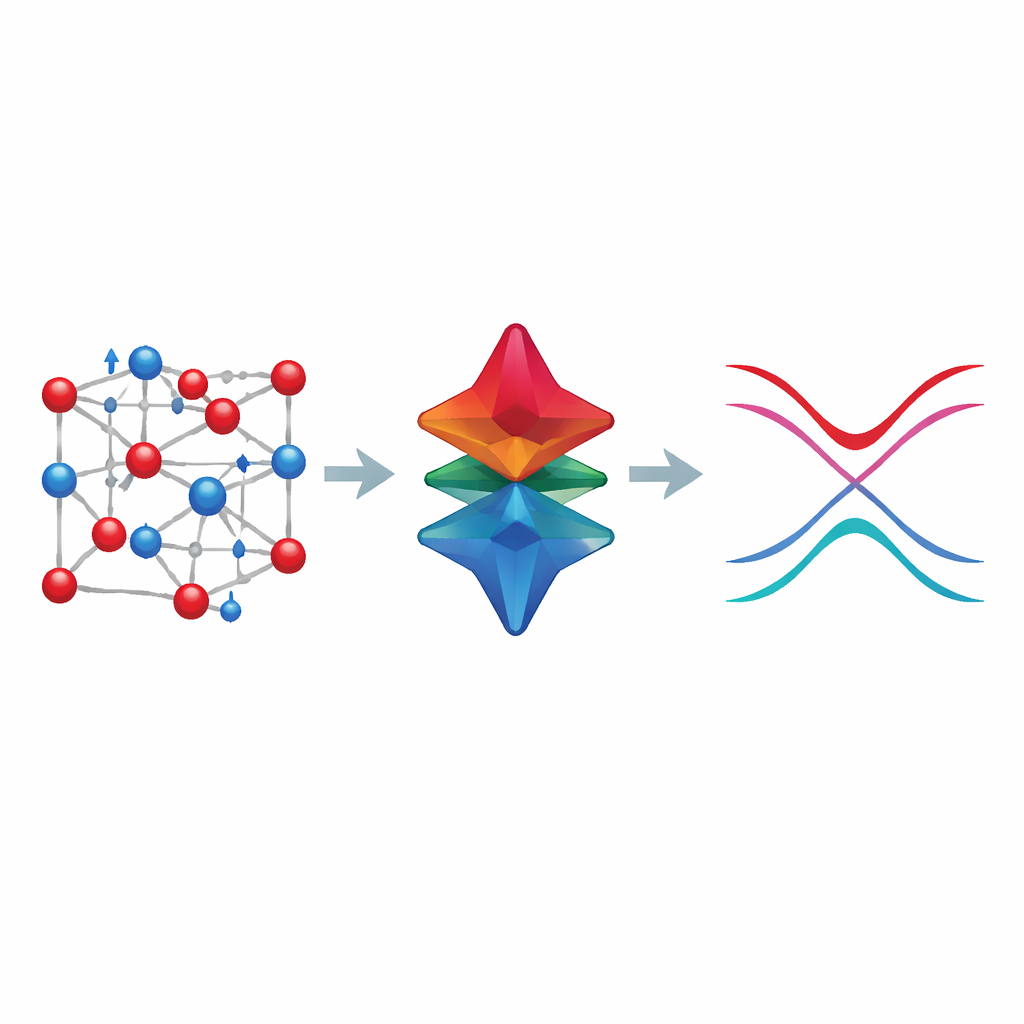
From simple magnets to complex patterns
In ordinary ferromagnets like iron, the key descriptor is the net magnetization: the sum of all tiny electron spins pointing mostly in the same direction. In antiferromagnets, neighboring spins point in opposite directions so the net magnetization vanishes, making it hard to define a single quantity that captures their magnetic order. A traditional choice, the Néel vector (the difference between spins on two sublattices), is essentially local: it does not connect cleanly to thermodynamic concepts such as conjugate fields, and it can become ambiguous in more complex magnetic structures.
A new way to describe hidden order
The authors focus on “magnetic multipoles,” which generalize the idea of a dipole (a simple north–south arrangement) to higher-order patterns in space. For certain antiferromagnets that break time-reversal symmetry but keep inversion symmetry—precisely the setting of d-wave altermagnets—the leading nonvanishing quantity is not a dipole or quadrupole but a magnetic octupole. Previous work had proposed this octupole as an order parameter, but a rigorous, gauge-invariant formula for it in realistic crystals was missing. Using quantum mechanics and thermodynamics, the authors derive such a formula for the spin magnetic octupole in periodic solids, expressed directly in terms of the electronic band structure and Fermi distribution, and carefully constructed so that it does not depend on arbitrary choices of phase in the quantum states.
Linking hidden order to measurable responses
Once the magnetic octupole is defined thermodynamically as the response of the free energy to gentle spatial variations of a magnetic field, it can be related to measurable effects. The authors classify how dipole, quadrupole, and octupole orders contribute to various electromagnetic responses in insulating crystals at very low temperature. Magnetic dipoles naturally produce the familiar anomalous Hall effect and magnetoelectric effects. Magnetic quadrupoles and octupoles, in turn, control more intricate phenomena such as quadrupolar and “octupolar” Hall responses, as well as higher-order magnetoelectric couplings sensitive to field gradients. By taking derivatives of the multipoles with respect to the chemical potential, they derive generalized Středa-type formulas that connect these hidden orders to nondissipative transport coefficients.

What model crystals reveal
To show that the new definition is practical, the authors compute the magnetic octupole for simple theoretical models of collinear magnets that mimic real materials such as MnF₂ and RuO₂. They compare an altermagnetic antiferromagnet, which has d-wave-like spin splitting in its electronic bands, with a conventional ferromagnet that has simple isotropic spin splitting. The octupole components they calculate track the detailed pattern of spin splitting in momentum space and change in characteristic ways as they vary the strength and direction of the internal magnetic moments or the spin–orbit coupling. Within an insulating window of the band structure, the octupole varies linearly with the chemical potential, just as expected from their thermodynamic analysis, confirming the internal consistency of the theory.
Anisotropic dipoles without net magnetization
A key result emerges when the authors decompose the full rank‑three octupole tensor into simpler pieces. Part of it behaves like a special kind of magnetic dipole called an anisotropic magnetic dipole. This dipole has the same symmetry as an ordinary spin or orbital dipole but carries zero net magnetization; it encodes directional imbalances of magnetism that cannot be seen by simply summing spins. Remarkably, this anisotropic dipole turns out to be the dominant magnetic descriptor in certain altermagnetic antiferromagnets that nonetheless show a Hall response. The authors argue—on symmetry grounds and using model calculations—that this hidden dipole is closely tied to anomalous Hall behavior in such systems, even when standard net magnetization is strictly zero.
What this means for future materials
For a non-expert, the main message is that antiferromagnets can host intricate, higher-order magnetic patterns that influence electrons just as strongly as simple bar-magnet order does, but in more subtle ways. This paper supplies a rigorous quantum and thermodynamic framework for one of the most important of these patterns, the magnetic octupole, and shows how it can be used to diagnose and classify altermagnets from their band structures. It also clarifies how this hidden order connects to experimentally accessible quantities such as Hall conductivities and X‑ray dichroism signals. These insights should help researchers systematically design and interpret new magnetic materials where information is carried by finely structured spin textures rather than by bulk magnetization.
Citation: Sato, T., Hayami, S. Quantum theory of magnetic octupole in periodic crystals and application to d-wave altermagnets. npj Quantum Mater. 11, 32 (2026). https://doi.org/10.1038/s41535-026-00865-9
Keywords: magnetic octupole, altermagnetism, antiferromagnets, anomalous Hall effect, spintronics