Clear Sky Science · en
Imaging of altermagnetic domains in orthoferrite DyFeO3 using electric field-induced nonreciprocal directional dichroism
Seeing Hidden Magnet Patterns
Inside many promising future materials, the tiny magnetic needles of atoms line up in patterns that are invisible to ordinary magnets and most microscopes. This paper shows a new way to "see" those hidden patterns in a crystal called dysprosium orthoferrite (DyFeO₃), using light and an applied electric field instead of a conventional magnet. The technique opens a window onto a whole family of so‑called altermagnets, which could underpin faster, more efficient technologies for electronics and data storage.
A Crystal with Two Interlocking Magnet Grids
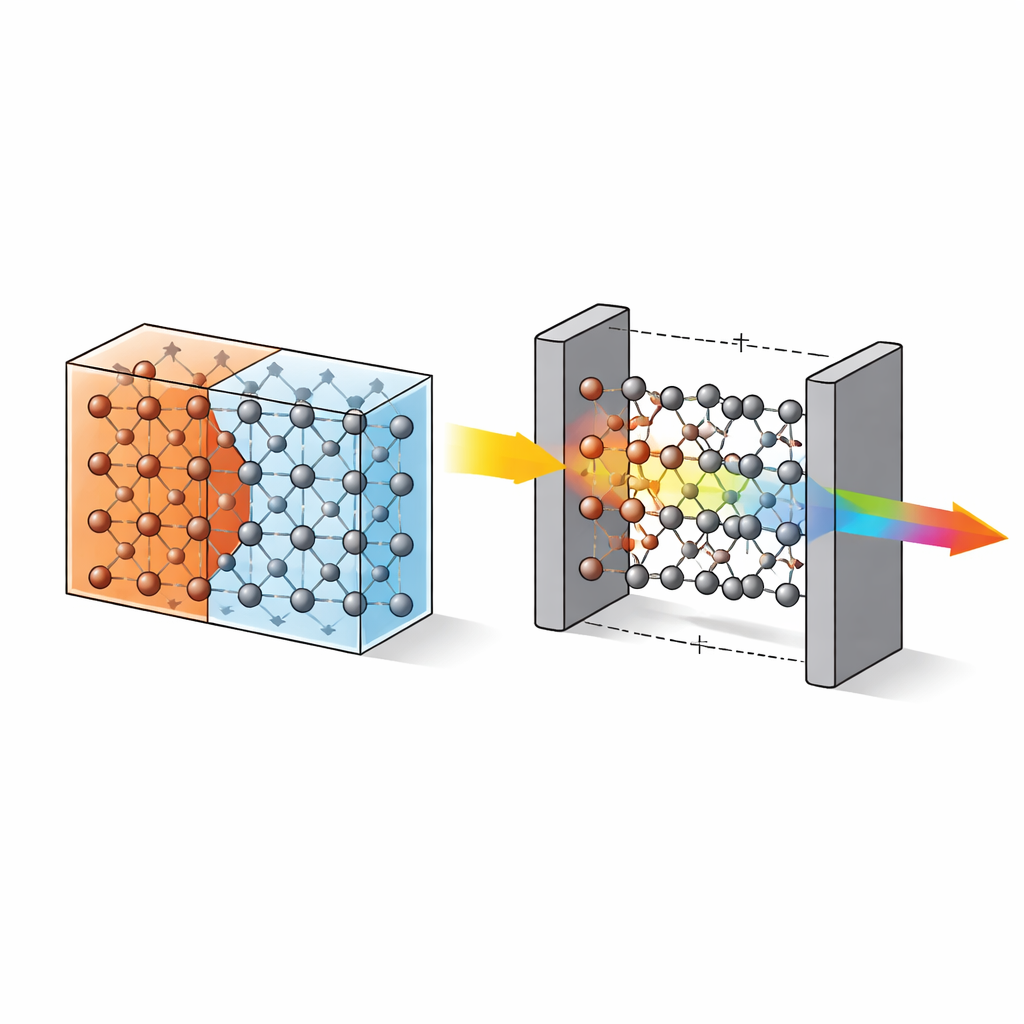
DyFeO₃ belongs to a well‑studied family of crystals where two different kinds of magnetic atoms, iron and a rare‑earth element, share the same lattice. Their magnetic moments form two interlocking sub‑grids that point in opposite directions overall, so the material has almost no net magnetization, even though time‑reversal symmetry is broken. This special arrangement, called altermagnetism, can generate unusual effects such as spin‑dependent currents and optical responses, without behaving like an ordinary bar magnet. In DyFeO₃, as the temperature is lowered, the iron spins abruptly reorganize at about 50 kelvin into a phase (named Γ₁) in which the weak ferromagnetic component vanishes completely, making the magnetism especially hard to detect.
Why Usual Magnet Microscopes Fail
Because the Γ₁ phase has no spontaneous magnetization, popular tools like the Faraday or Kerr effects—which rely on light twisting as it passes through a magnetized medium—see almost nothing. Earlier efforts to visualize the internal domains in this phase had to rely on more indirect effects, such as how the crystal bends light differently along different directions or how stress can induce a tiny magnetic response. These approaches work only in restricted conditions and can disturb the very domains they aim to probe. Researchers therefore needed a method that could distinguish regions where the microscopic spin pattern is flipped, yet leaves the crystal essentially unperturbed and does not demand a built‑in magnetization.
Letting Light Feel an Electric Push
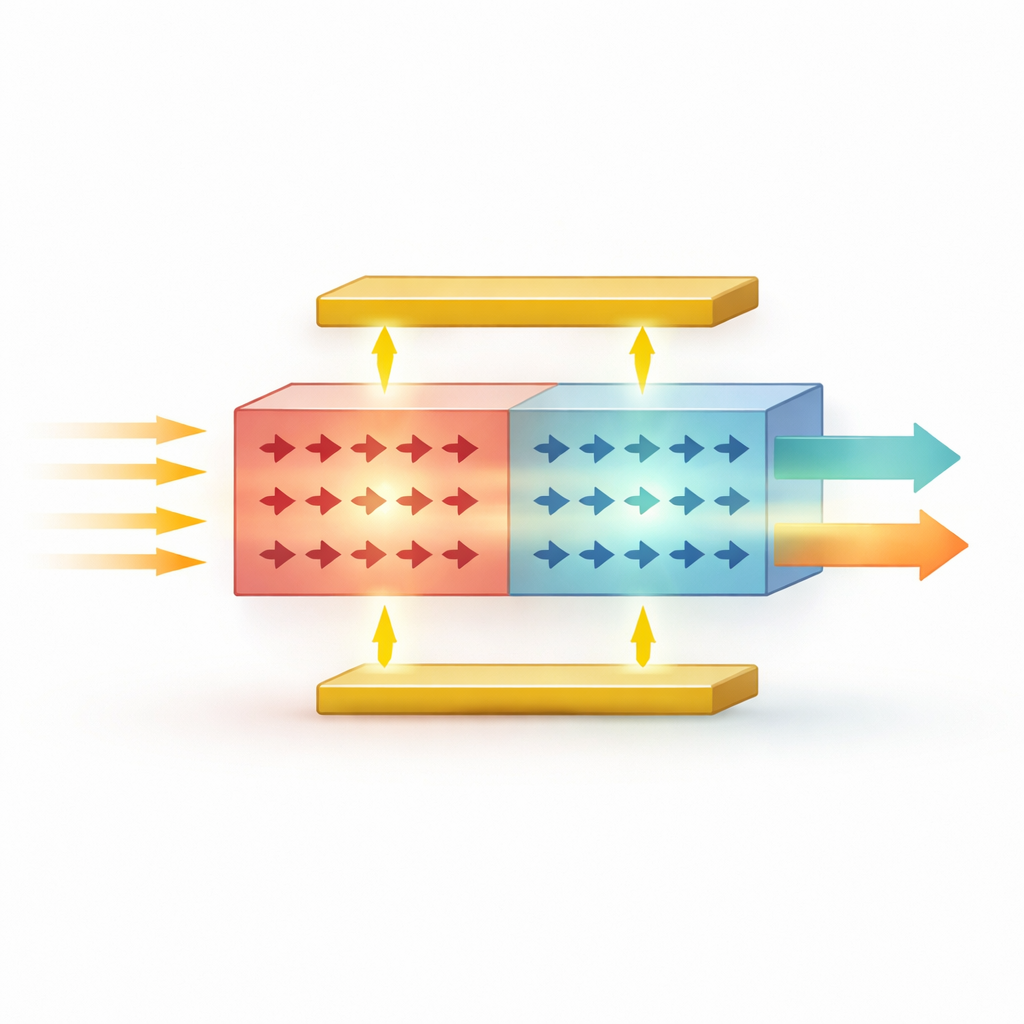
The authors exploit a phenomenon called electric‑field‑induced nonreciprocal directional dichroism. In simple terms, they shine light straight through a thin plate of DyFeO₃ while applying a voltage across its thickness. In the Γ₁ altermagnetic phase, the symmetry of the crystal allows the electric field to create a subtle "toroidal" magnetic pattern—like tiny current loops—which affects how strongly the material absorbs light depending on whether the light travels along or against that toroidal direction. Two neighboring domains, whose internal spin patterns are opposite twins, respond with absorption changes of opposite sign when the same electric field is applied. By modulating the voltage and recording tiny changes in transmitted intensity with a sensitive camera, the team converts those differences into two‑dimensional color maps, revealing a maze of domains hundreds of micrometers across in all three major crystal orientations.
Watching Domains React to a Magnetic Nudge
Although the Γ₁ phase shows no net magnetization, the researchers also explore how these domains respond when the crystal is cooled through the transition in the presence of a small magnetic field. Surprisingly, flipping the direction of the field along some crystal axes reverses the contrast of the domains—regions that previously appeared as increased absorption now appear decreased, and vice versa—while the overall domain shapes stay nearly the same. This behavior points to a subtle three‑way coupling among magnetization, internal strain frozen into the crystal, and the antiferromagnetic order, known as piezomagnetic coupling. Even though the resulting magnetization is extremely small, near the transition temperature it is enough to bias which twin domain is favored in each strained region.
Opening Doors to Practical Control
In everyday language, the study demonstrates a kind of non‑invasive magnetic photography for a class of materials whose magnetism is usually invisible. By using an electric field and carefully chosen light, the authors can map where one hidden spin pattern dominates over its twin and track how those regions react to gentle magnetic fields and internal strains. Because similar altermagnetic phases exist in other oxides—and can even appear close to room temperature when the composition is tuned—this method offers a broadly applicable way to study and eventually control these hidden magnet patterns, an important step toward using altermagnets in future spin‑based electronics and memory devices.
Citation: Kobayashi, K., Hayashida, T. & Kimura, T. Imaging of altermagnetic domains in orthoferrite DyFeO3 using electric field-induced nonreciprocal directional dichroism. npj Quantum Mater. 11, 38 (2026). https://doi.org/10.1038/s41535-026-00861-z
Keywords: altermagnetism, magnetic domains, optical imaging, piezomagnetism, DyFeO3