Clear Sky Science · en
Spin order and spin excitation spectra of spin-1/2 tetramer chains
Hidden patterns in chains of tiny magnets
Imagine a row of atoms whose tiny magnetic moments behave like spinning tops. Although each spin is microscopic, together they can organize into surprising patterns that are invisible to ordinary measurements yet leave clear fingerprints in advanced scattering experiments. This paper explores such hidden magnetic order and unusual excitations in a special kind of one‑dimensional material made of repeating groups of four spins, called a spin tetramer chain, and explains how future neutron and x‑ray experiments could actually see this elusive behavior.
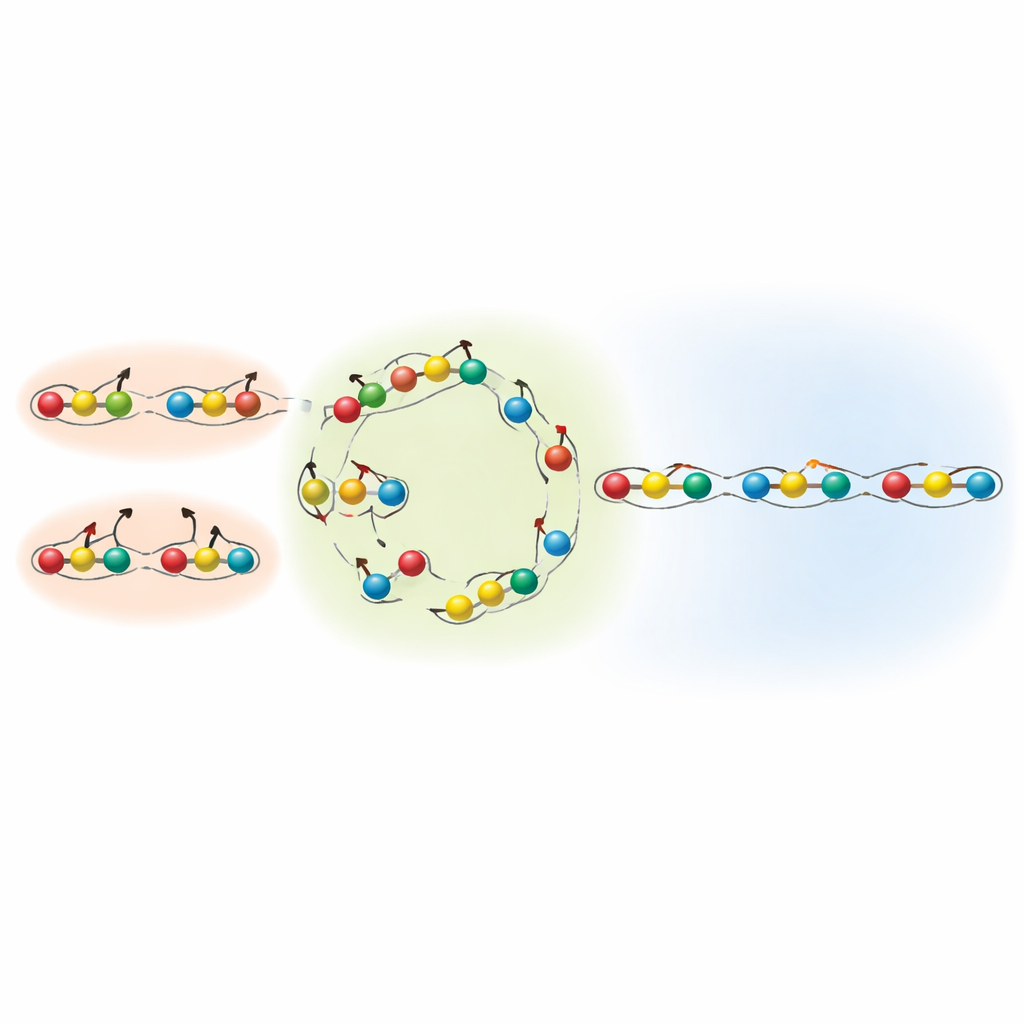
Building a chain from four‑spin building blocks
The authors study a theoretical model where spins are arranged in a straight line but coupled in a repeating pattern of four. Within each group of four spins, there are two types of magnetic links, and neighboring groups are also connected. By tuning the relative strengths of these links, the same chain can behave in very different ways. Sometimes each group of four acts like a tightly bound singlet cluster that is nearly isolated from its neighbors. In other regimes, the spins pair up in a way that makes the whole chain resemble a spin‑1 system, known to host the celebrated Haldane phase with a characteristic energy gap and special edge states.
Revealing a hidden kind of order
Unlike a familiar magnet that points north or south, the phases here often lack any obvious long‑range alignment. Instead, the key feature is a “hidden” pattern that can only be revealed by a nonlocal quantity called a string order parameter. Using powerful numerical simulations based on the density matrix renormalization group, combined with renormalization and perturbation theory, the authors map how this string order evolves across the space of coupling strengths. They find a “trivial” tetramer phase with almost no string order, a Haldane‑like phase where the string order is robust, and between them a narrow critical region where the system hosts deconfined spinons—fractional magnetic excitations that behave like free spin‑1/2 particles moving along the chain.
Exotic magnetic ripples and their fingerprints
When energy is injected, the chain does not just respond with conventional spin waves. In the tetramer phase, a single spin flip can promote a four‑spin unit into collective excited states. These appear as triplons (formed from triplet states) and higher composite modes such as quintons, involving fivefold spin configurations. In the Haldane‑like regime, excitations mostly resemble triplons living on effective dimers, while at the critical boundary low‑energy spinons propagate freely and coexist with higher‑energy bound modes. The team computes the dynamical structure factor, which predicts how these excitations would show up in experiments, and identifies distinct continua and sharp bands associated with spinons, triplons, and quintons.
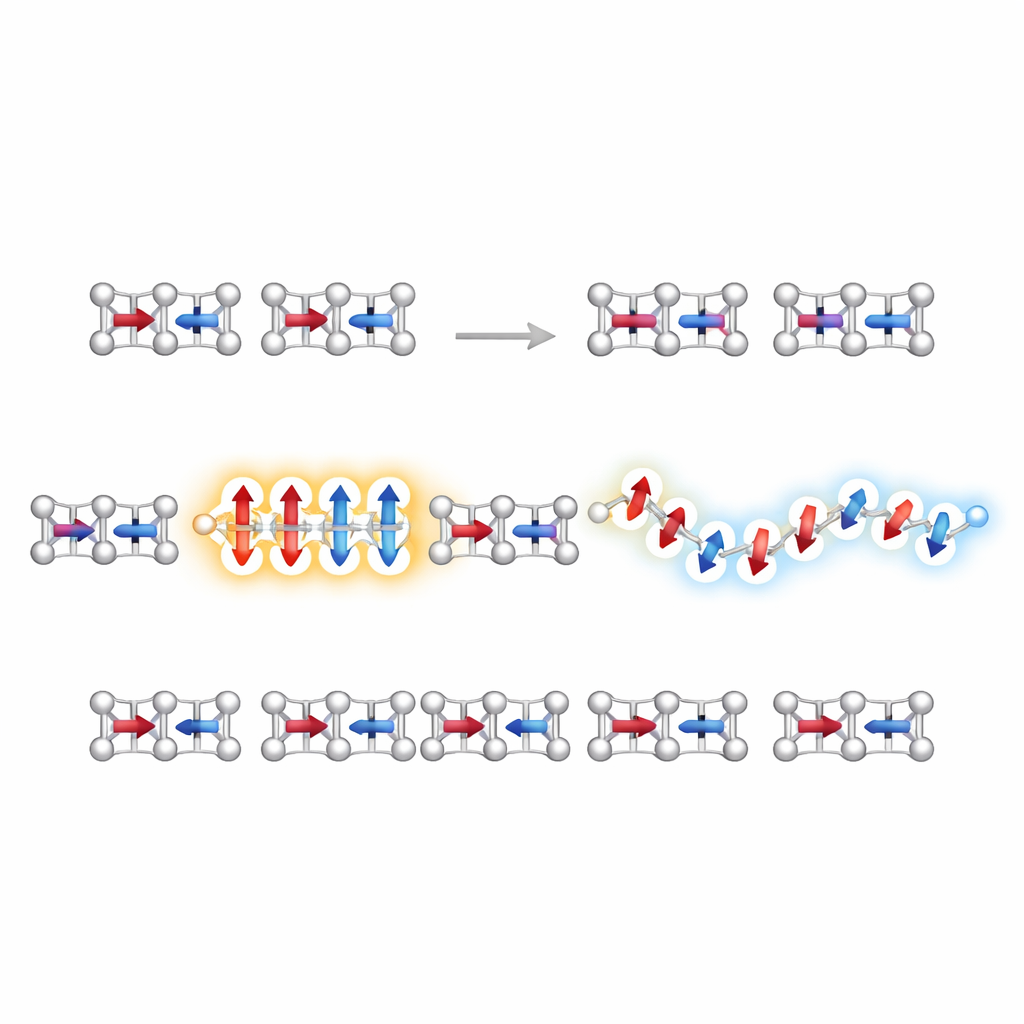
Seeing hidden order with neutrons and x‑rays
A major goal of the work is to connect this rich theoretical landscape to realistic measurements. Inelastic neutron scattering is an established probe of single‑spin dynamics, while resonant inelastic x‑ray scattering (RIXS) can reach higher energies and also access multi‑spin processes. The authors show that L‑edge RIXS and neutron scattering are sensitive to the single‑particle excitations—spinons, triplons, and quintons—whereas K‑edge RIXS can create and detect two‑particle combinations such as two‑triplon or triplon–quinton pairs. By calculating both direct and indirect RIXS spectra, as well as the underlying density of states and transition rates, they predict which excitations should produce the strongest observable signals.
From theory to a real quantum material
Importantly, the study is not purely abstract. Using exchange parameters extracted from previous work, the authors model the compound CuInVO5 as a concrete realization of a spin‑1/2 tetramer chain. Their string‑order and entanglement analyses indicate that this material should lie in the Haldane‑like phase, with a finite energy gap and characteristic edge behavior. The computed RIXS spectra for CuInVO5 show clear signatures of triplon and quinton modes, as well as multi‑particle features at higher energies, many of which fall within the resolution of existing x‑ray instruments. In plain terms, the paper argues that hidden topological order and exotic fractional excitations in this one‑dimensional quantum magnet are not just theoretical curiosities but should be directly observable in future neutron and x‑ray experiments.
Citation: Li, J., Cheng, JQ., Datta, T. et al. Spin order and spin excitation spectra of spin-1/2 tetramer chains. npj Quantum Mater. 11, 37 (2026). https://doi.org/10.1038/s41535-026-00855-x
Keywords: quantum spin chains, Haldane phase, spinon excitations, resonant inelastic x-ray scattering, topological magnetism