Clear Sky Science · en
Strain-tuned ferroelectric transitions in HfO2: role of $${X}_{2}^{-}$$ mode in ferroelectric instabilities
Why this strange oxide matters for tomorrow’s electronics
Ferroelectric materials, which remember an electric state even when the power is off, are key candidates for ultra‑fast, low‑energy memory chips. Hafnium oxide (HfO₂) is especially exciting because, unlike many classic ferroelectrics, it works well in the ultrathin layers used in modern semiconductor technology. Yet engineers still struggle to reliably make its ferroelectric form. This paper uncovers a hidden atomic “shift pattern” inside HfO₂ that is controlled by strain and turns out to be the real master switch behind its useful ferroelectric phase.
From rigid rocks to switchable memory
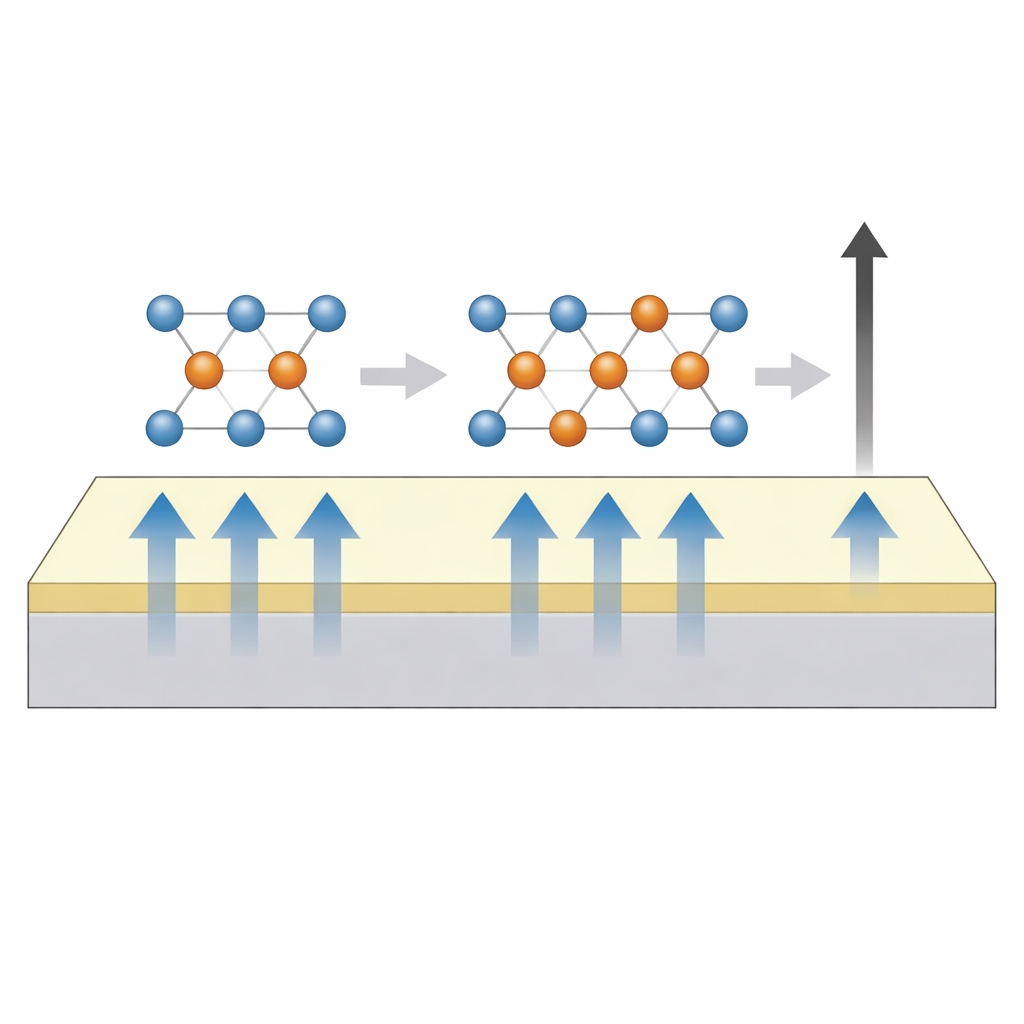
In bulk form, HfO₂ prefers crystal structures that are electrically neutral, with atoms arranged so that positive and negative charges balance perfectly. Under high pressure or special processing, however, it can adopt an orthorhombic structure known as the Pca2₁ phase, which carries a built‑in electric polarization and is responsible for ferroelectric behavior. In thin films used for devices, rapid heating and cooling steps tend to stabilize a tetragonal “parent” phase first, which later transforms into the desired ferroelectric phase. Understanding exactly how this parent phase morphs into the polar one, and what controls the ease of that transformation, is crucial for designing reliable ferroelectric memories.
A subtle oxygen shuffle that changes everything
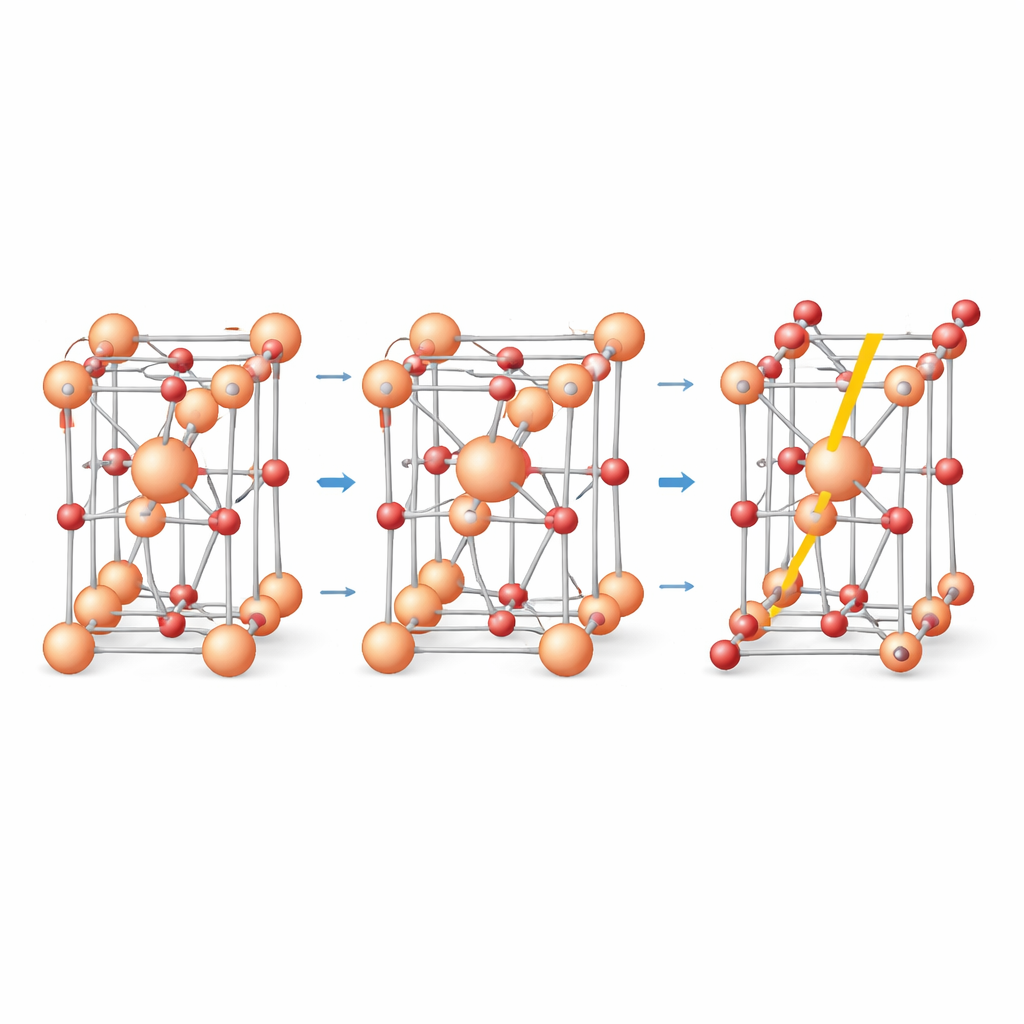
The authors focus on a particular collective motion of oxygen atoms, called the X₂ mode, in the parent tetragonal phase. On its own, this mode does not make the material ferroelectric; it simply shifts oxygen ions in a repeating pattern that still leaves the crystal non‑polar. Using detailed quantum‑mechanical simulations, the study shows that when the film is stretched (put under tensile strain) along various in‑plane directions, this oxygen shuffle grows in size. As the amplitude of this X₂ displacement increases, it reshapes the entire energy landscape of the crystal, lowering the barriers that normally keep the tetragonal structure stable.
Strain as a tuning knob for hidden transitions
By systematically applying strain along different crystal axes, the researchers map out how the material passes through a sequence of intermediate structures on its way to the ferroelectric phase. Depending on the strain direction, the tetragonal phase first collapses into other low‑symmetry phases, such as Pbcn or Aba2, before finally arriving at Pca2₁. These intermediate phases arise when certain collective atomic motions, known as polar and antipolar modes, suddenly become “soft,” meaning that the crystal can distort along them with little energy cost. The key result is that the X₂ oxygen shift couples strongly to these modes: once X₂ becomes large enough, it drives their softening and dramatically reduces the energy barriers for the subsequent transitions.
Design maps for real thin films
To connect their theory with real devices, the authors extend their analysis from simple one‑direction stretching to more realistic biaxial strains imposed by crystal substrates. They construct phase diagrams showing which crystal structure wins out for different combinations of in‑plane strain. Across these diagrams, a simple rule emerges: once the amplitude of the X₂ displacement exceeds a certain threshold, the preferred pathway leads downhill into the ferroelectric Pca2₁ phase. The specific intermediate structures and required strain differ depending on details such as the computational method used or whether hafnium is partially replaced by zirconium, but the controlling role of X₂ remains robust.
How this insight guides future memory materials
For non‑specialists, the takeaway is that ferroelectricity in HfO₂ thin films is not governed by strain alone, but by how strain amplifies a specific oxygen shift pattern that quietly orchestrates all the other distortions. Once this X₂ motion crosses a critical size, it lowers the barriers that separate non‑polar and polar structures, making it easier to form and switch the ferroelectric phase. This new viewpoint suggests practical strategies for engineering better memory devices: choosing substrates that apply the right kind of tensile strain, using high‑pressure annealing, or introducing defects and dopants that enhance the X₂ displacement. Rather than blindly tweaking processing conditions, researchers can now aim directly at “X₂ engineering” to control how much of the ferroelectric phase appears in a film and how easily it can be switched in operation.
Citation: Lee, I., Lee, W. & Yu, J. Strain-tuned ferroelectric transitions in HfO2: role of \({X}_{2}^{-}\) mode in ferroelectric instabilities. npj Quantum Mater. 11, 34 (2026). https://doi.org/10.1038/s41535-025-00841-9
Keywords: hafnium oxide ferroelectricity, strain engineering, thin film memory, phase transitions, phonon modes