Today’s quantum computers are powerful enough to tackle problems that overwhelm ordinary machines, but they are still far from perfect. Each calculation is plagued by small errors that can quickly add up, especially when simulating the behavior of electrons in materials, a key step toward new technologies and chemicals. This paper introduces a new strategy, called subspace noise tailoring, that squeezes far more reliable answers out of noisy quantum hardware and shows how it could allow near‑term devices to seriously compete with advanced classical simulations.
Making sense of noisy quantum machines
Every operation in a quantum computer has a chance to go wrong, and fully correcting these errors requires hardware that does not yet exist. In the meantime, researchers use “error mitigation” rather than full error correction: they run many imperfect circuits and process the results to reconstruct what an ideal machine would have produced. Existing approaches trade cost for accuracy. Some, based on enforcing conserved quantities or “symmetries,” are cheap but only catch a subset of mistakes. Others can in principle remove almost all errors, but demand so many extra circuit runs that they quickly become impractical. The central challenge is to find a middle ground that is accurate enough while remaining affordable on real devices.
Blending two ideas into one smarter scheme Figure 1.
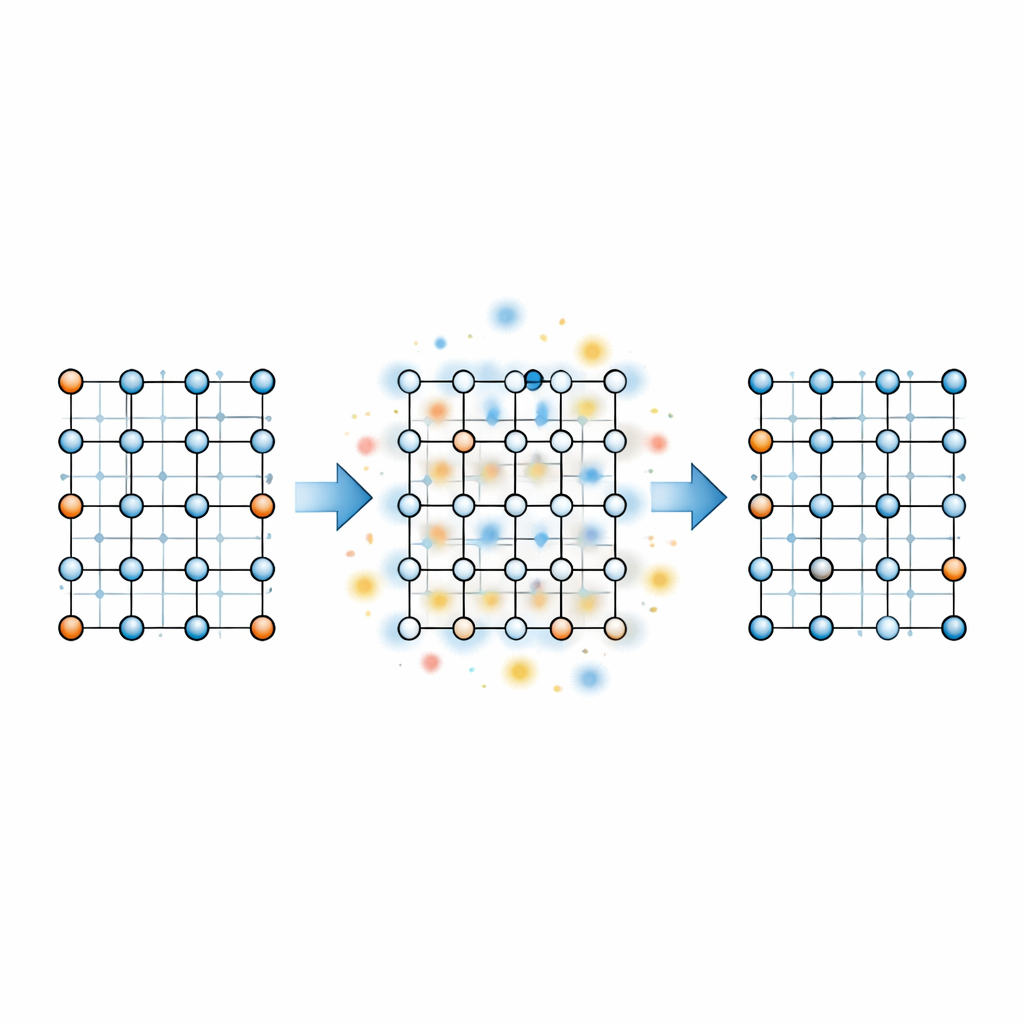
The authors combine two leading families of error mitigation into a single method, subspace noise tailoring (SNT). One ingredient uses symmetries of the physical system—such as conservation of particle number or spin—to flag circuit runs that must be wrong because they land outside the allowed sector of the state space; those runs are simply discarded. The other ingredient uses a carefully calibrated mixture of extra gates that statistically cancels out certain patterns of noise. SNT analyzes where and how errors can be detected by symmetry checks, then applies the costly cancellation trick only to the remaining, undetectable errors. In this way, most of the clean‑up is done by cheap filtering, and only a small residue is handled by expensive cancellation.
Designing encodings that help catch errors
To test SNT, the team focuses on the Fermi–Hubbard model, a standard playground for studying electrons moving and interacting on a lattice. To run this problem on a quantum processor, the electronic degrees of freedom must be encoded into qubits. Different encodings reorganize the problem in different ways, which not only change the number of qubits and gates required, but also which kinds of errors can be spotted by symmetry checks. The authors compare the conventional Jordan–Wigner encoding with several “local” encodings that introduce extra qubits specifically to create many short‑range symmetry checks. These additional checks act like an array of local guards that can catch far more errors without dramatically increasing circuit depth.
How far current machines can really go Figure 2.
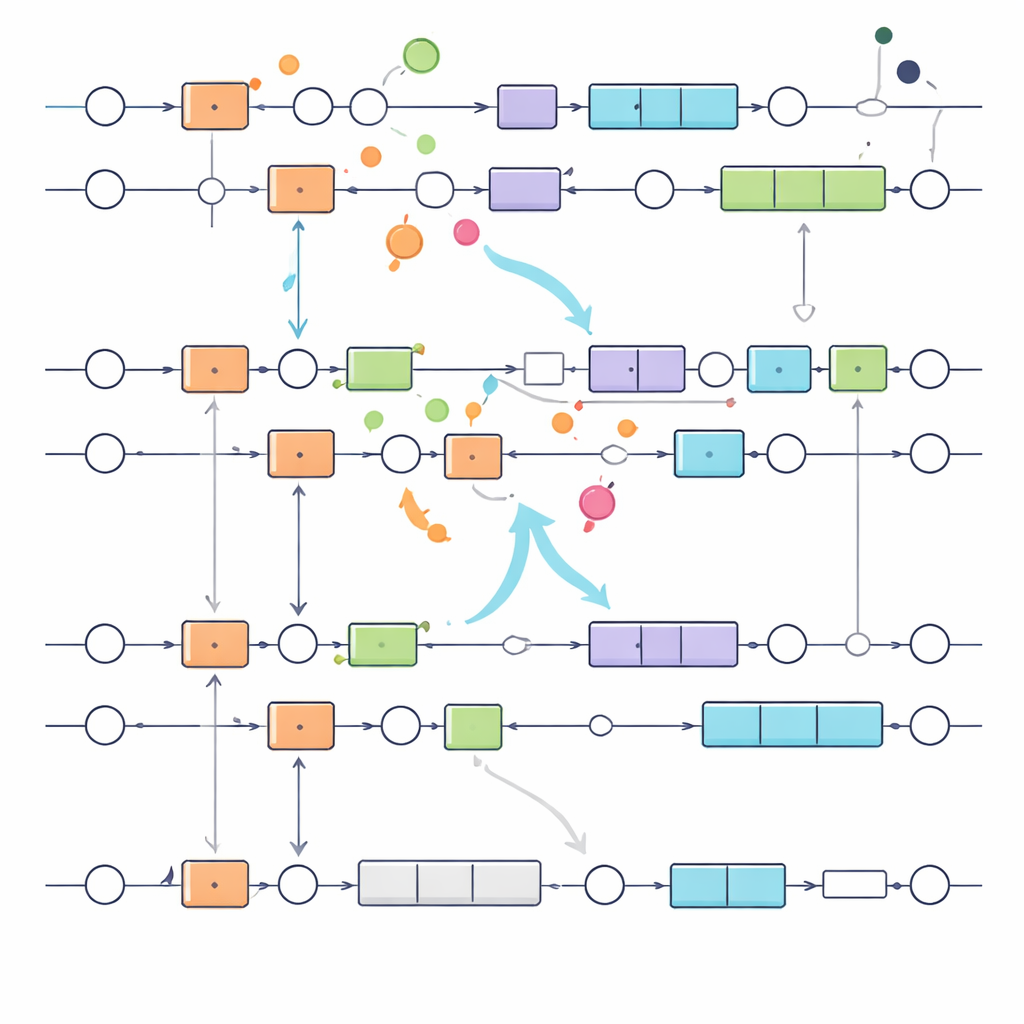
Using detailed simulations of noisy circuits, the authors map out which combinations of encoding and error‑mitigation strategy work best across a wide range of hardware qualities, system sizes, and measurement budgets. They find a rich “phase diagram” of optimal choices: when gates are relatively noisy, encodings that use fewer operations win; as hardware improves and more circuit runs are available, encodings with stronger local checks paired with SNT become superior. For a two‑dimensional 6×6 lattice evolved for 15 time steps—a problem size near the edge of what state‑of‑the‑art classical methods can handle—they estimate that SNT can keep the overall error in key observables around five percent if two‑qubit gate fidelities reach roughly 99.95%. Under the same conditions, using a brute‑force cancellation scheme alone would require about a million times more circuit executions.
What this means for the road to quantum advantage
In plain terms, this study shows that by cleverly combining symmetry checks with targeted noise cancellation, we can stretch the capabilities of imperfect quantum computers much further than previously thought. Subspace noise tailoring offers a recipe for choosing both how to encode electrons into qubits and how to clean up the resulting data so that realistic, near‑term devices might simulate strongly interacting electrons on two‑dimensional lattices at scales that seriously challenge classical algorithms. Rather than waiting for fully error‑corrected machines, this work outlines a concrete path for today’s emerging hardware to deliver scientifically meaningful insights into complex quantum materials.
Citation: Papič, M., Algaba, M.G., Godinez-Ramirez, E. et al. Near-term fermionic simulation with subspace noise tailored quantum error mitigation.
npj Quantum Inf12, 72 (2026). https://doi.org/10.1038/s41534-026-01248-5