Clear Sky Science · en
Surface-code hardware Hamiltonian
Why tiny glitches matter for future quantum computers
Quantum computers promise breakthroughs in chemistry, cryptography, and optimization, but today’s machines are extremely delicate. Even when engineers cool them near absolute zero and shield them from noise, the qubits inside still talk to one another in unintended ways. This article explores how seemingly tiny “whispers” between multiple qubits can quietly undermine one of the leading blueprints for building large, reliable quantum computers—the surface code—and introduces a new way to map and control those whispers directly from the hardware design.
Building logic from a quilt of tiny quantum tiles
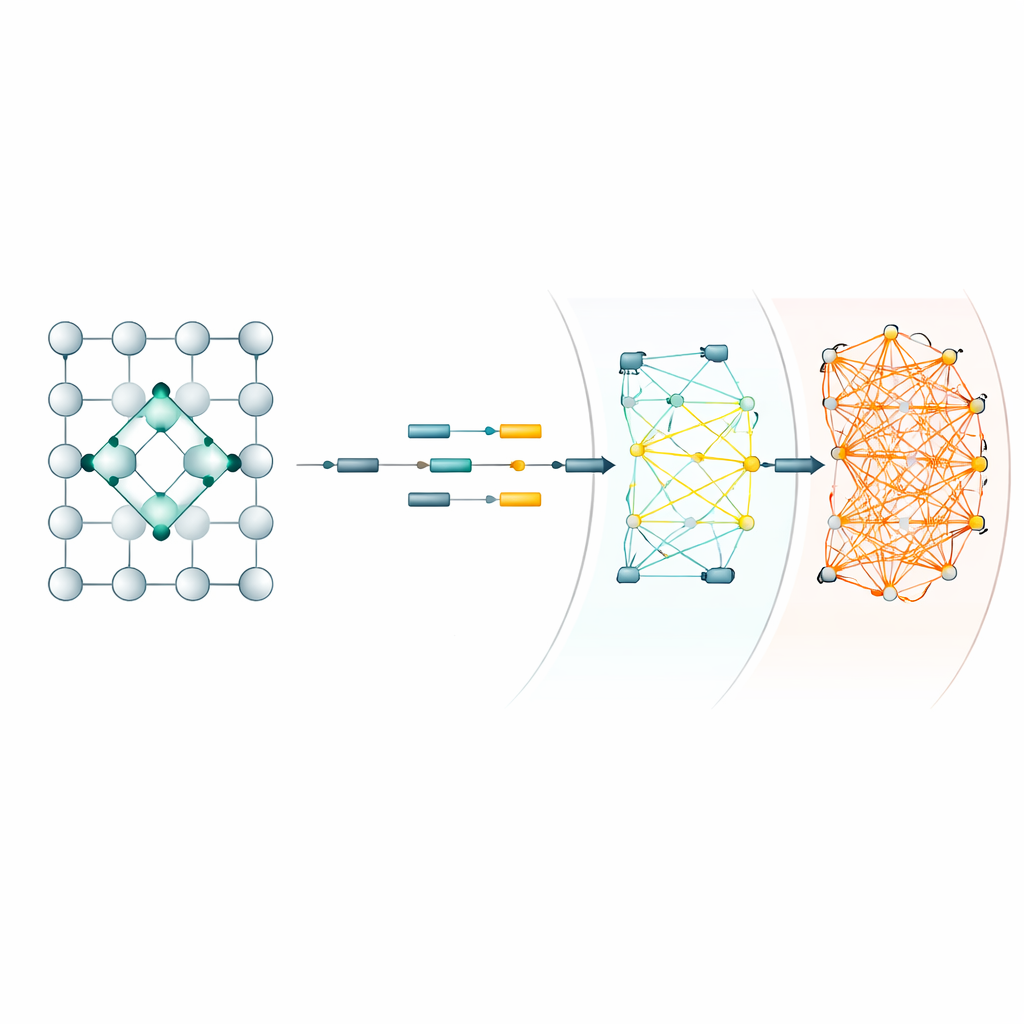
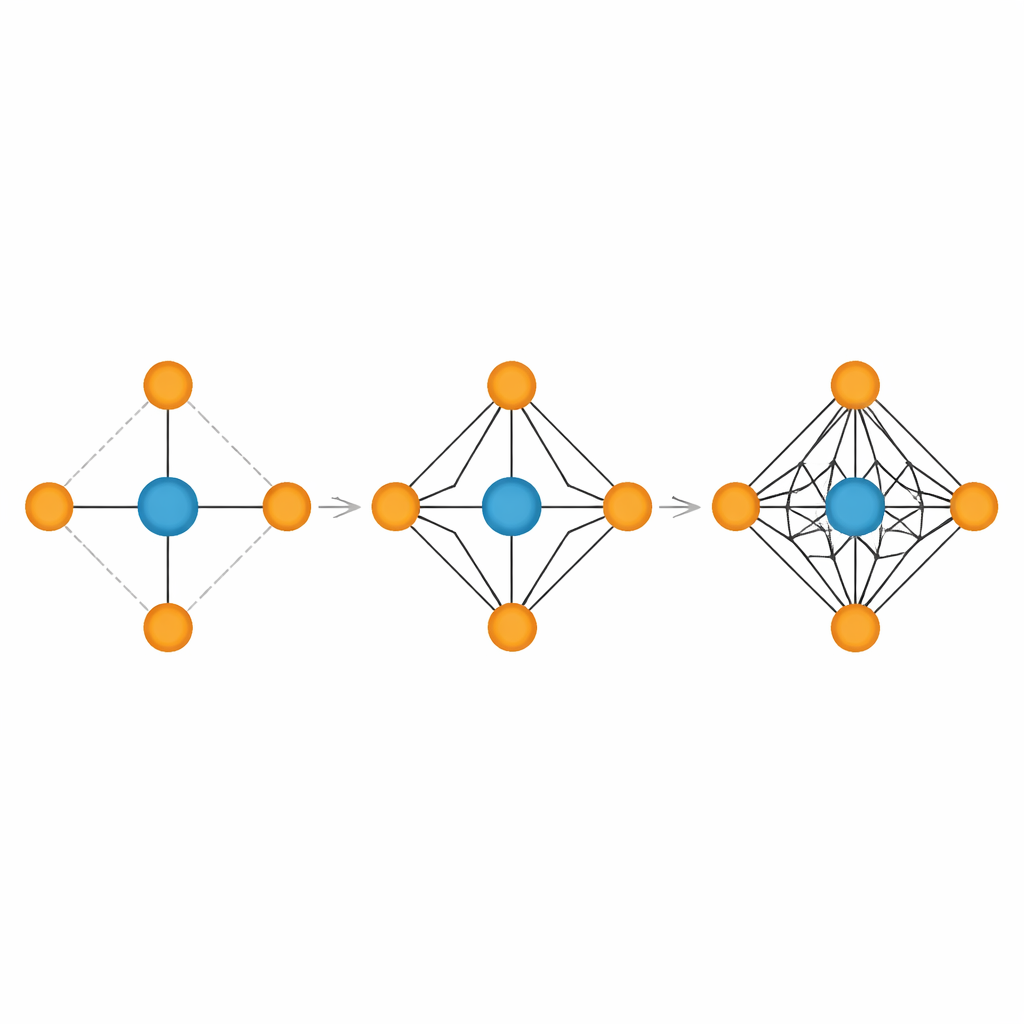
The surface code protects information by spreading one logical qubit over many physical qubits arranged on a two-dimensional grid. In practice, this grid is built from a repeating five-qubit tile: a central “measurement” qubit surrounded by four “data” qubits in a diamond pattern. Special coupler circuits link the center to each neighbor so that local checks can spot and correct errors without disturbing the stored information. The hope is that, by carefully tuning these couplers, each tile can behave like a simple, well-controlled building block whose interactions are dominated by straightforward pairwise effects between qubits.
When three-qubit whispers outshout two-qubit conversations
Reality, however, is more complicated. Besides the intended pairwise interactions, the circuitry naturally generates higher-order effects in which three qubits influence one another at once. Traditionally, these many-body terms were assumed to be weaker side effects that could be ignored. Using a mix of analytical “diagram” rules and heavy numerical simulations, the authors show that this assumption can fail badly. As certain couplings are adjusted—especially small direct links between the outer qubits in a tile—the balance can flip so that three‑qubit interactions become stronger than the usual two‑qubit ones. They call this a hierarchy inversion, and it marks a transition from a conventional computing regime into a more exotic, topologically ordered phase with very different behavior.
Turning hardware layouts into precise interaction maps
To track these effects, the authors develop a scalable framework that takes an entire chip layout—including intended couplers and unavoidable stray capacitances—and converts it into an effective Hamiltonian, the mathematical object that encodes all the interactions among qubits. Their diagrammatic method provides compact formulas that account for many‑body processes to high order, while a complementary numerical engine (CirQubit) refines the results even when the simple approximations break down. Applied to a Sycamore-style processor from Google, the method reveals three distinct regimes across the grid of tiles: a computationally friendly phase dominated by pairwise links, an error‑influenced phase where three‑qubit terms are noticeable but still weaker, and a hierarchy‑inverted phase where three‑qubit interactions take over.
Seeing hidden errors across an entire processor
Armed with this Hamiltonian, the authors perform what they call processor error tomography: they condense the interaction data from every five‑qubit tile into a visual map that highlights where three‑body terms rival or surpass two‑body ones. This reveals that only modest increases in side‑to‑side couplings—on the order of a few million cycles per second—can shrink the safe operating windows for common two‑qubit gates such as iSWAP. In some tiles, a single strong three‑qubit term is enough to push gate errors above the thresholds needed for the surface code to work, even when all ordinary pairwise couplings look benign. The study thus shows that calibrating only two‑qubit interactions can give a false sense of security, because hidden many‑body terms quietly erode performance.
Designing quantum chips that stay in the safe zone
For non-specialists, the core message is that the quality of a quantum computer is not just about how well individual qubits behave, but also about the full pattern of interactions tying many of them together. This work provides a kind of “Hamiltonian microscope” that lets engineers predict, before fabrication, whether a proposed chip design will sit in a good computing phase or drift into a problematic regime where complex multi‑qubit effects dominate. The authors argue that rather than trying to eliminate all stray couplings—a nearly impossible task—designers should keep them small, model them accurately, and deliberately choose operating points that preserve the natural hierarchy where simple two‑qubit interactions outweigh the more dangerous many‑body ones. In doing so, they sketch a practical path toward more reliable, large‑scale surface‑code quantum processors.
Citation: Xu, X., Kaur, K., Vignes, C. et al. Surface-code hardware Hamiltonian. npj Quantum Inf 12, 71 (2026). https://doi.org/10.1038/s41534-026-01241-y
Keywords: surface code, quantum hardware, many-body interactions, superconducting qubits, error correction