Clear Sky Science · en
On the constant depth implementation of Pauli exponentials
Turning Complex Quantum Moves into Simple Steps
Quantum computers promise to solve problems that overwhelm today’s machines, but actually running useful algorithms on real hardware is surprisingly hard. Many of the most important quantum routines rely on operations called Pauli exponentials, which normally need qubits to talk over long distances. Current devices mostly allow only short-range interactions, so researchers must either pay a heavy time cost or add lots of extra hardware. This paper shows how to perform any Pauli exponential quickly using only simple, local pairwise interactions, potentially making many quantum computations faster and more practical.
Why Long-Distance Quantum Talk Is a Problem
In many quantum algorithms and error-correcting codes, groups of qubits must act together as if they were all directly connected. These operations, built from strings of Pauli operators, appear in tasks such as stabilizing fragile quantum memories, running chemistry simulations, and implementing advanced optimization routines. However, physical qubits on a chip or in an ion trap usually interact only with neighbors. To fake an all-to-all network, engineers juggle qubits around, use complex multi-qubit gates, or add special “bus” structures. All of these options increase circuit depth, hardware demands, or decoding complexity, creating serious bottlenecks for both today’s noisy devices and tomorrow’s fault-tolerant machines.
Building Big Effects from Pairwise Interactions
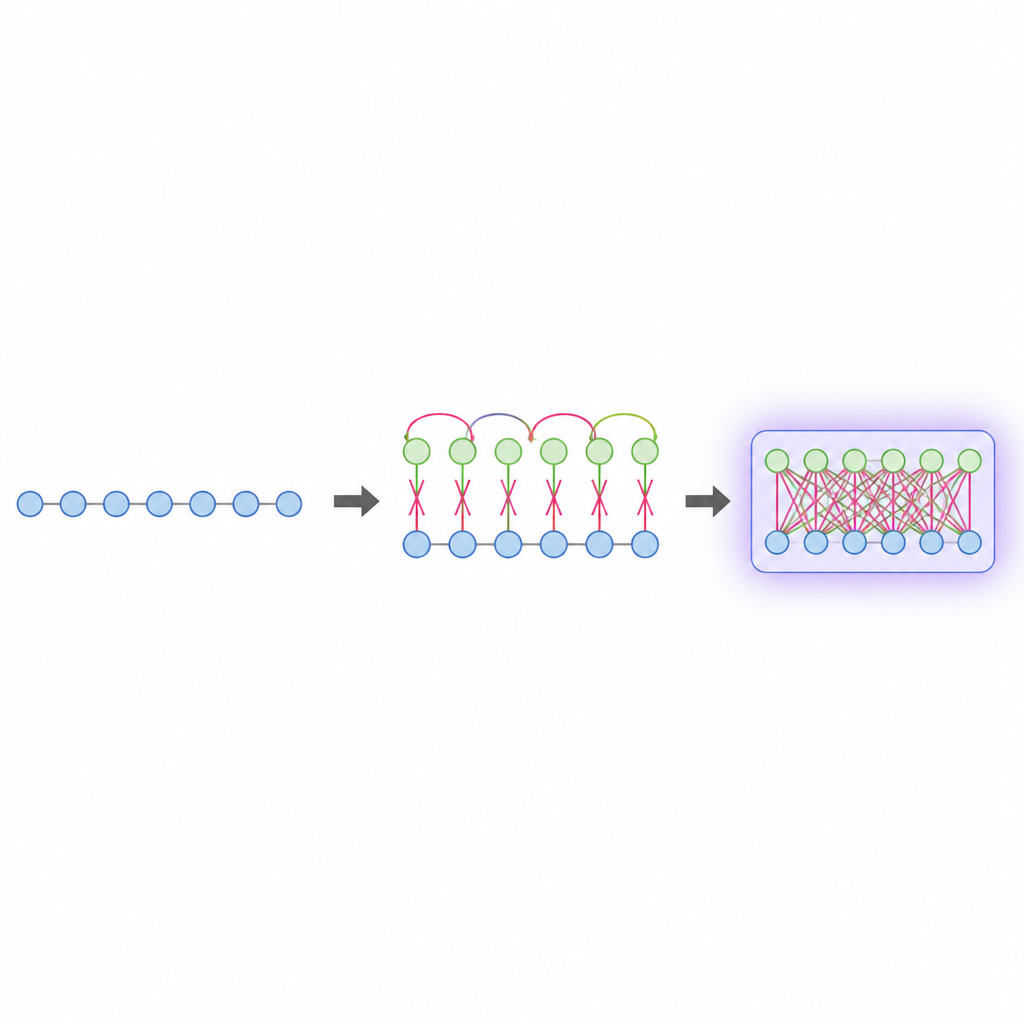
The authors introduce a way to implement any Pauli exponential using only two-body XX and ZZ interactions plus a linear number of helper qubits. Importantly, the overall depth of the quantum circuit stays constant, no matter how many qubits the Pauli string touches. Their method relies on viewing Pauli exponentials as special “phase gadgets” that can be broken down and rearranged using a collection of rewrite rules. These rules treat measurements, resets, and simple two-qubit gates as building blocks that can be merged, commuted, and simplified while preserving the overall action on the data qubits. By carefully scheduling XX and ZZ interactions and recycling ancilla qubits, they emulate long-range, many-body operations through a regular pattern of local pairwise steps.
Helping Quantum Error Correction Work in Parallel
The technique has particular impact for lattice surgery, a leading approach to fault-tolerant quantum computing. In lattice surgery, logical qubits live on patches of a two-dimensional grid, and multi-qubit Pauli exponentials appear as large, long-range measurements across many patches. These long interactions make decoding errors difficult, since a single operation can involve hundreds or thousands of physical qubits. The authors show that their constant-depth decomposition keeps each interaction local and bounded in size, effectively capping the “equivalent decoding distance” that decoders must handle in one cycle. This makes it easier to run many decoding tasks in parallel and to design decoders that communicate only limited, structured information about correlated errors.
From Noisy Devices to Fully Protected Machines
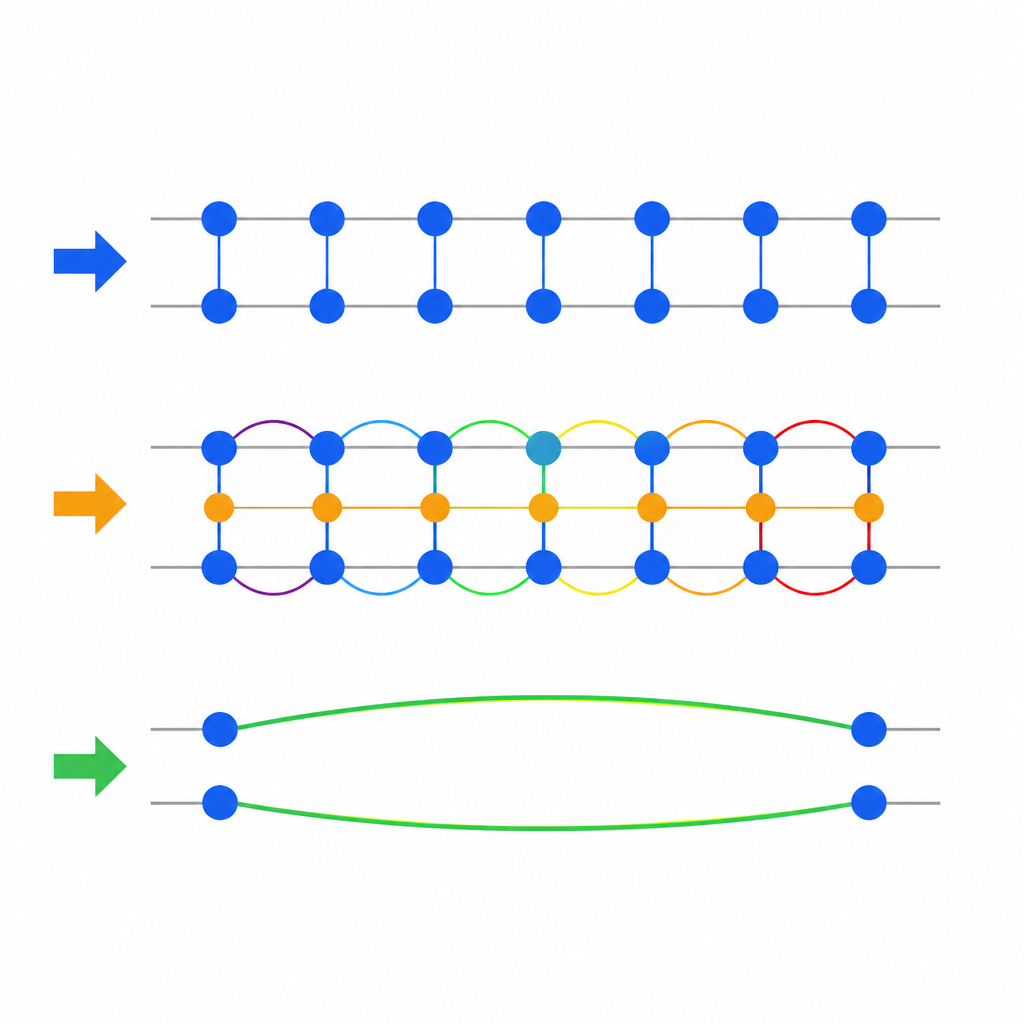
Because the method uses only two-body interactions, it aligns naturally with hardware where such gates are native, such as ion traps, silicon spin qubits, and certain Majorana-based devices. On near-term noisy machines, the authors’ decomposition can replace ladders of controlled-NOT gates that currently dominate the cost of chemistry and optimization circuits, potentially shortening runtimes and reducing error accumulation. In fully error-corrected settings, the same ideas can express arbitrary stabilizer measurements and even full Clifford circuits in constant depth, though at the price of extra ancilla qubits. The approach also extends to more exotic layouts and higher-dimensional qudits, offering several routes to handle cases where some qubits should be left untouched by a given Pauli string.
What This Means for the Future of Quantum Computing
Put simply, the paper shows that complex “many-qubit” quantum moves can be built from simple neighbor-to-neighbor steps without stretching out the computation in time. By proving that any Pauli exponential can be realized with constant depth using only local two-body interactions and modest extra qubits, the authors remove a key obstacle for both algorithm design and fault-tolerant architectures. Their construction promises more regular hardware layouts, easier parallel error decoding, and more efficient implementations of common quantum algorithms, bringing practical large-scale quantum computation closer to reality.
Citation: Moflic, I., Paler, A. On the constant depth implementation of Pauli exponentials. npj Quantum Inf 12, 82 (2026). https://doi.org/10.1038/s41534-026-01226-x
Keywords: Pauli exponentials, two-body interactions, lattice surgery, quantum error correction, constant-depth circuits