Clear Sky Science · en
Fiber-integrated quantum frequency conversion for long-distance quantum networking
Turning Fragile Quantum Signals into Long-Haul Travelers
Today’s internet sends light pulses through glass fibers across oceans, but the delicate light used in quantum technologies does not naturally fit this low-loss “telecom” window. This paper shows how to gently change the color of single photons from solid-state quantum devices so they can ride the same kind of fibers that already connect our world, without washing out the fragile quantum information they carry.
Why Quantum Messages Need a Color Change
Many leading quantum devices, such as nitrogen vacancy centers in diamond, emit light at visible red wavelengths that fade quickly in standard optical fibers. Telecom fibers are optimized for infrared light, where loss is much lower and long-distance links become practical. The challenge is to bridge this color mismatch without disturbing the quantum state of each photon. Quantum frequency conversion offers that bridge, shifting photons from one color to another while preserving their quantum character, but it must do so with high efficiency and very little added noise.
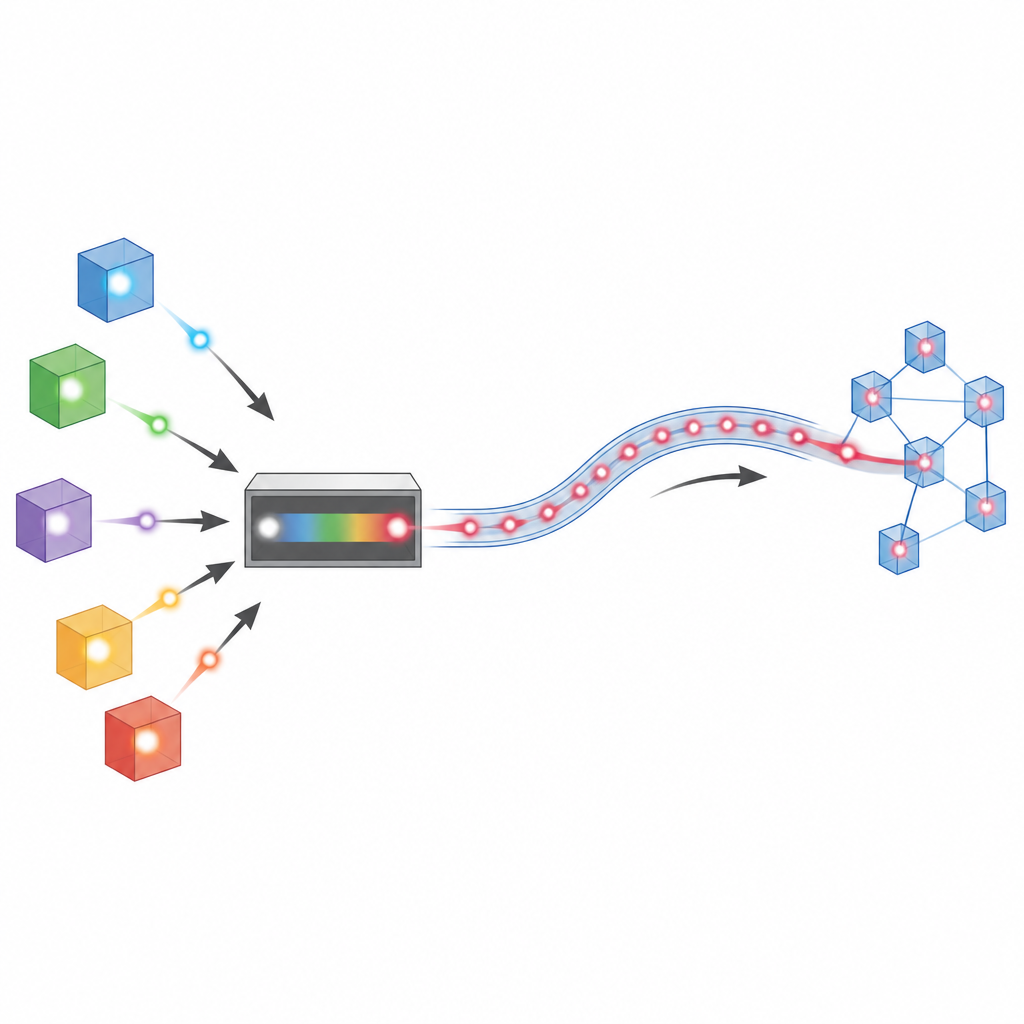
A Compact Fiber-Based Quantum Color Converter
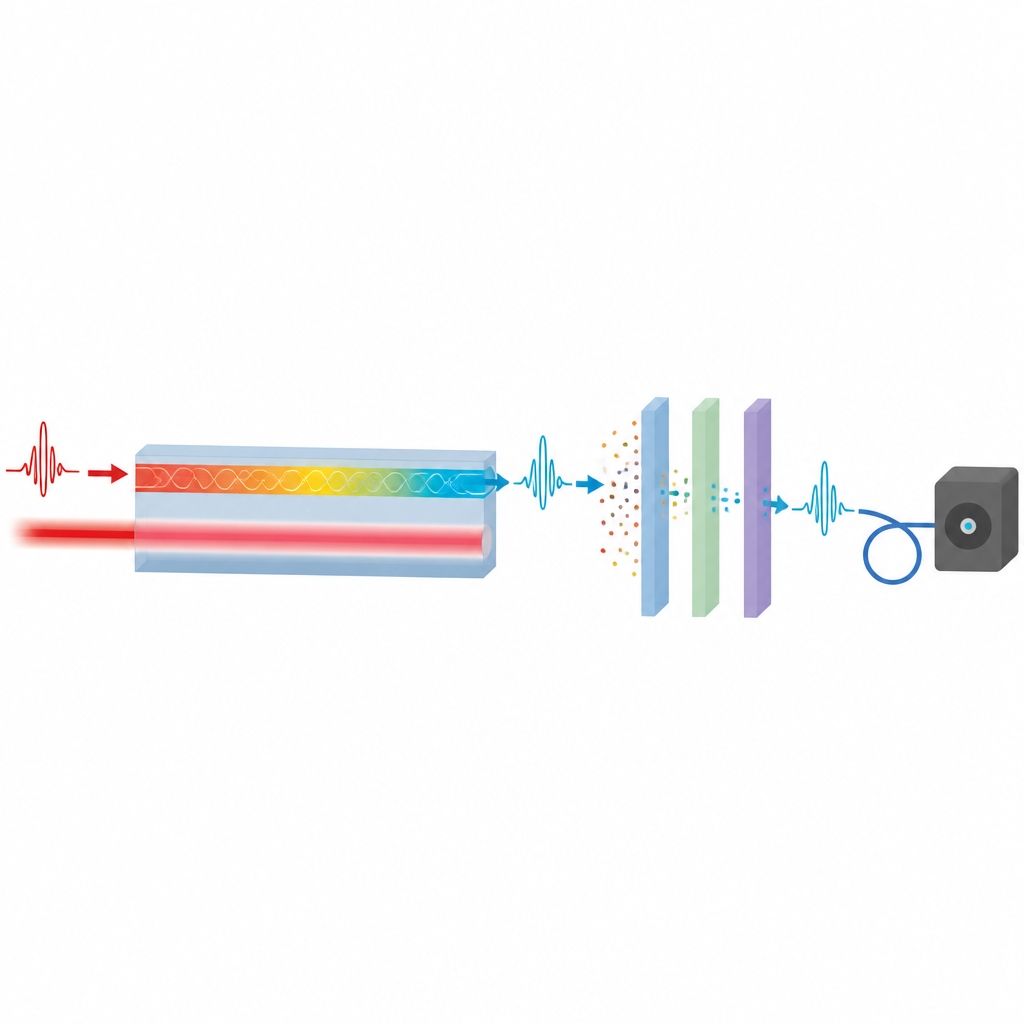
The authors build a quantum frequency conversion system that is fully integrated with optical fibers, making it compact, stable, and easier to deploy than bulky free-space setups. They start with a continuous beam of red light at 637.2 nanometers and carve it into short pulses that are then dimmed down to the level of single photons, mimicking emission from a nitrogen vacancy center. These pulses are combined with a powerful infrared pump beam and sent into a tiny lithium niobate waveguide, a chip-like structure that efficiently mixes the light fields so that the red photons emerge in the infrared telecom band near 1588.3 nanometers, suitable for long-distance fiber transmission.
Keeping the Quantum Signal Clean
Strong pump light can generate unwanted photons through side processes, adding background that drowns out genuine single-photon events. To fight this, the team uses a chain of fiber-based filters, including dense wavelength division multiplexers, fiber Bragg gratings, and an ultra narrow tunable filter. Together, these elements sharply cut away both residual pump light and broadband noise, achieving more than 97 decibels of suppression while sacrificing only a modest fraction of the desired signal. As a result, when the pump power is tuned to about 1.2 watts, the system converts roughly 9 percent of incoming photons while keeping pump-induced noise down to about 154 counts per second, leading to signal-to-noise ratios from 12 to well over 100 depending on the input photon rate.
Testing How Well Quantum Links Can Survive Distance
Beyond raw efficiency, the crucial question is whether the converted photons can still form strong quantum correlations with their source spins after traveling through many kilometers of fiber. The authors develop a simple model that links the quality of spin–photon entanglement to the measured signal-to-noise ratio, the detector background, and the fiber loss. They show that higher signal-to-noise directly translates into higher entanglement fidelity, especially as distance grows. Using their experimental values, they predict that photons converted by this system could still share more than 52 percent fidelity with their original spins after passing through 100 kilometers of standard telecom fiber, a substantial improvement over earlier work with higher noise and different hardware choices.
What This Means for Future Quantum Networks
By demonstrating a quiet, fiber-integrated color converter that works at realistic photon rates, this study points to a practical route toward connecting distant quantum nodes over existing telecom infrastructure. The device trades some efficiency for mechanical stability and ease of use, and the authors outline clear paths to raise performance further by improving coupling into the waveguide and boosting the useful emission from nitrogen vacancy centers. For readers, the key message is that reliable “adapters” between quantum hardware and long-haul fiber links are within reach, bringing a scalable quantum network closer to reality.
Citation: Liao, Z., Shen, A., Zhou, L. et al. Fiber-integrated quantum frequency conversion for long-distance quantum networking. npj Quantum Inf 12, 83 (2026). https://doi.org/10.1038/s41534-026-01225-y
Keywords: quantum frequency conversion, telecom photons, nitrogen vacancy centers, optical fiber networks, quantum entanglement