Clear Sky Science · en
Robust photon blockade with hybrid molecular optomechanics
Turning light into a one-way turnstile
Light usually flows in bunches, like cars on a busy road. For many quantum technologies, however, we want a light source that behaves more like a turnstile, letting photons pass one at a time. This paper shows how to build such a single-photon turnstile using tiny vibrating molecules and a special kind of light amplifier, and, strikingly, how to make it work even at room temperature.
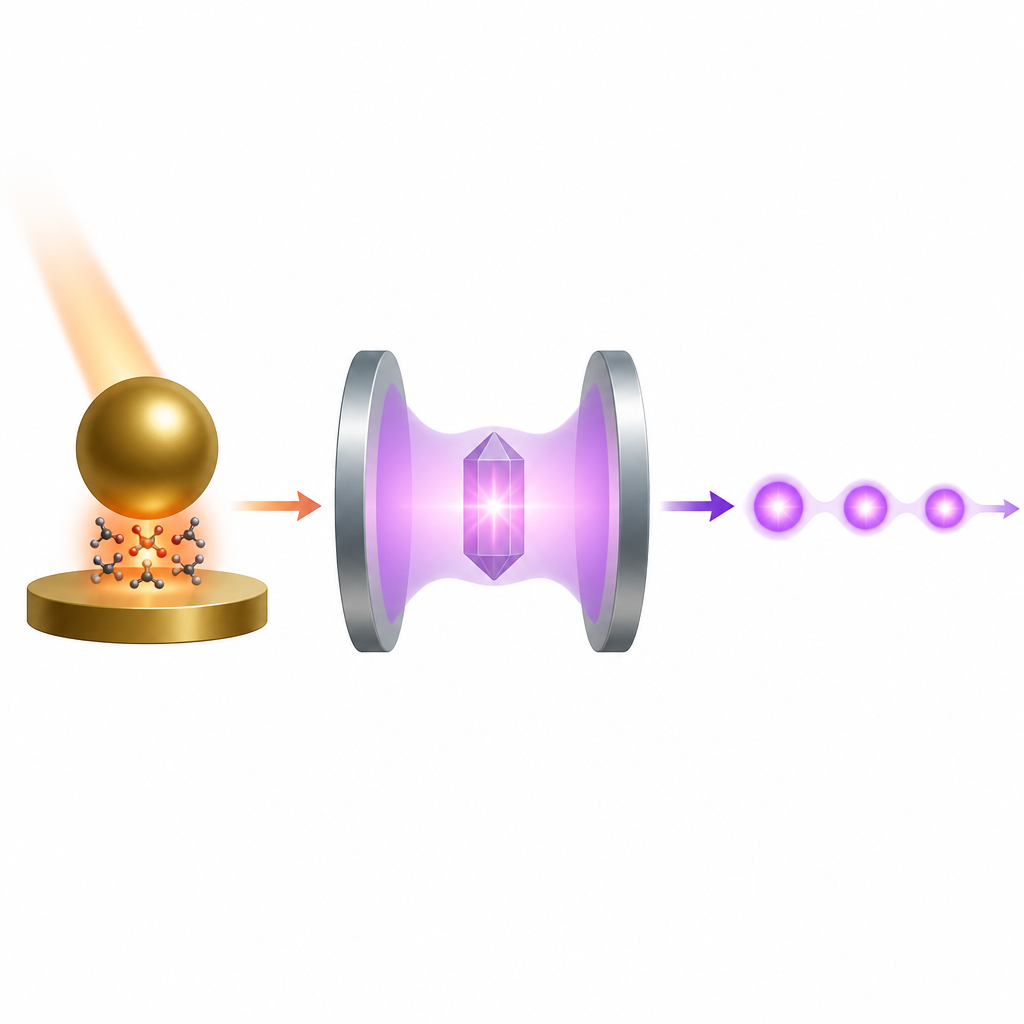
Tiny gaps that trap light and motion
The starting point is an emerging platform called molecular cavity optomechanics. Here, a metal nanoparticle is placed just a few billionths of a meter above a flat metallic mirror, with a layer of molecules squeezed in the gap. When light hits this “nanoparticle-on-mirror” structure, it becomes intensely concentrated in the gap and strongly linked to the vibrations of the molecules. These molecular vibrations act like ultra-fast mechanical springs, oscillating thousands of times faster than typical micromechanical devices and remaining stable even when the system is warm, which makes them attractive for practical quantum devices.
Adding a helper cavity and a special amplifier
To make the molecular system more flexible and easier to control, the authors couple it to a larger optical cavity formed by two mirrors, a Fabry–Pérot cavity. Inside this second cavity they place a device called a degenerate optical parametric amplifier, which can convert a strong pump beam into pairs of photons in a controlled way. The metal nanoparticle cavity and the Fabry–Pérot cavity exchange light, while the molecules in the gap feel the radiation pressure from the concentrated field. By adjusting the strength and phase of the pumping of the amplifier, the researchers can finely tune how these elements interact, effectively reshaping the flow of photons through the combined system.
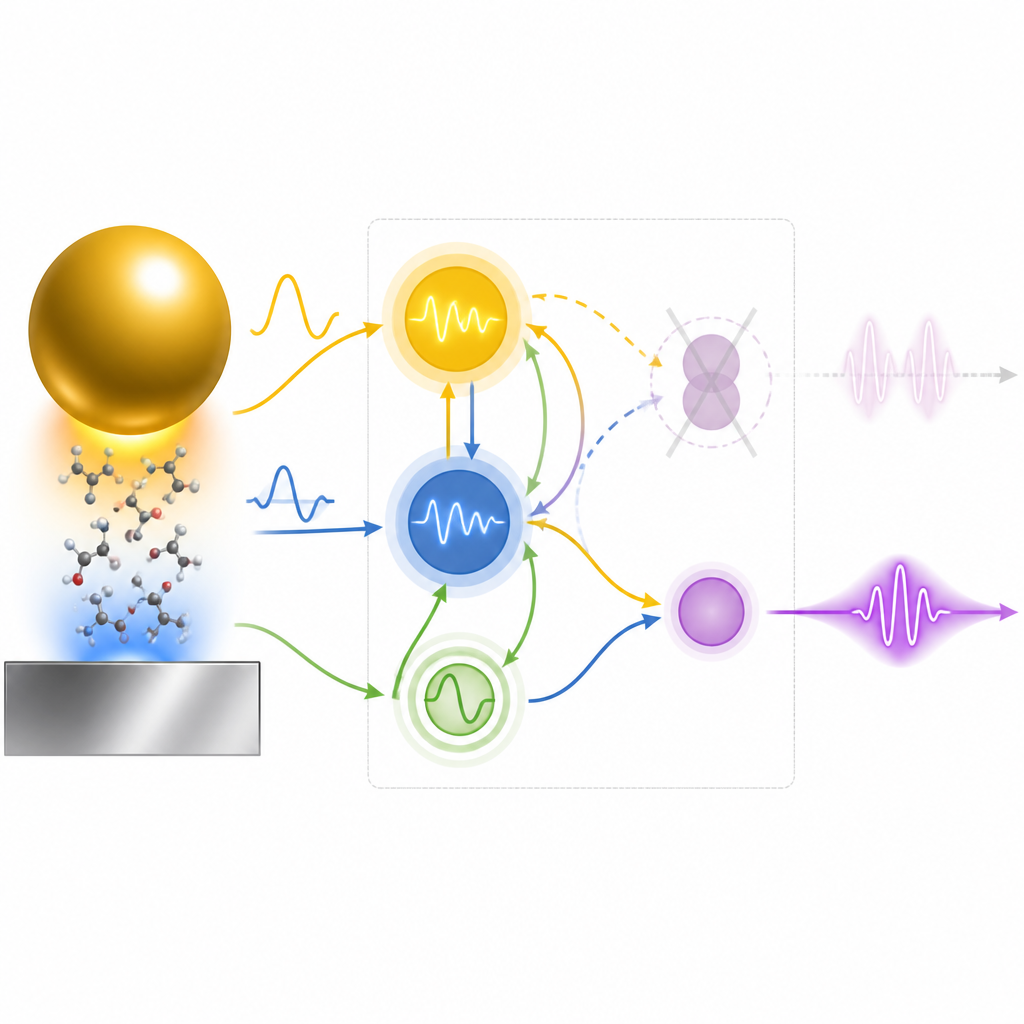
How destructive paths keep photons apart
In this hybrid setup, the key effect is photon blockade, where the presence of one photon prevents a second from entering the same mode. The team analyzes how different quantum pathways can lead from a state with no photons to states with one or two photons inside the cavities. Because the parametric amplifier offers an extra way to excite the system, these pathways can interfere with each other like ripples on a pond. With the right choice of gain and phase in the amplifier, the paths leading to two photons cancel out, while the path to a single photon remains, producing strong “antibunching” in the outgoing light across a wide range of frequency settings.
Working at room temperature and with leaky devices
An important practical challenge in many quantum optical systems is thermal noise and loss. In conventional optomechanical devices, raising the temperature quickly fills the mechanical mode with random excitations and spoils single-photon behavior, and high optical quality is often required. Here, the molecular vibrations are so fast that their thermal occupation stays low even at room temperature, and the added control from the parametric amplifier compensates for optical losses. The authors show that near-perfect photon blockade can survive both realistic temperatures and a wide range of cavity quality factors, meaning the effect does not demand exceptionally pristine hardware.
Single photons without racing the clock
Another obstacle in experiments is the need for very fast detectors to resolve rapid oscillations in photon correlations. In many earlier schemes assisted by similar amplifiers, the timing pattern of detected photons wiggles strongly in time, so one must measure at very fine time steps to verify single-photon behavior. In the present design, as the researchers tune the system towards zero frequency mismatch between the drive and the cavity, the required amplifier strength increases and these oscillations gradually fade away. At the optimal point, the single-photon character remains strong but the time-dependent correlations become smooth, so photon blockade can be observed over a broad time window without extreme timing precision.
Why this matters for future quantum tools
Put simply, this work describes a compact light source that can spit out one photon at a time, works at room temperature, tolerates imperfect cavities, and does not require ultrafast detectors. By harnessing molecular vibrations in a hybrid cavity and carefully choreographing interference with a parametric amplifier, the authors outline a realistic route toward robust single-photon sources and other nonclassical light states. Such devices could underpin future advances in quantum sensing, precision measurement, and integrated quantum photonic circuits.
Citation: Tang, J., Li, B., Yin, B. et al. Robust photon blockade with hybrid molecular optomechanics. npj Quantum Inf 12, 78 (2026). https://doi.org/10.1038/s41534-026-01220-3
Keywords: photon blockade, molecular optomechanics, single photon source, parametric amplification, quantum sensing