Clear Sky Science · en
Superiority of Krylov shadow tomography in estimating quantum Fisher information: from bounds to exactness
Why Sharper Quantum Measurements Matter
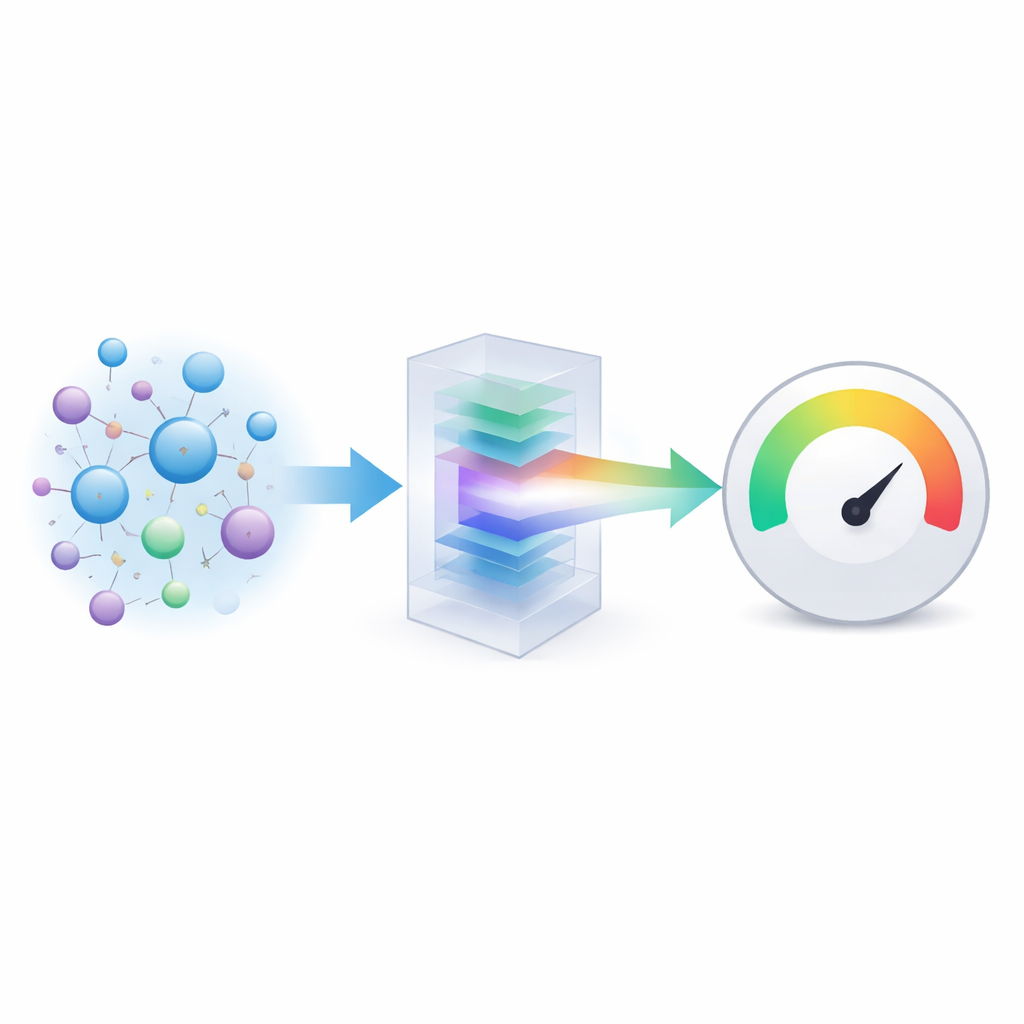
Modern quantum technologies—from ultra-precise sensors to emerging quantum computers—depend on how finely we can measure tiny changes in a quantum system. A key quantity that sets this ultimate limit is called the quantum Fisher information, which tells us how much information about a parameter is hidden in a quantum state. Knowing it lets scientists judge how good a given device, state, or protocol really is. But this quantity is notoriously difficult to measure directly in the lab, especially as systems grow larger. This paper introduces and analyzes a powerful method, Krylov shadow tomography, showing that it can estimate this crucial figure both efficiently and with unprecedented accuracy.
From Rough Estimates to a Clearer Picture
Until now, most practical methods have settled for lower bounds on the quantum Fisher information that are easier to access experimentally. These earlier approaches rely on simpler mathematical expressions—polynomials of the quantum state—that experimenters can estimate from measurements. While convenient, such “polynomial bounds” can never perfectly coincide with the true value for all possible states. This leaves an unavoidable systematic gap: even if you repeat your experiment millions of times, the bound can stubbornly remain below the true quantum Fisher information, limiting how confidently you can certify performance, entanglement, or sensing advantage.
A New Route Using Krylov Shadows
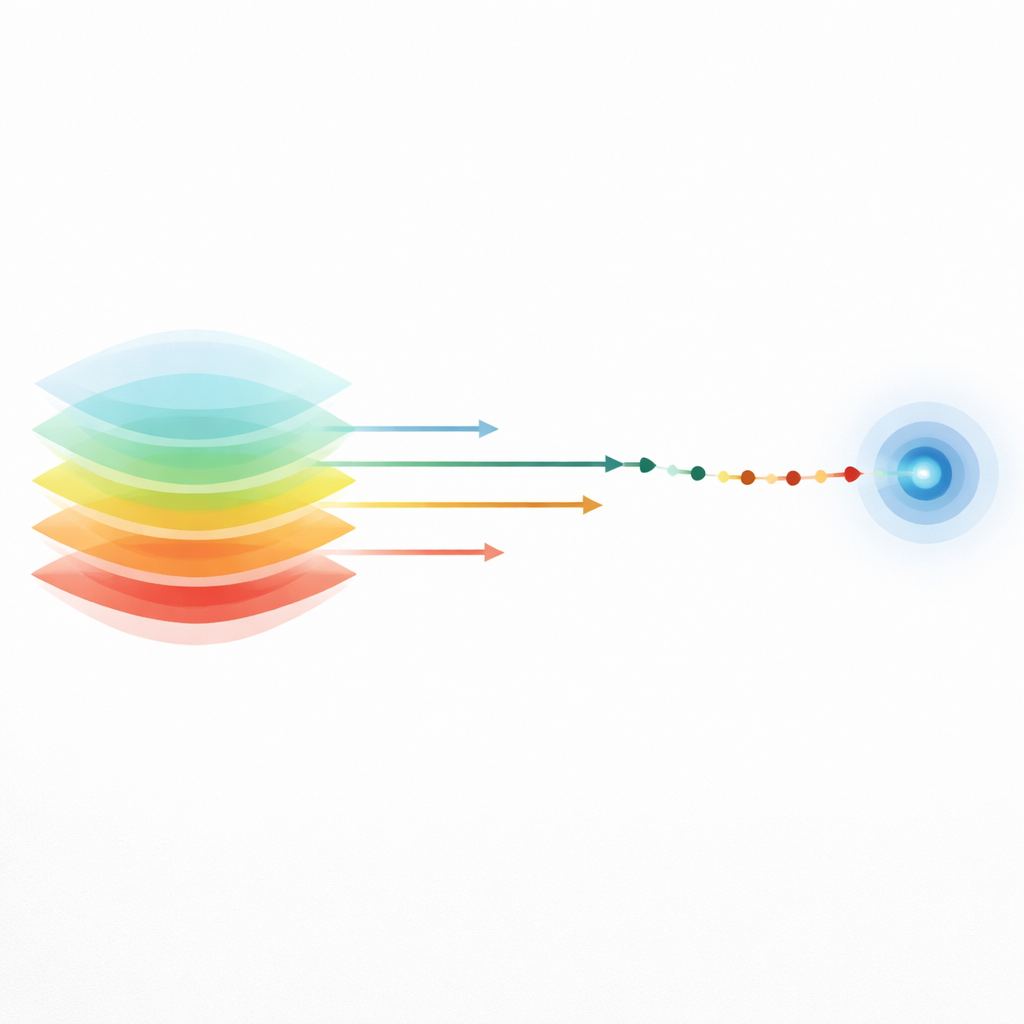
Krylov shadow tomography takes a different path. It combines two powerful ideas: Krylov subspace methods from numerical mathematics, and “classical shadows,” a modern tool for extracting many properties of a quantum state from a modest number of randomized measurements. Instead of targeting a single, fixed bound, the method constructs a ladder of increasingly rich subspaces, each associated with its own “Krylov bound” on the quantum Fisher information. As you climb this ladder by increasing the order, the bound moves closer and closer to the true value. In principle, after a finite number of steps, it can land exactly on the quantum Fisher information itself—something polynomial bounds can never guarantee.
Fast Convergence with Modest Effort
The central practical question is whether the low rungs of this ladder are already good enough, because higher orders cost more measurements and computation. The authors prove that the Krylov bounds close in on the true quantum Fisher information exponentially fast with order. This means that each additional step shrinks the remaining gap by a constant factor, so only a few steps are needed in many realistic cases. They further show that, for the same experimental effort, a Krylov bound of order n is tighter than a state-of-the-art polynomial bound of much higher order. Extensive numerical tests on multi-qubit systems confirm this behavior: even at small orders, the Krylov bounds typically differ from the true quantum Fisher information by less than ten percent and converge more steeply than competing methods.
Exact Answers for Common Quantum States
Beyond being merely good approximations, Krylov bounds can sometimes be exact at surprisingly low order. The authors identify a large class of “low-rank” quantum states—ones that effectively occupy only a few of the many mathematical dimensions available—for which a small number of Krylov steps already matches the quantum Fisher information exactly. Such states are not exotic; they naturally arise in many quantum information tasks where one aims to prepare nearly pure states but unavoidably introduces weak noise. The paper backs up this prediction with numerical simulations, showing that for these states the highest relevant Krylov bound coincides with the true value within numerical precision, all while using feasible numbers of measurements and efficient post-processing techniques.
Unlocking Quantum Advantages in Practice
To demonstrate the impact of their method, the authors apply Krylov bounds to a prominent task: using quantum Fisher information to detect entanglement. In this setting, the question is how often a given bound can correctly flag a state as entangled compared with using the exact quantum Fisher information. Their simulations show that Krylov bounds detect a much larger fraction of entangled states than the best polynomial bounds, and at third order they recover almost all of the detection power of the exact quantity. This suggests that Krylov shadow tomography can bring theoretical promises of quantum-enhanced sensing and information processing closer to reality, providing experimenters with a practical tool to assess and optimize quantum resources without sacrificing accuracy.
Citation: Wang, YH., Zhang, DJ. Superiority of Krylov shadow tomography in estimating quantum Fisher information: from bounds to exactness. npj Quantum Inf 12, 74 (2026). https://doi.org/10.1038/s41534-026-01216-z
Keywords: quantum Fisher information, shadow tomography, quantum metrology, entanglement detection, noisy intermediate-scale quantum devices