Clear Sky Science · en
Polychromatic continuous-variable quantum communication network enabled by optical frequency combs
Why splitting light into many colors matters
Today’s internet depends on squeezing ever more information through the same glass fibers by using many colors of light at once. This study shows how a similar trick can supercharge quantum communication, the emerging technology that promises virtually unbreakable encryption. By using a special “comb” of laser colors and a carefully designed network, the researchers demonstrate a quantum system where adding more users does not dilute the security or speed of each connection—a key step toward a practical quantum Internet.
From one color to many at the quantum level
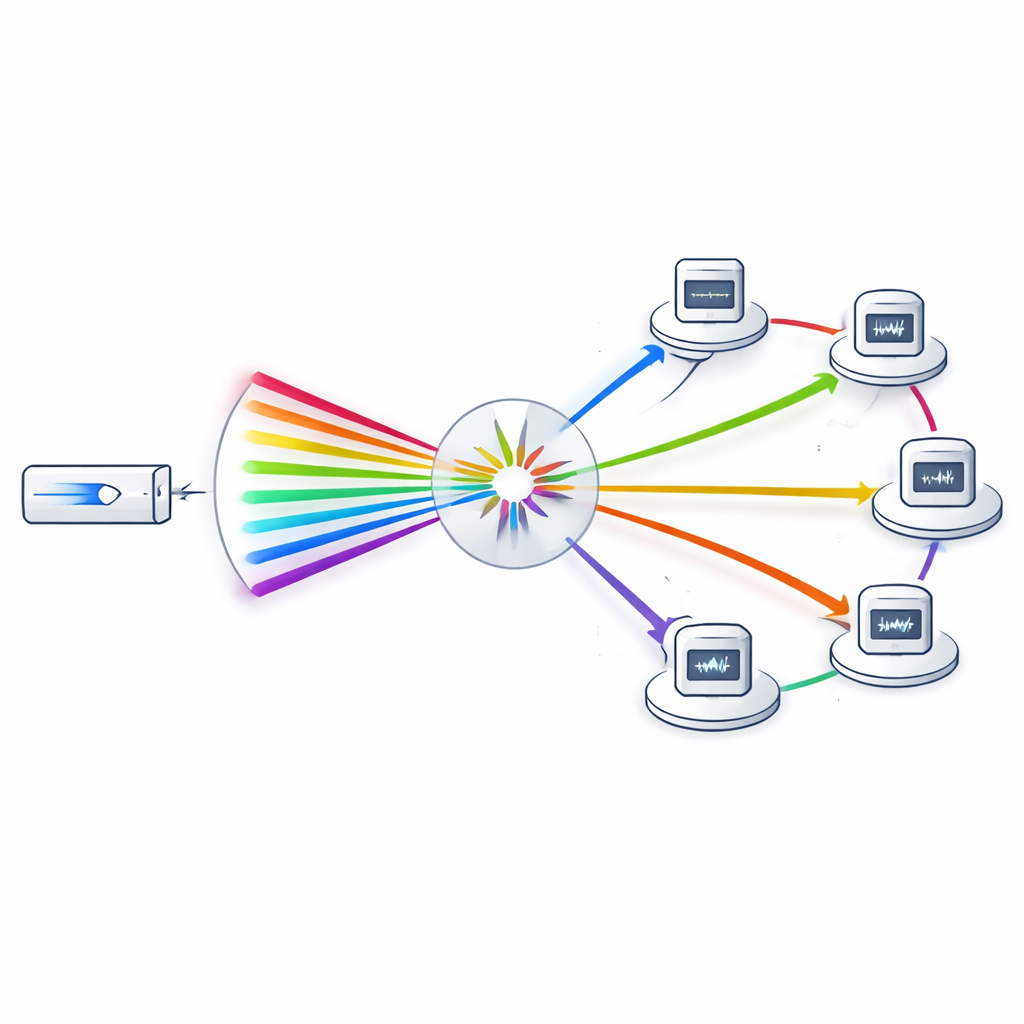
Most existing quantum communication systems rely on a single color of light, which limits how many users can share a network without slowing each other down. The authors instead build a “polychromatic” network that uses many closely spaced colors, all generated from a single ultra-stable laser in the form of an optical frequency comb. Each tooth of this comb acts like its own tightly defined color channel, allowing quantum signals to be sent in parallel. Crucially, they work with continuous variables—small changes in the electric field of light—rather than single particles of light, which makes the system more compatible with standard telecom hardware.
How the multi-color quantum network operates
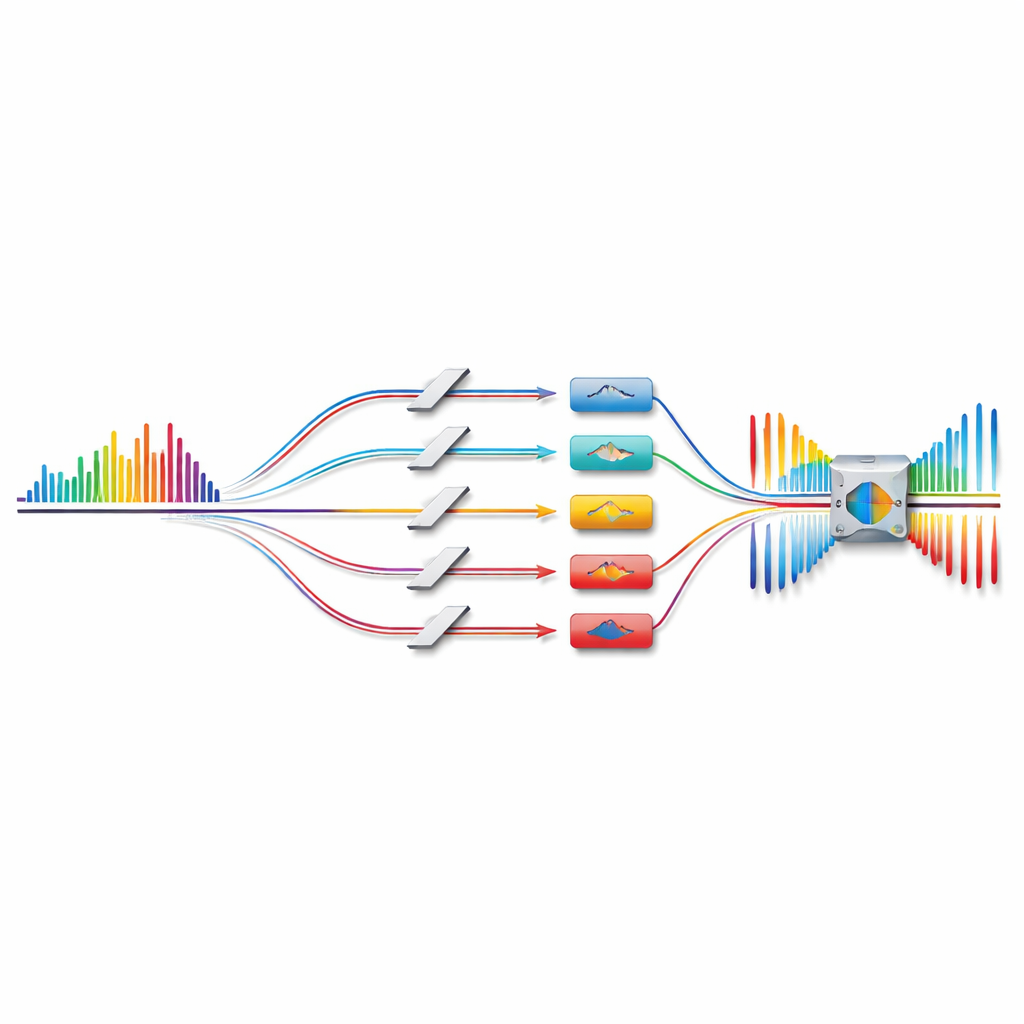
The team describes the network in two complementary ways. In the “prepare-and-measure” picture, a central node shapes the laser light in time and then uses a kind of time lens to map those temporal shapes into many distinct colors. A device analogous to a color filter then separates these frequencies into individual channels, each of which is gently randomized with a Gaussian modulation to encode secret information. These quantum-coded light beams travel through optical fiber to multiple users, who measure the incoming signals with sensitive coherent detectors and then use classical post-processing to distill shared secret keys.
Keeping secrets safe in a crowded quantum network
In any quantum key distribution system, a central question is how much information a potential eavesdropper could steal. The authors build an “entanglement-based” model of their multi-color network that captures subtle crosstalk between different frequency channels. They generalize a key quantity called the Holevo bound to many modes at once, allowing them to compute a worst-case limit on an eavesdropper’s knowledge. A central finding is that security hinges on mode isolation—how well each color is kept from leaking into its neighbors. With good isolation, the total secret key rate of the network grows roughly in proportion to the number of users, without weakening individual links.
Beating conventional limits with many colors
Using this framework, the researchers compare their multi-color approach with other ways of sharing quantum channels, such as using different time slots or repeatedly splitting a single beam. Those alternatives tend to spread the available quantum information ever thinner as more users join, so the total secret key rate plateaus or even drops. In contrast, the polychromatic network can in theory keep increasing its overall key generation rate while maintaining a nearly constant rate per user, forming lines that run parallel to known upper bounds on point-to-point quantum links. Two features drive this advantage: the abundance of frequency channels available in standard telecom fiber, and the fact that dividing light by wavelength does not inherently add extra loss the way repeated beam splitting does.
Putting the quantum comb network to the test
To move beyond theory, the team builds two experimental versions of their network. In one, each user has a local laser to act as a reference for measurements; in the other, a strong reference beam makes a round trip between the center and users. Both rely on an optical frequency comb to generate 19 usable color channels and on dual-comb detection to read out the quantum signals efficiently. Across these channels they achieve a combined secret key rate of 8.75 gigabits per second over 5 kilometers of fiber in idealized conditions, and secure operation over distances up to 120 kilometers when more realistic constraints on data size and security definitions are enforced. Importantly, the key rate per user depends mainly on the initial number of frequency modes, not on how many users share the network.
A step toward a scalable quantum internet
Viewed in everyday terms, the study shows how to build a quantum “multi-lane highway” where adding more lanes does not slow down the traffic in each one. By harnessing many colors of light from a single highly controlled source, and by carefully accounting for how those colors interact, the researchers outline and demonstrate a network architecture whose capacity per user is effectively independent of its size. Because it reuses much of today’s optical communication technology, this polychromatic quantum network offers a realistic path toward large-scale, high-speed, and widely shared quantum-secure communication—the sort of backbone a future quantum Internet will require.
Citation: Xu, Y., Zhang, Q., Zhang, J. et al. Polychromatic continuous-variable quantum communication network enabled by optical frequency combs. npj Quantum Inf 12, 68 (2026). https://doi.org/10.1038/s41534-026-01211-4
Keywords: quantum communication, optical frequency comb, continuous-variable QKD, wavelength multiplexing, quantum internet